Nim
- Platform
- Linux macOS Windows
- Licence
- MIT Open source
- Website
- nim-lang.org/
- Source code
- github.com/nim-lang/Nim
Overview
Nim is a statically typed, compiled systems programming language created by Andreas Rumpf, first released publicly in 2008 and still developed by him and a large open-source community. Its design goal is stated on nim-lang.org as efficiency, expressiveness and elegance, in that order: the language borrows Python’s indentation-based readability and Ada and Modula’s type safety, then compiles the result to native machine code through C, C++ or JavaScript. Nim 2.4.0 is the current stable release. The compiler and its standard library are themselves written in Nim, and the whole toolchain is MIT licensed, which puts it among the more permissive options for a language you might build a product on.
Key Features
- Python-like syntax, native binaries — statements are grouped by indentation and generics read like Python’s, but the compiler emits dependency-free executables with no virtual machine and no runtime to redistribute.
- Multiple backends — a single source tree can target C, C++ or JavaScript, and an Objective-C backend covers macOS and iOS work, so the same language serves a CLI tool, a server and a browser front end.
- Deterministic memory management — the default ORC memory model uses destructors and move semantics (inspired by C++ and Rust) instead of a tracing garbage collector, which makes it usable for embedded and hard-realtime code;
--mm:arc,--mm:refcand--mm:noneare available when a project needs different trade-offs. - Real metaprogramming — templates and macros manipulate the AST directly, and compile-time function evaluation lets ordinary-looking Nim code run during compilation, so configuration parsing, serializers and DSLs can cost nothing at runtime.
- Modern type system — local type inference, generics, tuples, object variants (sum types), distinct types and an effect system, with range types that catch out-of-range values where they are created.
- Iterators and zero-overhead abstractions —
iteratorplusyieldcompiles down to an inline loop, so custom traversal costs no more than a hand-writtenfor. - Nimble package manager —
nimble install PACKAGEpulls from the nimble.directory index and builds it from source;atlasis the newer workspace-oriented alternative for multi-project setups. - C and C++ interop —
importcandheaderpragmas bind existing libraries directly, with no binding generator required, and Nim code can be exported for use from C. - Everything ships in the standard library —
std/strutils,std/tables,std/json,std/net,std/asyncdispatch,std/osandstd/parseoptcover most of what a command-line tool or service needs before any third-party package is installed. - Cross-compilation and small output — the compiler cross-compiles to other platforms from one host, and release builds of small programs come out in the low hundreds of kilobytes.
Why Use Nim?
Nim is the option for people who like writing Python but need the result to be a fast, self-contained executable. Because the language has one syntax with several backends and a memory model you can change per project, the same codebase can start as a script, grow into a service and still be linked into a native binary without a rewrite — and the macro system means the awkward, repetitive parts of a domain can be turned into syntax rather than copy-pasted. The trade-off is a much smaller ecosystem than Rust, Go or Python: expect fewer ready-made libraries and be prepared to read the compiler’s own documentation, which is unusually good.
Getting Started
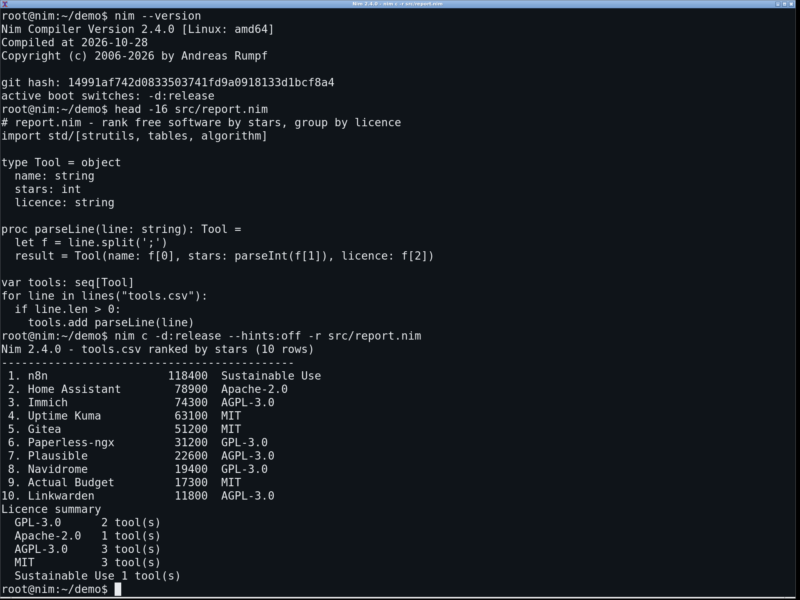
Prebuilt compilers for Linux (x86-64 and x86-32), macOS (Intel and Apple silicon) and Windows are published on nim-lang.org; choosenim and the distribution packages handle upgrades. Compiling and running a file is a single command:
nim c -r hello.nim— compile with default settings and run the result.nim c -d:release hello.nim— optimised build with runtime checks relaxed.nimble install PACKAGE— add a dependency and record it in the project’s.nimblefile.
As with any compiled language, gcc or clang must be installed on the host, because C is the default target.
Alternatives
- Zig — compiled systems language with manual memory management and a strong C interop story, but a very different, more explicit syntax.
- Rust — borrow-checked systems language with the largest ecosystem of the three; slower to learn, more libraries available.
- Go — garbage-collected, fast to compile, designed for services; simpler type system and no macros.
- Python — the language Nim’s syntax is closest to, interpreted rather than compiled, with by far the largest ecosystem.