MyFin
- Platform
- Web Docker Self-hosted
- Licence
- GPL-3.0 Open source
- Website
- myfinbudget.com
- Source code
- github.com/afaneca/myfin
What MyFin is
MyFin Budget is a personal-finance and budgeting platform assembled from three parts: a React and TypeScript front end, a Node and TypeScript REST API, and an Android client. It started in 2020 as a passion project, out of the author’s frustration that the finance managers he tried were not friendly to use, had no real budgeting engine, and kept his data on someone else’s server. The whole platform is run from a Docker Compose stack you own: MySQL 8.4 for storage, the API, and the web front end, with images published on the GitHub Container Registry.
The budgeting method follows the approach Boonzi uses: you plan forwards, month by month, instead of only recording what has already gone out. Transactions, budgets, accounts, investments and statistics live in one interface, and the statistics view projects the balance of your patrimony into the coming years from what has already been recorded.
Transactions, imports and rules
Transactions can be entered by hand or pasted in batches from a CSV file or straight out of a bank’s homebanking screen. The import expects clipboard text, so no bank connection or aggregation service is involved and no third party sees the data. Once a transaction is stored it can be split into two, so a single card payment that covered groceries and a household repair stops being one undifferentiated line.
Rules automate the dull part of importing: match a description or an amount against criteria you define and MyFin applies the category and the entity for you. Categories and entities are free-form, so you create as many as the way you actually spend needs rather than fitting into a fixed chart of accounts.
Budgets, accounts and statistics
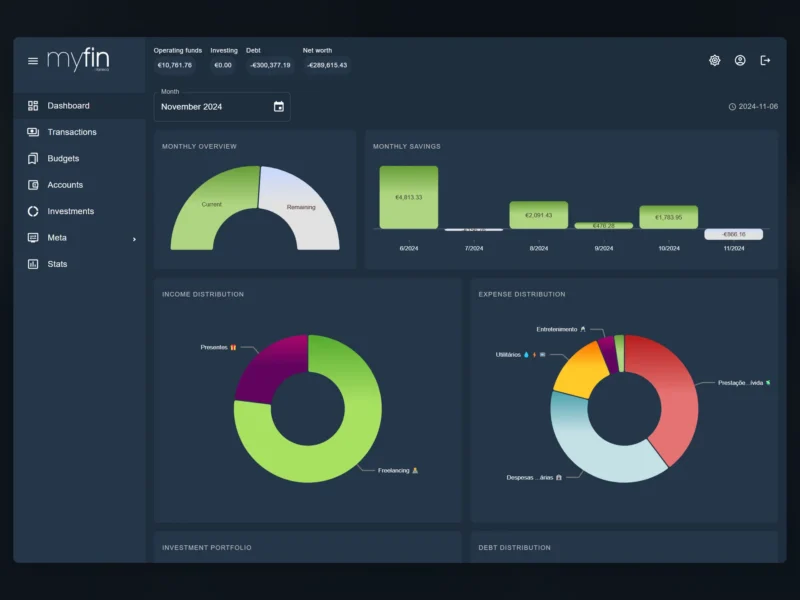
Budgets are set per month and compared against what has actually been spent, with a monthly overview and a remaining figure for the month in progress. Every account carries its own transaction list and running balance, and the dashboard rolls them up into operating funds, debt and net worth. Investments are tracked in their own section, still marked beta upstream, and both income and spending are broken into distribution charts for the selected month.
A monthly savings bar chart and the patrimony forecast carry those numbers forward, so a thin month several years out is visible before it arrives. The interface ships light and dark themes and is localised into several languages.
Running it yourself
The supported route is the repository’s docker-compose.yml: MySQL, the API on port 3001 and the front end on port 8181, both application images pulled from GHCR. Registration is disabled by default through ENABLE_USER_SIGNUP=false, so an instance is single-household unless you deliberately open sign-up; the SMTP block is left empty and only matters for password-reset mail. First-run setup is documented on the project wiki, and a public demo account, demo / demo, is reachable from the project site if you want to try the interface before pulling any images.
Licensing and editions
The web front end and the API are both published under the GNU General Public License v3.0, so the stack is open source in the OSI sense and any modification you distribute has to stay under the same licence. The Android client lives in its own repository under the same licence. A hosted instance runs at myfinbudget.com, but self-hosting is what the README documents and what the compose file is written for, and the demo account is there to compare the two before you commit to either.