Hook0
- Platform
- Docker Linux
- Licence
- SSPL-1.0 Source-available
- Website
- hook0.com
- Source code
- github.com/hook0/hook0
Hook0 is a self-hostable webhooks server with a web dashboard, aimed at SaaS teams that need to deliver their events to customers’ endpoints. Instead of building retries, delivery logs and per-subscriber filtering from scratch, your application posts events to Hook0’s JSON REST API, and your users subscribe their own webhook URLs through the Hook0 console. The server is written in Rust and stores its data in PostgreSQL.
What you get
- Event types and fine-grained subscriptions — define the events your product emits, and let each subscriber choose which of them they want to receive.
- Automatic request retries — when a subscriber’s endpoint is unreachable or answers with an error, Hook0 retries the delivery instead of dropping it.
- Events and responses persisted — every event your application sends and every HTTP call Hook0 makes is recorded, which is what makes debugging a failed webhook practical rather than guesswork.
- Event scoping — keep one customer’s traffic apart from another’s inside the same project.
- A dashboard for non-technical users — subscriptions, deliveries and secrets are managed in the browser, so a support or product colleague can inspect a stuck webhook without reading logs on the server.
- JSON REST API — the same operations the dashboard uses are available as an API, so sending an event from your backend is a single POST.
Delivery log
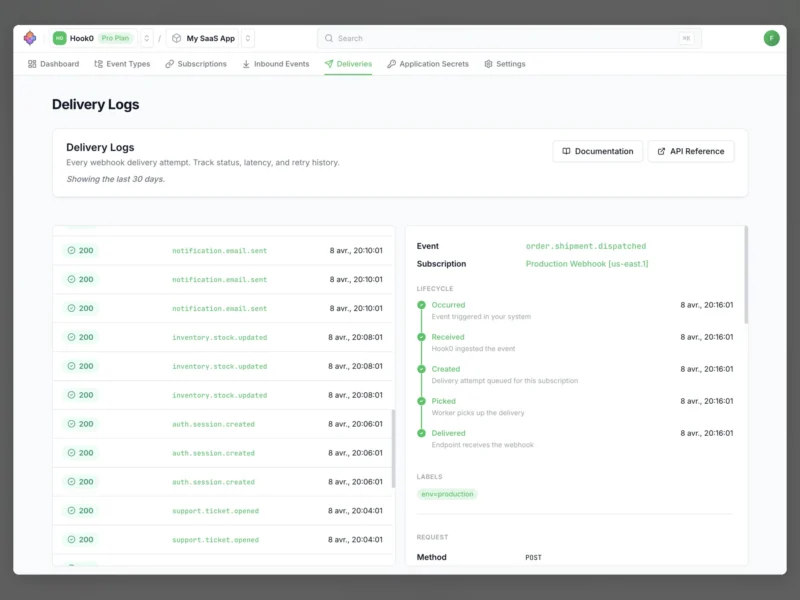
The deliveries view lists each attempt with its HTTP status, the event that triggered it and the time it ran, next to a detail pane showing the request body, the response and the lifecycle of that delivery (occurred, received, created, picked, delivered). That timeline is the part most home-grown webhook implementations lack: when a customer says “we never received it”, the answer is on one screen instead of spread across application logs and proxy logs.
Running it yourself
Hook0 ships container images and a compose-based stack: the Rust backend, the web frontend and a PostgreSQL 18+ database. The published requirements are an active LTS Rust toolchain for building from source, PostgreSQL 18 or newer, and Linux (Ubuntu LTS, CentOS/RHEL 8) or Docker as the supported run targets, with macOS and Windows listed for development use. A hosted cloud version with a free community tier exists as well, if you would rather not operate the stack.
Hook0 is released under the Server Side Public License (SSPL) v1. That is source-available, not OSI-approved open source: you may use, modify and redistribute it, but you may not provide it to others as a managed service, and the licence-key functionality may not be circumvented or removed. If you need a fully open-source licence, look elsewhere; if you are embedding webhooks in your own product and running the server for yourself, the terms are workable.