Rackula
- Platform
- Linux Docker Self-hosted
- Licence
- MIT Open source
- Website
- racku.la
- Source code
- github.com/RackulaLives/Rackula
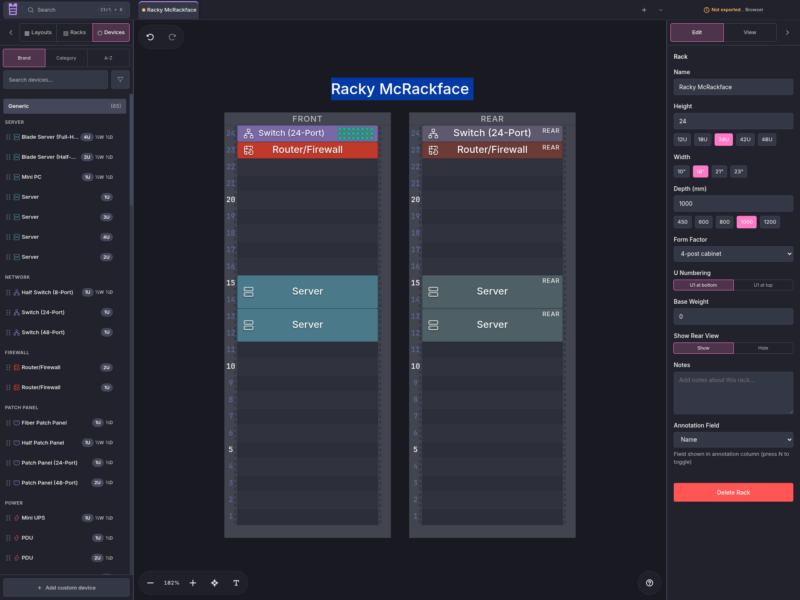
Rackula is a drag-and-drop rack layout designer for anyone who plans a rack before lifting a server into it. You drag devices out of a hardware library onto a to-scale rack elevation, and the tool keeps every device on whole rack units the way real rails register equipment under EIA-310 — so a 4U chassis occupies four units at a whole-U boundary instead of floating somewhere between them. Gear smaller than 1U, such as half-width pairs or side-by-side brackets, rides inside a 1U carrier that registers to the rails. It is written in TypeScript with Svelte, released under the MIT licence, and the layouts are useful for change requests and runbooks rather than only for planning.
Key capabilities
- Drag-and-drop editing — pull devices from a categorised library (servers, switches, firewalls, patch panels, power, storage, KVM, AV) into the rack and move them around until the layout is right.
- Real device artwork — device images come from the NetBox devicetype-library, so the elevation shows recognisable hardware instead of grey boxes.
- Front and rear elevations — both faces of the cabinet are modelled, so half-depth and rear-mounted equipment is documented where it actually sits.
- Export and sharing — layouts export to PNG, PDF or SVG for documentation and change requests, and can be shared by URL or QR code without attaching files.
- Bayed racks — group cabinets into bays for AV installs and multi-cabinet deployments.
- Optional persistence and auth — layouts can stay in the browser, or sync through an API-backed store with local accounts or OIDC for shared deployments.
- Mobile-friendly UI — the same designer works on a phone or tablet for use in the field.
Deployment
The client-side app is a single container: docker run -d -p 8080:8080 ghcr.io/rackulalives/rackula:latest. A Compose file with a data volume adds persistence, a pre-release Proxmox LXC route exists for homelabs, and building from source is npm install && npm run build followed by serving the static dist/ directory. Configuration is environment based: CORS_ORIGIN, RACKULA_API_WRITE_TOKEN for API writes, and RACKULA_AUTH_MODE set to none, local or oidc. A hosted demo runs at count.racku.la with no account required, which is the quickest way to try it before installing anything.
Who it is for
Homelabbers planning a first rack, AV technicians mapping amplifier and patch-bay chains, network engineers documenting switch and router positions, data centre teams laying out colo cages, and educators who want a visual way to teach rack and networking concepts.
Project status
MIT licensed, copyright Gareth Evans, developed in the open on GitHub with CalVer releases and a container image published for every release. The repository is active — recent commits land most days — and the project documents its architecture, technical spec and self-hosting guide alongside the code. Parts of the codebase were written with AI assistance, which the project states openly and marks in commit trailers.
Browse more tools in Developer Tools.