Bugsink
- Platform
- Docker Web
- Licence
- PolyForm Shield 1.0.0 Source-available
- Website
- bugsink.com/
- Source code
- github.com/bugsink/bugsink
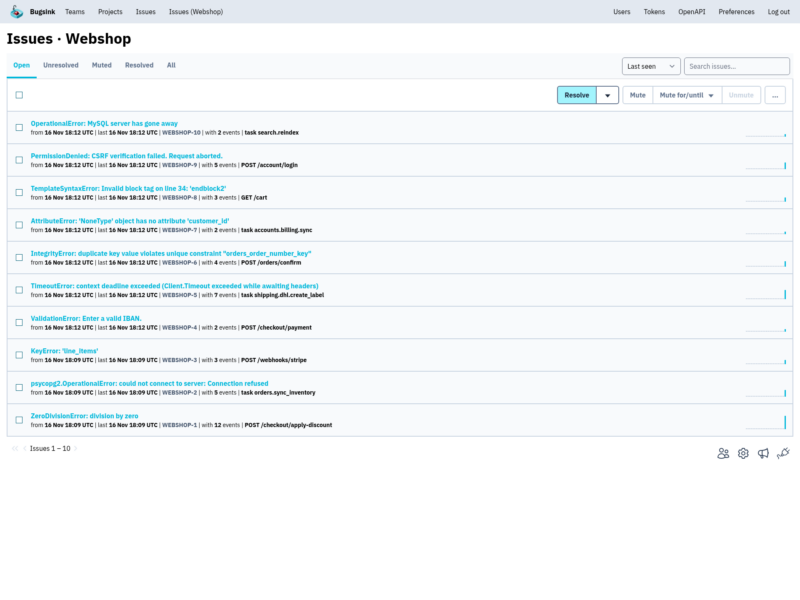
Bugsink is an error tracker you run on your own server: it shows you when your code fails in production and why, with full stacktraces, local variables and request context. It is built to be dropped into a project in minutes, and it speaks the Sentry wire protocol, so any Sentry SDK can send events to it without changing your application code.
How it works
You create a team and a project, connect your application with the project DSN, and exceptions start arriving. Bugsink groups them into issues, counts every occurrence, and keeps the “last seen” timestamps so you can tell a brand-new bug from a long-standing one. Each issue opens on a stacktrace with the surrounding source lines, the request that triggered it, breadcrumbs before the failure, tags, and the full event list for that group.
Key features
- Sentry-SDK compatible — use the official Sentry SDKs for Python, JavaScript, PHP, Go or anything else; you only swap the DSN.
- Stacktraces with source context — inline code around each in-app frame, with local variables and request data.
- Issue grouping you can inspect and adjust — Bugsink exposes its grouping history, so you can see why two events were merged.
- Triage controls — resolve, mute (for a period or indefinitely), and unmute; alerts fire on new issues, regressions and unmutes.
- Per-project retention cap — set a maximum stored event count and old events are evicted automatically, which keeps disk use predictable.
- Small footprint — a single container with SQLite by default (PostgreSQL is supported for busier installs).
- API tokens and an OpenAPI spec — drive it from scripts or CI rather than only through the web UI.
- Teams and projects — separate applications and share visibility with the people who need it.
Deployment
The self-hosted install is one Docker container. Bring it up with a secret key and a superuser, then create your first project and copy its DSN:
docker run -d -e SECRET_KEY=<50+ random chars> -e CREATE_SUPERUSER=you@example.com:password -e PORT=8000 -p 8000:8000 bugsink/bugsink
Bugsink is a stand-alone error tracker rather than a suite: it deliberately covers exception monitoring only, so there are no performance traces, session replays or uptime checks bundled in.
Licence
Not open source. Bugsink is released under the PolyForm Shield License 1.0.0: the source code is public and you may self-host it, but the licence does not permit using it to compete with Bugsink. The ee/ directory and Sentry-derived parts carry their own licences. Bugsink B.V. also sells a hosted service at bugsink.com, so the licence is what funds the project rather than an OSI-approved grant.
Alternatives
- GlitchTip — MIT-licensed, open source, Sentry-SDK compatible error tracking you can self-host.