Best Free & Open-Source Games for Linux (2026)
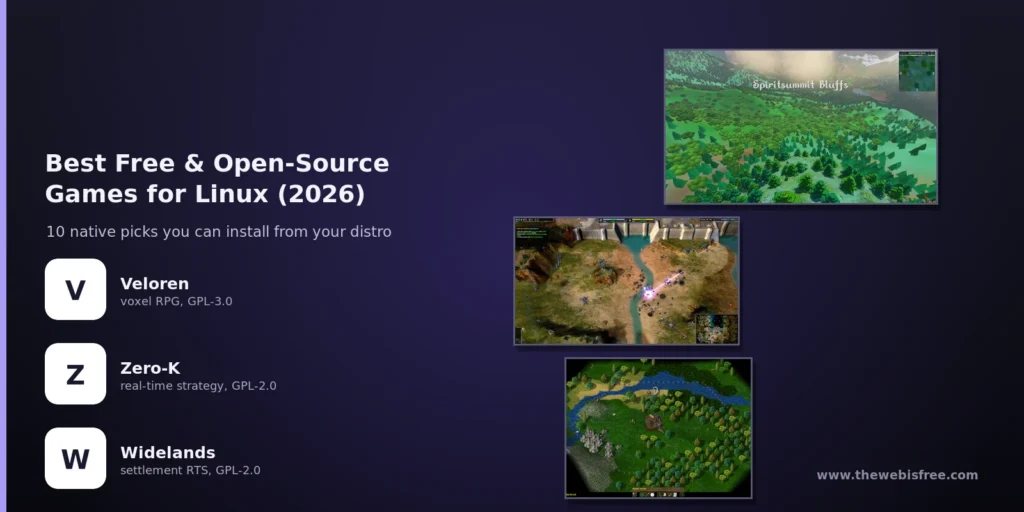
Linux has quietly become one of the best places to play games — not because of big-budget ports, but because of a deep pool of free and open-source titles that are built for the platform. They ship in your distro’s repositories, install with one command (or a Flatpak), run natively without a compatibility layer, and their source code is open for anyone to read, patch and keep alive.
This list sticks to games that are genuinely Linux-native: installable from Debian/Ubuntu/Fedora repositories, Flathub, or an upstream tarball, with no proprietary launcher required. Every entry below has a full listing in our directory with licence details and links.
Veloren — a voxel RPG built in Rust
Veloren is a multiplayer voxel RPG written in Rust, and one of the most interesting ongoing experiments in open-source game development. The world is procedurally generated and enormous, with dungeons, towns, NPCs and flying mounts, and it plays well both solo and on community servers. Because it is developed in the open with weekly progress reports, you can watch the game grow release by release.
It runs natively on Linux (and builds cleanly from source if you have a Rust toolchain), and is packaged for most distributions as well as on Flathub. Licence: GPL-3.0-or-later. See the Veloren listing.
Widelands — settlement building, done slowly and well
Widelands is a slow-burn real-time strategy game in the tradition of The Settlers II: you claim territory, build a supply chain, and manage workers who haul goods between buildings. It is friendly to newcomers, has a large campaign set and a very active map-making community, and its economy simulation rewards patience over clicking speed.
It is one of the classic Debian games — apt install widelands is usually all you need — and it is also on Flathub for immutable distributions. Licence: GPL-2.0-or-later for the code, with some art under Creative Commons licences. See the Widelands listing.
Zero-K — a large-scale RTS with a modern engine
Zero-K is a free real-time strategy game with hundreds of units, terraforming, physics-driven projectiles and a single-player campaign with dozens of missions. It uses the Spring/Recoil engine and is unusually polished for a community project, with a proper lobby and matchmaking for online play.
The Linux build is first-class — a Flatpak is available on Flathub, and the game also ships through Steam for Linux. Licence: GPL-2.0. See the Zero-K listing.
Naev — open-world space trading and combat
Naev is a 2D space RPG in the spirit of Escape Velocity: you fly a ship, trade cargo, take missions, join factions and upgrade your hull as you go. The universe is large and persistent, the flight model is satisfying, and development has been steady for years.
Native Linux builds are provided upstream and the game is packaged on Flathub. Licence: GPL-3.0. See the Naev listing.
Unvanquished — a team-based FPS with an alien-versus-human war
Unvanquished is a first-person shooter where humans and aliens fight for territory. Humans rely on equipment and buildable bases; aliens evolve into faster, tougher forms. It is built on the Daemon engine with a modern renderer, and it supports bots for offline play — useful when the servers are quiet.
Linux builds are the primary target of the project and are distributed directly by the developers. Licence: GPL-3.0. See the Unvanquished listing.
Teeworlds — fast 2D multiplayer that still has players
Teeworlds is a small, fast, 2D multiplayer shooter with grappling hooks, and it has been a staple of Linux LAN parties for well over a decade. Servers are community-run, the netcode is excellent, and many popular community variants build on the same engine.
It is available in almost every distribution’s repository and remains tiny enough to run on very old hardware. Licence: Zlib for the code with game content under CC BY-SA 3.0. See the Teeworlds listing.
Hedgewars — turn-based artillery with a sense of humour
Hedgewars is a turn-based artillery game featuring hedgehogs, a wide arsenal of weapons and destructible terrain. It supports hot-seat play as well as online matches, and the physics are deep enough to reward practice. It has been ported to almost every platform, but Linux is where it started.
Install it from your distribution’s repositories or Flathub. Licence: GPL-2.0. See the Hedgewars listing.
SuperTux — the platformer everyone’s distro already ships
SuperTux is a jump-and-run platformer starring the Linux mascot, and it is one of the most-installed free games in existence because most distributions include it by default. Modern versions are genuinely good: crisp 2D art, tight controls, hidden secrets and a level editor.
If it is not already on your system, one package install gets it — and it runs comfortably on decade-old hardware. Licence: GPL-3.0. See the SuperTux listing.
Pioneer — a space sim with a whole galaxy to explore
Pioneer is a single-player space trading and exploration game set in a procedurally generated galaxy. You start with a small ship, take delivery and bounty missions, and gradually upgrade. The flight model is Newtonian rather than arcade, which makes docking and combat feel earned.
Native Linux builds are published by the project and it is packaged for several distributions. Licence: GPL-3.0. See the Pioneer listing.
Simutrans — a transport tycoon you can lose months to
Simutrans is a transport simulation game where you connect industries, cities and passengers with trains, ships and aircraft, and then try to keep the network profitable. It supports both a commercial-style simulation and a “pak” ecosystem with hundreds of community add-ons.
It runs on modest hardware and is packaged in most distributions, making it an easy way to try a deep tycoon game without buying anything. Licence: Artistic-1.0. See the Simutrans listing.
Why these ten
Every game here is native on Linux, still maintained, and free to download with source available. They also cover a genuine range — if you want strategy there is Zero-K and Widelands, for shooters Unvanquished and Teeworlds, for solo exploration Veloren, Naev and Pioneer, and for quick sessions Hedgewars, SuperTux and Simutrans.
If you are coming from Windows, the practical difference is small: install from your package manager or Flathub and launch from your application menu. No launcher, no account, no store.
The Bottom Line
You do not need to buy anything to have a well-stocked Linux games library. Start with SuperTux or Teeworlds if you want something running in under a minute, and move to Veloren, Zero-K or Widelands when you want a deeper world to get lost in. All ten are open source, all ten run natively, and all ten are still being worked on in 2026.
Browse the full Games category for more free and open-source titles, or see the complete directory of free software if you are building out the rest of your desktop too. If a title in this list belongs on a machine you run, download it from the links above and give it an evening — that is how these projects stay alive.
Related reading: Open-Source Minecraft Alternatives, 0 A.D. vs OpenRA vs Warzone 2100, and Open-Source Civilization Alternatives.