Atuin
- Platform
- Linux macOS Windows
- Licence
- MIT Open source
- Website
- atuin.sh
- Source code
- github.com/atuinsh/atuin
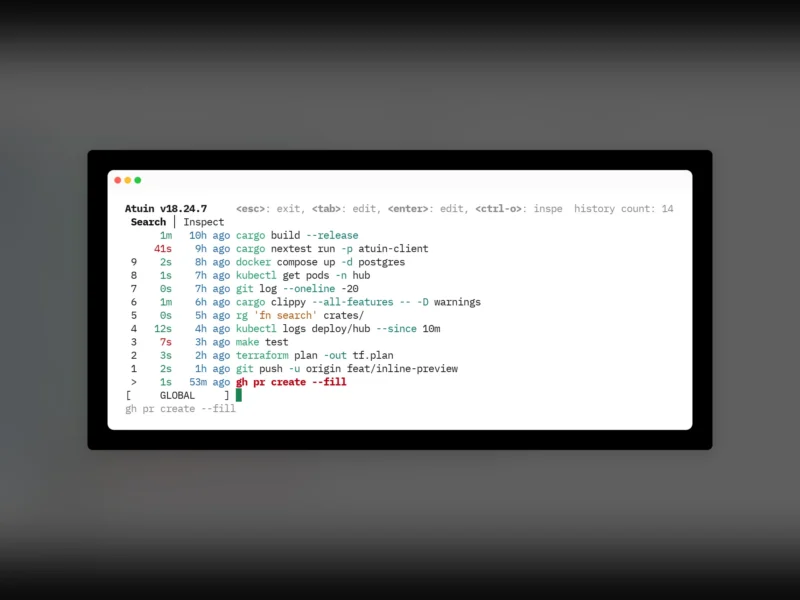
Atuin replaces the shell history file with a SQLite database that records far more than the command line itself: exit codes, the working directory a command ran in, the hostname, and how long it took. Hitting Ctrl+R opens a searchable, full-screen picker over every command you have ever run, and the same data is available from the command line with atuin search, which can be filtered by exit status, time and text — for example, every successful make since yesterday afternoon. It is one Rust binary, MIT licensed, and works entirely offline if you never enable sync.
Newer versions extend the same idea to coding agents: Atuin records Claude Code, Codex, OpenCode and similar sessions as threads, so work started on one machine can be picked up on another, in a different harness, with atuin resume. A built-in MCP server lets an agent query that history directly.
What it stores and how you search it
- Richer history. Each entry keeps the exit code, working directory, hostname and duration alongside the command, so a search can be narrowed to what actually worked, where it ran and when.
- Interactive picker.
Ctrl+Ropens a full-screen search over local and imported history; Enter runs the highlighted command and Tab puts it back on the prompt for editing. - Scriptable search.
atuin search --exit 0 --after "yesterday 3pm" makeand similar filters make the history queryable from scripts and shell functions. - History statistics. Usage summaries show which commands dominate and when you work, from the same local database.
Agent threads and MCP
Atuin captures agent sessions in addition to shell history. A thread begun in one harness can be resumed in another — start something in Claude Code on a laptop and continue it in Codex over SSH — and atuin threads search queries those sessions the same way command history is searched. The bundled MCP server exposes history and threads to agents, so a coding agent can recall how a problem was solved months ago instead of asking again.
Sync, self-hosting and privacy
History and threads can be synchronised across machines, including ephemeral VMs, either through the official Atuin service or through a sync server you host yourself. Everything synchronised is end-to-end encrypted with a key held locally, and the tool works fully offline with sync disabled.
Shell support and installation
Atuin integrates with zsh, bash, fish, nushell, xonsh and PowerShell. It installs from a single shell installer script, ships as a Debian and Homebrew package, and runs on Linux, macOS and Windows; the sync server can be deployed separately for self-hosting. Agent integrations are provided for Claude Code, Codex, OpenCode, Copilot, Grok and others.