positive-intentions Chat
- Platform
- Web Windows macOS Linux Android iOS Docker
- Licence
- GPL-3.0 Open source
- Website
- chat.positive-intentions.com
- Source code
- github.com/positive-intentions/chat
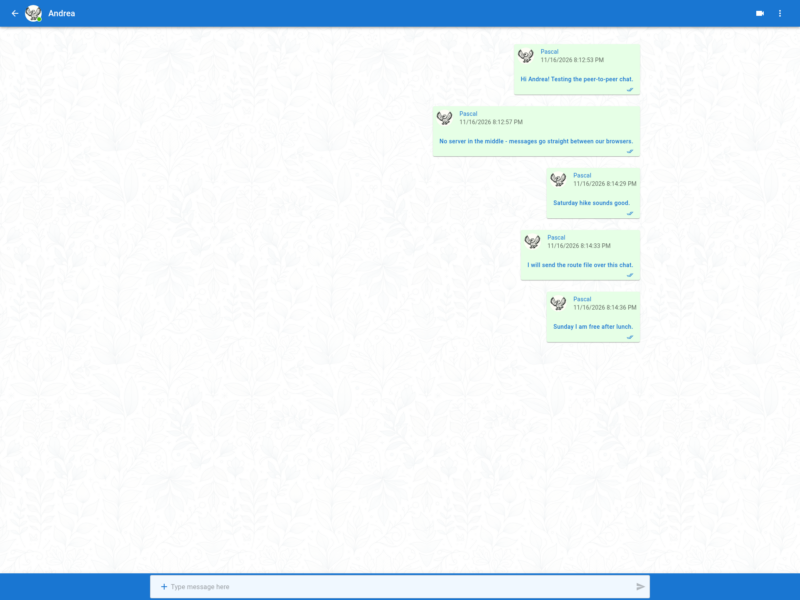
positive-intentions Chat is a peer-to-peer messenger that runs entirely in the browser: there is nothing to install and no account to create. You open the page, pick a display name, share a link or a QR code with the person you want to talk to, and the two browsers connect directly over WebRTC. No chat server sits in the middle, so messages, calls and files travel only between the two devices.
What it does
- Text chat with text, photos and videos, carried over a direct peer connection.
- Voice and video calls between connected peers, again peer-to-peer with no media relay owned by the project.
- Encrypted local file storage for documents you want to keep and share from the browser, with everything held on the host device.
- Plan, a local-first calendar: your schedule stays on your device with no account and no cloud sync.
- End-to-end encryption using the Signal Protocol implemented in Rust and compiled to WebAssembly, plus ML-KEM (Kyber) for post-quantum resistant key encapsulation.
- Import and export of your profile and data, so a browser or device change does not strand your identity.
- No tracking, no ads and no message limits, and a connection is established from a shared link without a registration step.
How a connection works
Two peers find each other through PeerJS signalling and then hold the conversation over WebRTC data channels, so the signalling service never sees the message payloads. Connecting is a link exchange: one side generates a share link (or an online QR code), the other pastes it in, and the contact appears in the sidebar with a public key hash that can be compared out of band. The app is deliberately strict about Content-Security-Policy, which is also the main thing to watch if you point it at your own signalling server.
Running your own copy
The project ships a web build plus Capacitor targets for Android and iOS and a Tauri desktop shell, and the repository includes a docker/ directory with a Dockerfile and compose file for hosting the front end yourself. That compose setup is explicitly marked work in progress: you have to edit the PeerJS host in src/index.html and rebuild, and allow the cryptography module’s remoteEntry.js in your CSP before the app will work. The hosted instance at chat.positive-intentions.com is the zero-setup way to try it.
The application is under active development and describes itself as being in a testing phase, so treat it as an early, fast-moving peer-to-peer client rather than a finished messaging platform.
Licence
GPL-3.0. Free and open source; the source is published on GitHub and the full licence text sits in the repository root.
Alternatives
- Sharkord — self-hosted Discord-style server with text channels, roles and voice, if you want a team server rather than a direct peer connection.
- Virola Messenger — multi-platform encrypted messenger with a self-hostable web client.