Sharkord
- Platform
- Web Linux Windows macOS Docker
- Licence
- MIT Open source
- Website
- sharkord.com
- Source code
- github.com/Sharkord/sharkord
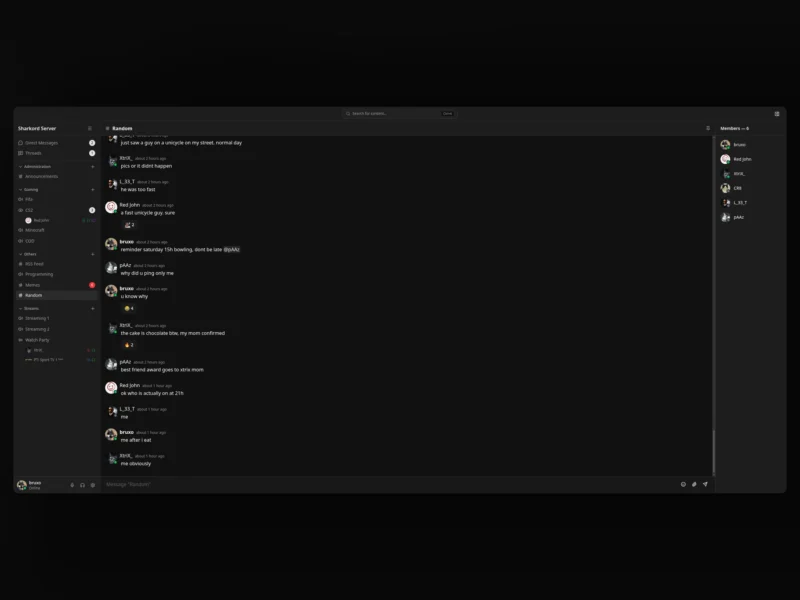
Sharkord is a self-hosted real-time communication server that reproduces the shape most teams already know from Discord — a server with text channels grouped into categories, voice channels you drop into, direct messages and roles — while keeping the data on your own machine. It ships as a single standalone binary for Linux, Windows and macOS that bundles both the server and the web client, and also as a Docker image, so a small group can be chatting within minutes rather than after a platform migration.
What it does
- Text channels organised into categories, with threads, replies, reactions, pins and message search.
- Voice channels carrying video and screen sharing over a built-in mediasoup SFU (WebRTC), with call-duration timers, the ability to pause an incoming screen share or webcam, and call transfer between devices or tabs.
- Direct messages between members, plus mentions, channel references and custom emoji.
- Roles and permissions, including per-channel overrides for individual roles and users.
- Invites with usage limits and automatic role assignment on join.
- File uploads with per-user storage quotas and optional signed URLs.
- Plugins that extend server and client through a published plugin SDK — a plugin marketplace is part of the hosted documentation and demo.
Running it
The quickest route is the standalone binary from the project’s releases, which serves the client on port 4991; the Docker route publishes 4991/tcp for the app and 40000/tcp plus 40000/udp for the media server, with a bind mount for the data directory (the image expects it at /home/bun/.config/sharkord). Clients need nothing but a browser — desktop builds also exist as a separate Electron project.
The first launch prints a secret token to the console. That token is both the owner credential and the key used to sign sessions and file URLs, so anyone holding it can take over the server and impersonate accounts: treat it like a root password, keep it out of screenshots and issue reports, and store it somewhere safe before you close the terminal.
Points to weigh
- Alpha software. Upstream marks the project as alpha and explicitly warns that updates can break things and break compatibility; back up the data directory before every upgrade so a rollback is possible.
- There is no federation and no mobile client of its own — this is one server for one group, reachable over the web interface.
- Voice and screen sharing need the UDP media port open; behind NAT or a firewall, plan for that before inviting people.
- Latest release at the time of writing is v0.0.31 (13 November 2026), so expect the feature set to move quickly.
Alternatives
- Spacebar — an API-compatible open source Discord reimplementation if you want existing Discord clients and bots to keep working.
- Mattermost — team messaging with a far larger surface, enterprise features and a heavier install.
- Rocket.Chat — chat plus omnichannel support and integrations, at the cost of a bigger stack.
- Zulip — threaded conversations as the organising principle instead of channel scrollback.