OpenTalk
- Platform
- Web Docker
- Licence
- EUPL-1.2 Open source
- Website
- opentalk.eu
- Source code
- gitlab.opencode.de/opentalk/opentalk
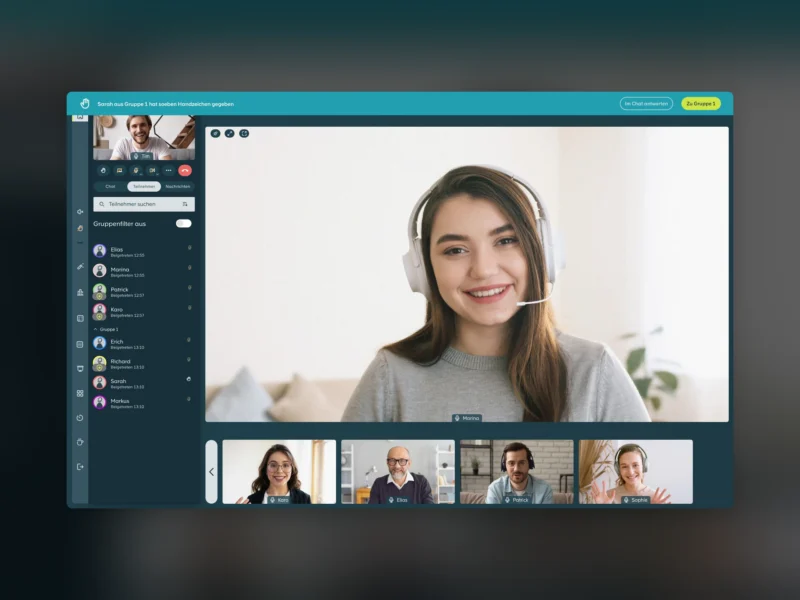
OpenTalk is a browser-based video conferencing system developed in Germany by Heinlein Support GmbH and published as open source under the EUPL-1.2. It targets organisations that need meeting data to stay under their own control: meetings run entirely in the browser with nothing to install, and the whole platform — controller, room servers, recorder and web frontend — can be deployed on your own hardware or Kubernetes cluster. Heinlein also runs a hosted EU instance with a free Starter tier.
What it delivers
- Meetings in the browser — Chrome/Chromium, Edge, Firefox and Brave; Safari works with functional limitations because Apple’s WebRTC support is incomplete.
- Chat with single participants, groups or the whole session; chat groups are created automatically so messages do not reach the wrong people.
- Breakout rooms — created by hand or generated automatically from parameters, with moderators able to drop into any room and an event console that collects messages and moderation controls.
- Moderation — lobby/waiting room with manual admission, collective mute, a centrally managed queue of speaking requests, speaker and speaking-time assignment, multiple moderators, and a coffee-break mode that pauses and resumes a session including its recording.
- Collaboration — polls and audit-proof voting, an interactive whiteboard, shared notes (Etherpad and Spacedeck ship as optional services in the deployment template), screen sharing and session recording.
- Telephone dial-in — the SIP gateway (Obelisk) brings phone participants into a conference; an optional transcription service also lives in the source repository.
- Dashboard — calendar view of your own and invited meetings, templates for recurring meetings, and instant rooms by sharing a link.
- Identity — own accounts or single sign-on and 2FA through the identity provider (Keycloak by default).
How it is put together
OpenTalk is not a single application but a set of cooperating services: a Rust controller that holds rooms and permissions, a room server for media (LiveKit in the current template, Janus in older deployments), the web frontend, a recorder, the SIP gateway, an SMTP mailer, Keycloak for accounts, PostgreSQL for state, RabbitMQ for internal queues, and S3-compatible object storage for recordings. The upstream ot-setup Compose template wires the core services with profiles for the optional ones, and the same services can be scheduled on Kubernetes when a single host is not enough.
Self-hosting requirements
Upstream recommends at least 2 cores, 4 GB RAM and 20 GB of disk for a small installation, with Docker Engine and the Compose plugin. A real deployment also needs its own domain with DNS records for the frontend, the accounts (Keycloak) and the controller hosts, TLS certificates behind a reverse proxy, an imported Keycloak realm, and an initialised object-storage bucket and key — so self-hosting is a server administration job rather than a one-command install. Releases are published as bundles (26.3, 26.2, 26.1 and older) with a documented migration path and a stated support window per branch; the current 26.3 bundle was released on 29 October 2026, with patch releases 26.2.3 and 26.1.7 following on 16 November 2026.
Points to weigh
- Documentation and much of the marketing material are written German-first, even though the interface itself is localised into English.
- Safari participants should expect limitations; the project points at Apple’s WebRTC implementation rather than at its own client code.
- The hosted offering runs in German data centres and is priced per user per month, with a free Starter tier that caps meeting length; self-hosting is the licence-free route.
- Components are versioned and released together as bundles, so partial upgrades of a single service are not the supported path.
Alternatives
- Jitsi Meet — the lighter, quicker-to-deploy option for ad-hoc meetings.
- BigBlueButton — built around the virtual-classroom use case rather than general meetings.
- MiroTalk — a single small Node.js service when a full platform is more than you need.
- Mumble — low-latency voice for always-on groups instead of scheduled conferences.