MiroTalk
- Platform
- Docker Linux Web
- Licence
- AGPL-3.0 Open source
- Website
- p2p.mirotalk.com
- Source code
- github.com/miroslavpejic85/mirotalk
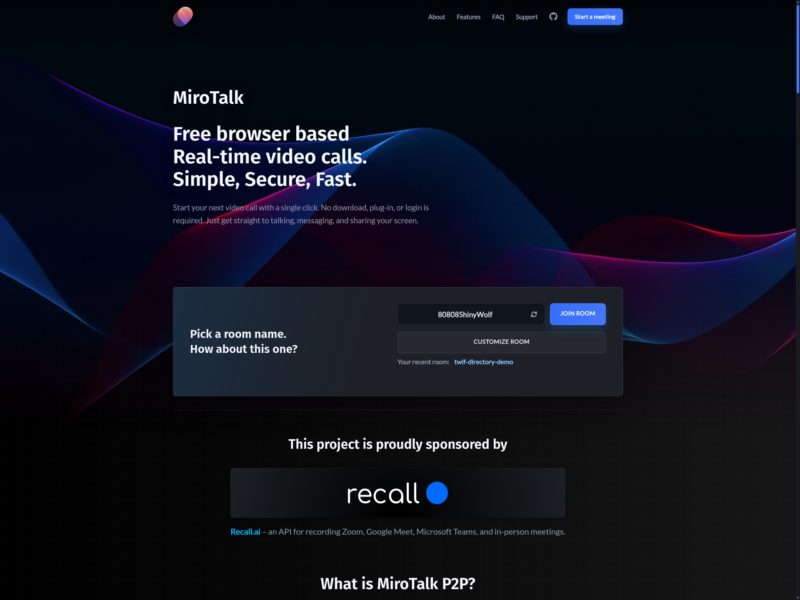
MiroTalk P2P is a free, open-source video conferencing server you run yourself. Participants join from an ordinary browser — no download, plugin or account — and the call is carried over direct peer-to-peer WebRTC connections instead of being relayed through a central media server. Rooms are unlimited, calls have no time limit, and the whole application ships as a single Node.js container.
What it does
MiroTalk covers the everyday remote-meeting basics in the browser: multi-party video and audio, screen sharing, a collaborative whiteboard, chat, file sharing and session recording. Video is negotiated at up to 8K at 60 fps between capable endpoints, with picture-in-picture and camera background blur or image replacement handled locally in the browser.
- Multi-party video calls with screen sharing, recording and picture-in-picture
- In-call chat with Markdown and emoji, shared whiteboard, collaborative editor, live polls, breakout rooms and file sharing
- Optional OpenAI (ChatGPT) integration, speech recognition and voice commands
- Access control: OIDC login, JWT credentials, room passwords, lobby and host-protection mode
- REST API, embeddable iframe and widget, Slack and Mattermost integration, and a UI translated into 133 languages
Peer-to-peer instead of a media server
Because streams travel directly between browsers, the server does the signalling and serves the web application but does not carry the audio and video. That keeps bandwidth and CPU costs low and means the host never holds the media, which is the main privacy argument for self-hosting it. The trade-off is scale: full-mesh peer-to-peer connections get expensive as participants are added, so it suits small teams and private rooms rather than large webinars. The same project also publishes MiroTalk SFU, a selective-forwarding variant for bigger calls.
Deployment and requirements
The official image is mirotalk/p2p on Docker Hub, and a Compose template ships in the repository alongside a Node.js install path. Configuration lives in app/src/config.js and .env; a strong JWT_KEY must be set or the server refuses to start. Browsers only grant camera and microphone access over HTTPS (or on localhost), so a self-hosted instance needs a TLS reverse proxy and a STUN/TURN service for participants behind restrictive NATs. Rebranding is supported through the source code, and there is a documented REST API plus webhook for automation.
Licence
AGPL-3.0 — free to self-host, modify and redistribute, provided modifications stay available under the same licence and network users can obtain the source. Closed-source, rebranded or commercially resold deployments require a paid one-time licence from the author.
Alternatives
- Jitsi Meet — Apache-2.0 conferencing built on an SFU, better suited to larger meetings
- BigBlueButton — LGPL-3.0 virtual classroom with recording and breakout rooms