Fluxer
- Platform
- Web Linux macOS Windows Android
- Licence
- AGPL-3.0-or-later Open source
- Website
- fluxer.com
- Source code
- github.com/fluxerapp/fluxer
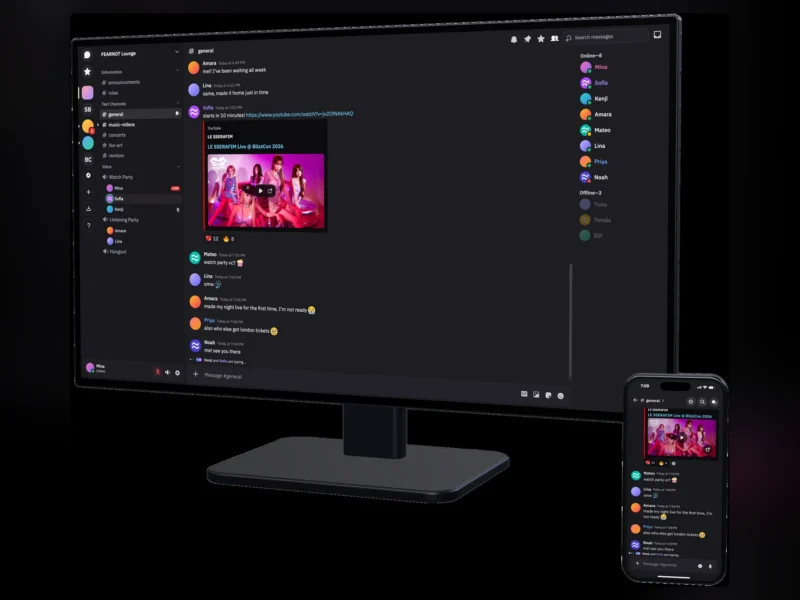
Fluxer is a free and open source instant messaging and VoIP app for friends, groups and communities, written in TypeScript and released under the AGPL-3.0-or-later licence. It gives a community the familiar layout — a rail of servers, a channel sidebar, text and voice channels, direct messages and a member list — in a desktop build for Windows, macOS and Linux, a browser tab, and an Android client. The same repository also ships the server, so an instance can be self-hosted.
Chat features
- Servers organised into text and voice channels, with roles and a member list that separates online from offline people
- Voice channels and hangouts that people join and leave inside the client, with participants listed beneath the channel
- Direct messages, reactions, emoji, GIFs and stickers, and inline embeds such as YouTube videos in the conversation
- Typing indicators and per-message reaction counts
Clients and packages
- Windows — x64 and ARM64 installers, plus portable builds for both
- macOS — one universal disk image covering Apple silicon and Intel
- Linux — deb, rpm, AppImage and tar.gz for x64 and ARM64, plus a Flatpak on Flathub
- Android — Google Play and direct APK downloads; the iOS beta is currently paused
- Web — fluxer.com/app runs in the browser with nothing to install
Vendor repositories on Linux
The project publishes its own signed apt, dnf, pacman and Flatpak repositories, each with a stable and a canary channel. Subscribing to the repository is the recommended route on Linux: a one-off package file only updates once its channel entry file has been added. On RHEL, Rocky, Alma and CentOS Stream the dnf install needs epel-release first, because those base repositories lack libXScrnSaver; Fedora does not.
Self-hosting
The server side lives in the same repository and the project documents running your own instance at docs.fluxer.com. That is the route for a community that wants its messages and accounts on its own infrastructure rather than on the public service.
Alternatives
- Mattermost — self-hosted team messaging oriented around workplace workflows
- Rocket.Chat — self-hosted messaging platform with channels and omnichannel support
- Element — Matrix client for federated, end-to-end encrypted chat
- Zulip — team chat built around threaded conversations