Chatwoot
- Platform
- Web Docker
- Licence
- MIT (core; enterprise directory separately licensed) Open source
- Website
- chatwoot.com
- Source code
- github.com/chatwoot/chatwoot
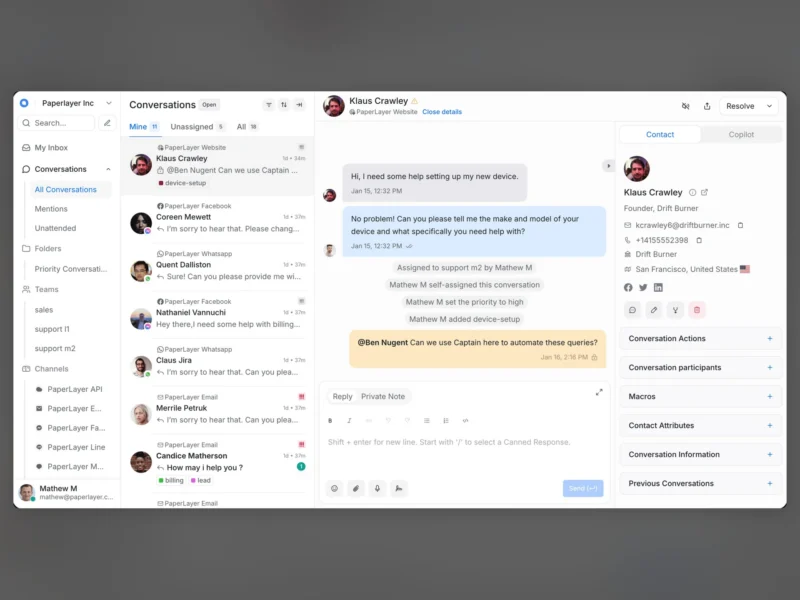
Chatwoot is an open-source customer engagement platform that puts the website live-chat widget, email support and messaging channels into a single agent dashboard. It is a self-hostable answer to Intercom, Zendesk and Salesforce Service Cloud: a conversation that starts in the website chat bubble arrives in the same shared inbox as the follow-up email, so the team answers in one place instead of copy-pasting between tools.
What it covers
- Omnichannel inbox — website live chat, email, WhatsApp, Facebook, Instagram, Telegram, SMS, LINE and a generic API channel all land in one queue.
- Chat widget and help centre — an embeddable widget with pre-chat forms, plus a public help-centre portal for articles that agents can link to a conversation.
- Shared-inbox workflow — assignment to agents and teams, labels, canned responses, private notes, mentions and conversation status tracking.
- Automation — rules and macros that route, tag and reply to conversations without an agent touching them.
- Reporting — conversation, agent, inbox and label reports, plus customer-satisfaction scores recorded in the conversation.
- Integrations and API — a documented REST API, webhooks and SDKs for embedding the widget or building on top of the inbox, with Slack and other integrations for notifications.
Deployment
Chatwoot is a Ruby on Rails application with a Vue front end. The project publishes official Docker images and a Docker Compose setup, so a self-hosted install is a compose file with PostgreSQL and Redis behind the Rails app on port 3000; Heroku deployment is documented as well. Upgrades run the usual Rails database migrations, so pin a release tag rather than tracking develop. The vendor also sells a managed Chatwoot Cloud instance for teams that would rather not run it.
Community edition and the enterprise directory
The code outside the repository’s enterprise/ directory is MIT-licensed, which is what most self-hosters run. The enterprise/ tree carries its own separate commercial licence, and some advanced capabilities ship only from that edition — check the feature list before assuming a given premium feature is in the free build.
Alternatives
- Zammad — open-source helpdesk with ticketing, email and chat channels.
- Rocket.Chat — open-source team chat and omnichannel messaging platform.
- Mattermost — self-hosted team messaging for internal communication rather than customer support.