Colanode
- Platform
- Web macOS Windows Docker Self-hosted
- Licence
- Apache-2.0 Open source
- Website
- colanode.com
- Source code
- github.com/colanode/colanode
Overview
Colanode is an open-source collaboration workspace that puts team chat, rich-text pages, databases and file sharing in one application you can host yourself. It is the closest free-software answer to running Slack and Notion side by side, built local-first: every change is written to a local SQLite database on the client first and synced to the server in the background, so the app keeps working when the network, or the server, does not.
What you can do with it
- Real-time chat — direct messages and channels, with message threads inside a workspace.
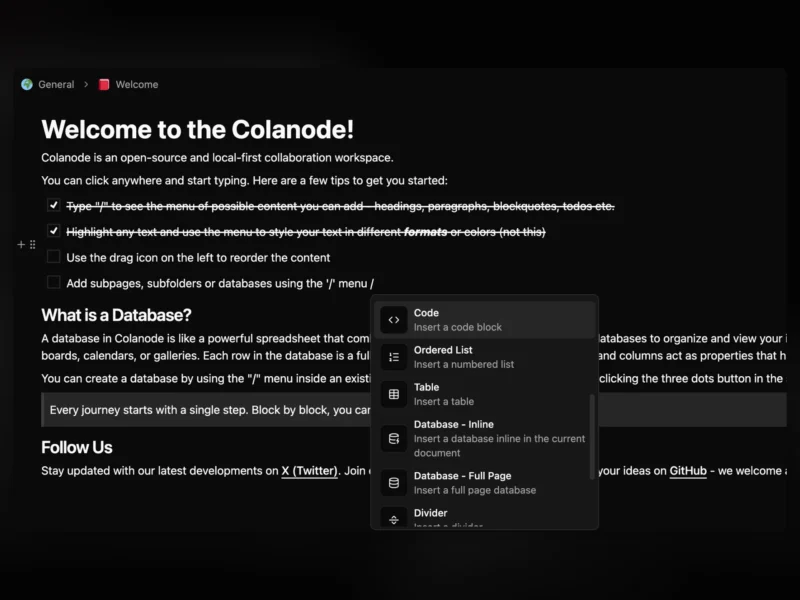
- Rich-text pages — documents, wikis and notes in a block editor with a slash menu for headings, lists, tables, code blocks and callouts.
- Databases — structured records with custom fields, shown as table, kanban or calendar views. Databases can sit inline in a page or take a whole page of their own.
- Files — files stored and shared inside the workspace, on local disk or an object-storage backend.
How the sync works
The client app (web or desktop) keeps its own copy of everything you can see. Reads happen locally and are instant; writes land in SQLite and a background process reconciles them with the server. Concurrent edits on pages and database records are merged with CRDTs, using Yjs, so two people editing the same page do not overwrite each other. Messages and file operations do not support concurrent editing and use simpler tables instead.
One client can connect to several servers, and each server holds one or more workspaces for different teams or projects.
Self-hosting it
The server ships as a Docker image, with a Docker Compose file and Helm charts for Kubernetes in the repository’s hosting/ directory. A deployment needs:
- PostgreSQL with the pgvector extension,
- Redis or any compatible service such as Valkey,
- a storage backend — local filesystem by default, or S3-compatible, Google Cloud Storage or Azure Blob Storage,
- the Colanode server API image.
Configuration lives in a single config.json; only POSTGRES_URL and REDIS_URL are required to start, and secrets can be pulled from environment variables with env:// pointers instead of being written into the file.
Clients
There is a web app at app.colanode.com, currently in early preview, and Electron desktop builds for macOS (Intel and Apple Silicon) and Windows, published as release assets on the project’s repository. The hosted cloud servers in the EU and the US are free while in beta, with pricing still to be announced — a self-hosted server needs no subscription at all.
Who it is for
Small teams and organisations that want chat and a knowledge base in one place without handing their conversations and documents to a SaaS vendor. If you only need messaging, a dedicated chat server such as Mattermost or Rocket.Chat is lighter; if you want the chat-and-docs combination and can run Postgres and Redis, Colanode covers both.
Alternatives
- Mattermost — self-hosted team chat with a Slack-style channel model.
- Rocket.Chat — channels, threads and omnichannel support, self-hosted.
- Zulip — threaded conversations organised by topic.
- Chatwoot — customer-support inboxes rather than internal team chat.