Novu
- Platform
- Web Docker
- Licence
- MIT Open source
- Website
- novu.co
- Source code
- github.com/novuhq/novu
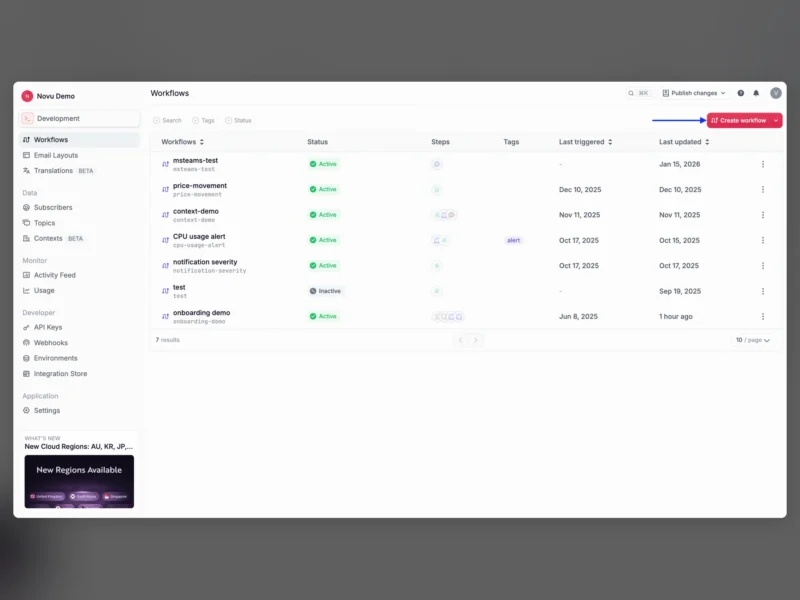
Novu is open-source communication infrastructure for products and AI agents: one API and one workflow engine that deliver messages across in-app inbox, email, push, SMS and chat, instead of one integration per channel. You can run the entire platform yourself — API, worker, dashboard and all — so subscriber data, notification history and provider credentials stay on your own infrastructure.
What it does
At the centre is a workflow engine. A workflow is defined by a trigger identifier and a chain of steps: channel steps that render content for In-App/Inbox, Email, Push, SMS or Chat, and action steps such as Delay, Digest and Throttle. Each step carries its own template and conditions, so a single trigger can show an in-app notification immediately, hold an email back for a digest window, and skip a push when the reader is already active.
Key features
- One API, many channels — a single trigger call fans out to Inbox/In-App, Email, Push, SMS and Chat.
- Workflow engine — branching steps with per-step conditions and per-channel templates.
- Embeddable Inbox component — a real-time notification centre for your web app, shipped as a React or plain JavaScript component, with a matching preferences component so subscribers choose their own channels.
- Digest engine — batch a burst of events into one message instead of twenty.
- Delay and Throttle actions — schedule a step, or cap how many notifications one subscriber receives inside a window.
- No-code email editor — compose and preview email templates inside the dashboard.
- Activity feed — per-run logs with request payloads and delivery status for debugging a workflow that did not fire.
- Subscribers, topics and contexts — address individual subscribers, group them into topics, and scope workflows by context.
- Separate environments — Development and Production each get their own API keys, integrations and data.
- Translations — localise workflow content per subscriber locale.
- Agent communication (ACI) — the newer half of the project: a unified conversation model for two-way messaging, so an agent you have already built can receive and answer on Slack, Microsoft Teams, Telegram, WhatsApp, email and the in-app inbox without maintaining one webhook handler per platform. Novu connects the agent to the channels; it is not the agent itself.
How it fits together
The visible piece is the dashboard web app; underneath sit an API, a worker that executes queued jobs, and a WebSocket service, with MongoDB holding state and Redis handling queuing. Self-hosting means running that set yourself, typically from the self-hosted release assets in the repository. Provider credentials — whichever email, SMS, push or chat service you already pay for — are entered in the integration store, so swapping a provider is a dashboard change rather than a code change.
Who it is for
Product teams that need reliable multi-channel delivery without building a queue, a template system and a separate integration for every provider, and teams wiring AI agents into the channels their users already read. It is a heavier install than a simple push-notification daemon: expect a MongoDB, Redis and several application containers before the first notification is delivered.
Alternatives
- Apprise — one command line and API to push plain notifications to a long list of services, with no workflow engine, subscriber model or embeddable inbox.
- ntfy — a lightweight self-hosted pub-sub notification server for alerts to phones and desktops; simpler, but it does not manage per-user preferences or multi-step workflows.
Novu’s core is MIT-licensed, and the project states this explicitly: everything outside the enterprise/packages directory is MIT, while those enterprise packages carry a separate proprietary Novu Enterprise Edition licence, so a self-hosted deployment using only the open-source packages stays free software. A hosted cloud version of the same product is also sold, which is how the project is funded.