OpenSlides
- Platform
- Linux
- Licence
- MIT Open source
- Website
- openslides.com
- Source code
- github.com/OpenSlides/OpenSlides
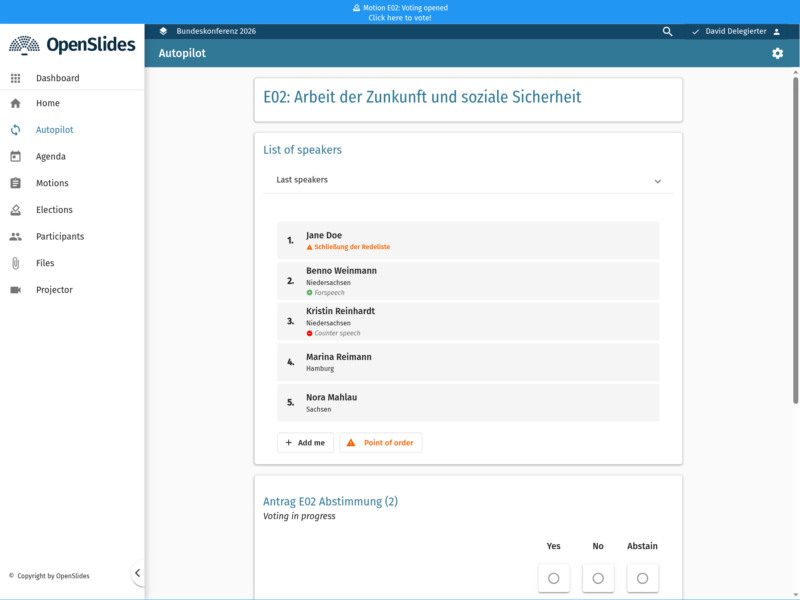
OpenSlides is a digital assembly system for bodies that decide things in a room: parliaments, party conferences, association meetings, works councils and large member assemblies. It manages the agenda, the motions and their amendments, the speaker lists and the votes, and projects the current state onto screens in the hall so delegates can follow the meeting without paper.
Key Features
- Agenda management — build the agenda from items and motions, reorder it live, and keep the hall’s view in step with what the chair is actually handling.
- Motions and amendments — submit motions online, attach amendments and change recommendations, and follow how a motion changed as amendments were accepted or rejected.
- Elections and voting — run elections and votes and record the result against the motion it belongs to.
- Speaking lists — maintain a speaking list per agenda item, with the next speaker visible to the chair and the room.
- Projector views — dedicated views for one or more projectors, so the room sees the current motion while the chair sees the list of speakers.
- Participant and group management — participants belong to groups with permissions, which is what makes a delegate different from a guest.
- Autopilot — an operator can pre-schedule the sequence of views for a session and step through it, which is how larger assemblies are actually run.
- Accessible and multilingual — the interface follows accessibility guidance and supports translated motions, important when a body operates in more than one language.
Why Use OpenSlides?
Assembly software earns its place on the difficult day: the agenda is running late, three amendments are on the floor and the projector is showing the wrong motion. OpenSlides is built around that situation rather than around publishing a programme — the chair, the operator and the room work from one live state, so what is projected is what is being decided.
It is also unusually forgiving about what a “meeting” is. The same system runs a two-day party conference and a monthly committee, because the underlying objects are agenda items, motions and votes rather than conference sessions and speakers.
Use Cases
- Party conferences and association assemblies with motions, amendments and elections.
- Parliaments and councils that need motions voted and recorded in public.
- Works councils and member organisations that must publish decisions and their paper trail.
- Large hybrid meetings where the room and the remote participants watch the same projected state.
Requirements
OpenSlides 4 is a set of Docker services — a backend, a web client, an autoupdate service, an authentication service, voting and projector services — deployed together with Docker Compose on Linux. The project’s repositories are published under the MIT licence.
Alternatives
- motion.tools (Antragsgrün) — motion and amendment management with an emphasis on drafting and discussion, from the same problem space.
- pretalx or Indico — if the meeting publishes a programme of talks rather than deciding motions.