Indico
- Platform
- Linux
- Licence
- MIT Open source
- Website
- getindico.io
- Source code
- github.com/indico/indico
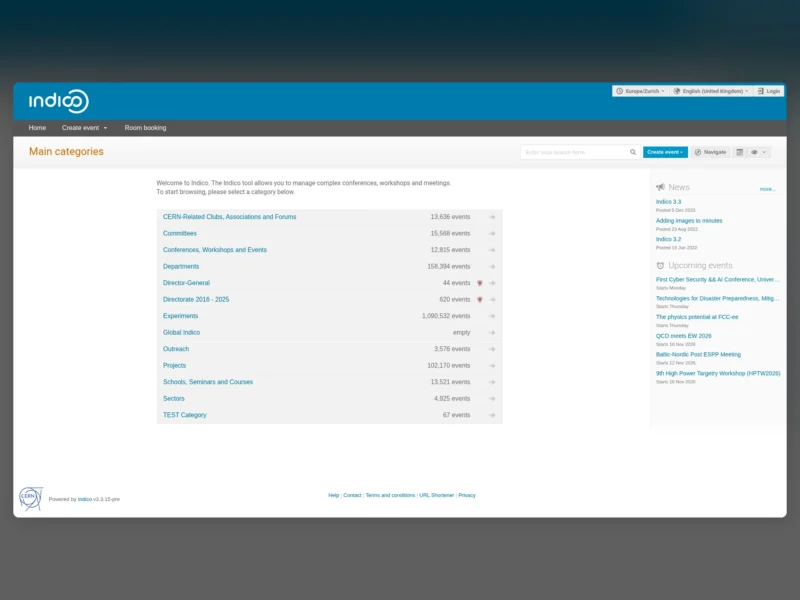
Indico is an open-source event management system built at CERN to run the whole life of a conference in one place — from the first call for abstracts to the published timetable and the attendee check-in on the day. It has been developed continuously at CERN for research institutes, universities and international organisations, and the project lists CERN itself, the United Nations and ENEA among the bodies running it.
Key Features
- Call for abstracts and reviewing — collect submissions against a deadline, assign reviewers, record marks and acceptance decisions, then move accepted contributions straight into the programme.
- Registration with fees — build registration forms with your own fields, handle participant categories and payments, and keep the participant list in the same system as the programme.
- Timetable and contributions — drag contributions into a timetable with parallel tracks and rooms, attach material such as slides, papers and minutes to each contribution, and export the programme.
- Room booking module — book rooms, equipment and services across a site from a separate booking area, so an ordinary meeting and a full conference reserve the same resources.
- Badges and tickets — print participant badges and tickets directly from the registration data.
- Surveys and feedback — send post-event questionnaires and keep the answers next to the event they belong to.
- Fine-grained permissions — managers, reviewers, speakers and participants each see only their own part of an event.
- REST API and plugins — every object is reachable over the HTTP API, and the plugin system extends the platform without forking it.
Why Use Indico?
Most conference stacks solve one slice at a time — a call-for-papers service here, a ticketing page there, a spreadsheet holding the programme — and the record gets copied between them with something always left behind. Indico keeps abstracts, reviews, registrations, the timetable and the event’s own documents as one object with one set of permissions, so the programme you publish is the same data you reviewed and the badge you print is the same participant you invoiced.
Because it was written for an institute that runs hundreds of events a year, it also copes with the awkward parts: events that are one lecture and events that are a week of parallel tracks, restricted events visible only to a collaboration, and room bookings that belong to the site rather than to one conference.
Use Cases
- Academic and institutional conferences that need abstract review alongside a citable, exportable programme.
- Workshops and collaboration meetings on a site that also needs to book its rooms and equipment.
- Organisations that must self-host because participant data cannot leave their own infrastructure.
- Research groups running recurring events with the same structure every year, reused as templates.
Requirements
Indico runs on Linux with Python, PostgreSQL and Redis. Official Docker images are published for both the application and its supporting services, and a hosted trial is available from the project for evaluation before an install.
Alternatives
- pretalx — narrower and lighter if all you need is a call for papers, a review round and a published schedule.
- OpenSlides — aimed at assemblies and motions rather than academic programmes.
- OSEM — a smaller successor-in-spirit used by openSUSE for community conferences.