Invoicerr
- Platform
- Web Docker Self-hosted
- Licence
- AGPL-3.0 Open source
- Website
- invoicerr.app/
- Source code
- github.com/invoicerr-app/invoicerr
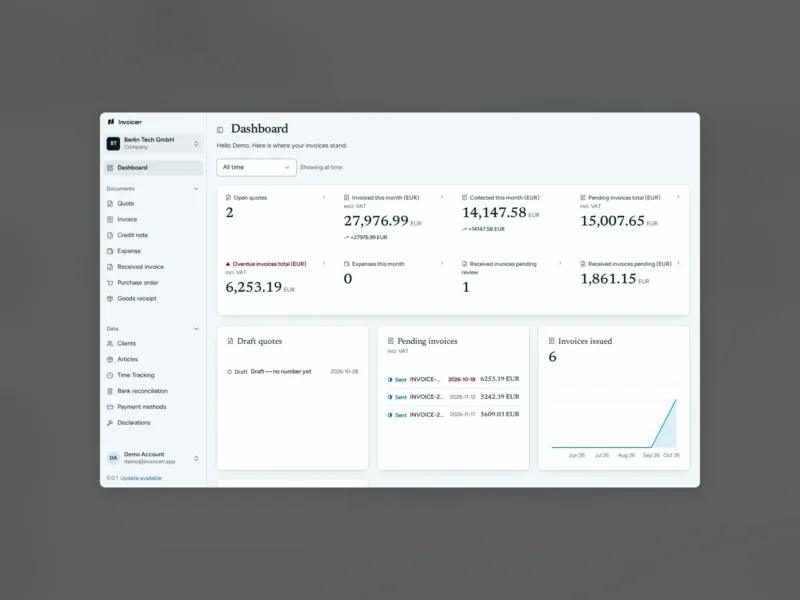
What Invoicerr is
Invoicerr is an open-source invoicing and e-invoicing application for freelancers, small businesses and their accountants. It is written in TypeScript, with a NestJS backend and a React front end, and licensed under the GNU Affero General Public License v3.0. It is meant to be hosted on your own server: the documents, the client records and the legal archive sit in a PostgreSQL database you control, and a published container image brings the whole stack up with one compose file.
What it is built for is narrow and specific — issuing invoices that a country now expects to arrive as structured data, and keeping the paperwork trail that follows. Quotes, invoices, credit notes, purchase orders, goods receipts, expenses and received invoices all run through one document engine, so numbering, VAT rates, settlement state and archiving behave the same way whatever the document is called.
E-invoicing that follows national rules
Each supported country ships as a catalogue of sourced facts rather than a code path: which identifiers a party must supply (SIREN/SIRET and the intra-community VAT number in France, USt-IdNr. and Handelsregisternummer in Germany, Partita IVA in Italy), which e-invoice format the buyer expects, which channels the invoice may travel through, which VAT rates exist, and how long the archive has to be kept. France, Germany, Italy, Poland and Portugal ship filled in today; adding another country means writing data files in the same shape.
Each invoice is produced as a PDF with e-invoice XML beside it — Factur-X, UBL, CII, XRechnung, Peppol BIS, FatturaPA or FA(3) — and validated before it leaves. Delivery is per country: an accredited PDP in France (SUPER PDP, Iopole, Billit or Invopop) or Chorus Pro for public buyers, SdI over web service or certified e-mail in Italy, KSeF in Poland, and plain e-mail with the XML attached anywhere else. Invoicerr is not itself an approved platform: it builds and validates the invoice, and the platform delivers it.
Documents, payments and reconciliation
Quotes convert into invoices, and credit notes correct an invoice line by line instead of freehand. Deposits, instalments and partial payments are computed from the payment records rather than stored on the document, so the settlement state always matches the money that arrived. Bank statements import as CSV or OFX and are matched by reference and amount, turning a suggested match into a real payment record once it is confirmed.
Every issued document gets a legal archive entry with its retention period and the point that period starts from, taken from the country’s own rule — ten years under the French commercial code, eight under the German UStG, and so on. The archive and the uploaded files can be backed up on a schedule, encrypted with a key the storage provider never holds.
Clients, catalogue and time
Clients get a portal of their own: their documents, their balance and aged balance, PDF downloads, payment, and quote decisions. A quote is signed with a one-time code sent to the signer. An article catalogue prices work by hour, day, unit or service and tracks stock with low-stock alerts, and per-project time tracking turns into invoice lines in one step. Recurring documents, multi-currency with rate history and a per-recipient document language cover the rest of the routine billing work.
Running it yourself
The image runs on linux/amd64 and linux/arm64 and expects a PostgreSQL database and a Redis instance — Redis is required for the backend to boot, because document actions are queued. Mount a volume for the document archive: without it the archive sits in the container’s writable layer and is destroyed by the next image pull. A mail provider (SMTP or Resend) is needed for anything to be sent, and the application URL has to be the real address of the instance because it is used in e-mail links.
Sign-in is by e-mail and password out of the box, with OIDC/SSO (instance-wide or per company) and API keys as alternatives. Several companies can run on one installation with role-based access, and there is a REST API, webhooks, an MCP server and a plugin system. The interface is translated into 18 languages, documents can be issued in the recipient’s language, and the web app installs as a PWA with light and dark themes. A managed cloud is announced but still a waiting list, so self-hosting is how it is used today.
Alternatives
- InvoiceShelf — self-hosted invoicing and estimates for freelancers and small teams, without the e-invoicing compliance layer
- Invio — invoicing in a single Docker container, kept deliberately smaller than an ERP
- Invoice Builder — account-free invoicing and quoting with the data stored locally