Budget Board
- Platform
- Web Docker
- Licence
- AGPL-3.0 Open source
- Website
- budgetboard.net
- Source code
- github.com/teelur/budget-board
What Budget Board is
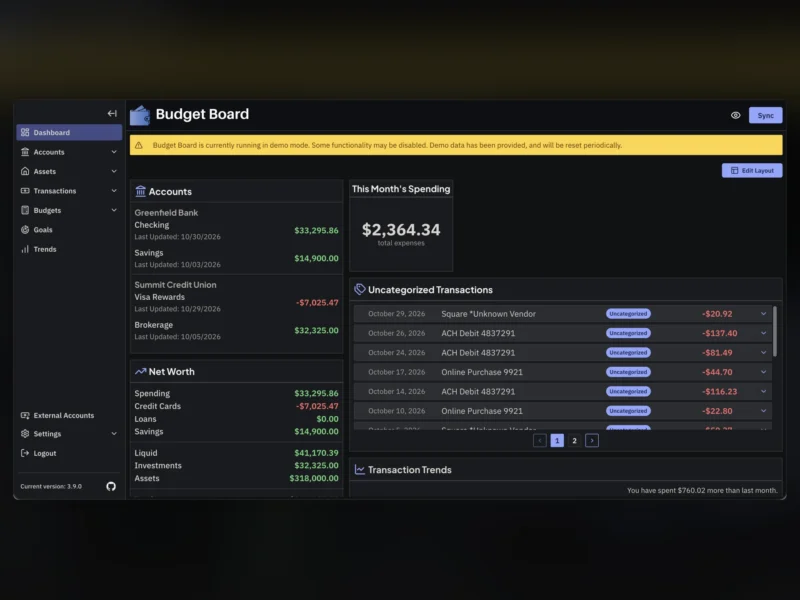
Budget Board is a self-hosted personal finance app for tracking monthly spending and working towards savings goals, written by teelur as an explicit replacement for Mint after Intuit shut it down. It runs as a web application – an ASP.NET backend with a React front end, shipped as a Docker image – and is published on GitHub under the AGPL-3.0 licence.
It is deliberately narrower than a business accounting package: no invoices, no double-entry ledger, no tax reports. The scope is a household’s accounts, the transactions moving through them, a monthly budget per category, and charts that show whether the month is going to plan.
Accounts, transactions and budgets
- Accounts and assets. Checking, savings and credit cards sit alongside non-cash assets such as property or valuables, so net worth is one figure rather than a spreadsheet.
- Transactions. Record and categorise spending, with filtering by account, category and date.
- Budgets. A monthly budget per category, with actual spending tracked against it as the month progresses.
- Rules. Automatic rules rewrite or categorise transactions on criteria like description, amount or date, which keeps recurring merchants tidy without manual work.
Import, sync and auto-categorisation
For getting data in, Budget Board accepts bulk CSV imports from a bank export. For keeping it current, it connects to financial institutions through aggregators – SimpleFIN and LunchFlow are the supported providers – and pulls transactions and balances on a schedule rather than on demand. A machine-learning model can be trained on the transactions you have already categorised and then predict categories for new ones, which is the difference between a one-off import and an install you keep using.
Goals, charts and access
Financial goals – saving for a house, paying off a card – are tracked as progress against a target, and the trend charts are customisable by date range, account and category. Authentication can be local username and password, administrator-managed local accounts, or OIDC through an external identity provider. The interface is translated into English, German, French and Simplified Chinese, with date and number formats following the selected locale.
Running it yourself
The project publishes a Docker image built by its own GitHub Actions workflow, and the setup instructions live in the wiki at budgetboard.net. There is no hosted version: this is a container you run yourself, pointed at a database, with your transaction history stored on your own hardware. That is the trade – you take on the updates and the backups, and your bank data never reaches a third-party budget service.
Where it fits
Budget Board is the Mint-style envelope view of personal finance rather than the ledger view. Actual Budget is the closest self-hosted comparison and has the longer track record; Firefly III is stronger on double-entry bookkeeping and reporting; GnuCash is the desktop option if you would rather keep the file local and skip running a server at all.