Rachoon
- Platform
- Web Docker
- Licence
- AGPL-3.0 Open source
- Website
- github.com/ad-on-is/rachoon
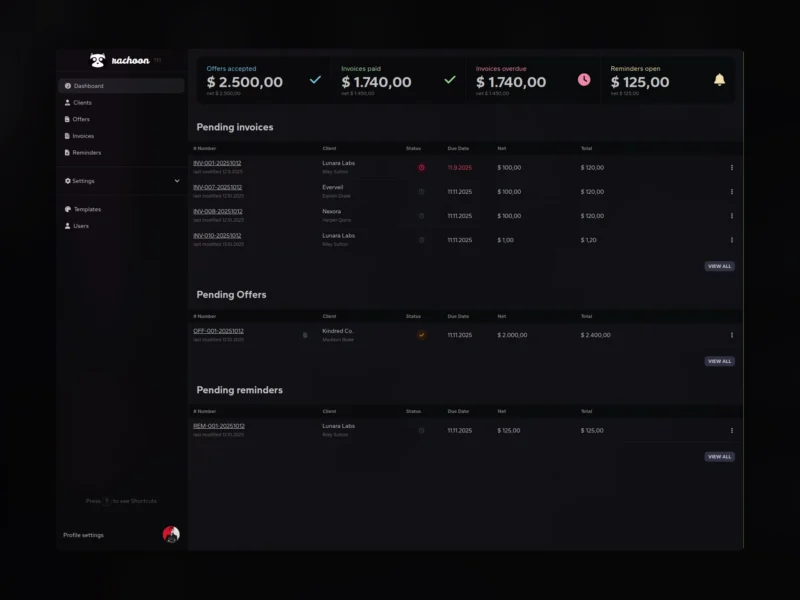
Rachoon is a self-hosted invoicing platform for freelancers and small businesses: invoices, quotations, clients and payment reminders in a single web app that runs on your own server. The name comes from račun, the Bosnian word for invoice, softened into the raccoon that fronts the project. It covers the same ground as a proprietary billing service, but the client list, the invoice history and the numbers on the dashboard stay in a database you control.
The dashboard
The dashboard opens on four summary cards — offers accepted, invoices paid, invoices overdue and open reminders — each showing a total and a time window, with overdue amounts coloured so a late payment is visible at a glance. Below them sit three tables: pending invoices, pending offers and pending reminders, each with the client, status, due date, net and gross totals, a row menu for actions, and a link through to the full list.
Invoices and offers
- Invoices — create, edit and track invoices, with line items, tax, and a status that moves as payments arrive.
- Offers — quotations handled as their own document type, so a quote can be sent and accepted before it becomes an invoice.
- Clients — a searchable client book holding the addresses and details that invoices are generated from.
- Reminders — follow-ups on unpaid invoices, tracked as their own records rather than written by hand.
Templates and PDF export
Invoice and offer layouts are templates written in nunjucks, so the wording, colours and structure of the printed document can be changed without touching the application code. Finished documents are exported as PDFs. Currency and tax settings are flexible enough to invoice across borders and to apply the tax rules that apply where you trade.
Running it yourself
The project publishes a Docker image at ghcr.io/ad-on-is/rachoon. The documented compose file runs three containers: the application, a gotenberg service that renders the PDFs, and PostgreSQL 16 for storage. Configuration is through environment variables — an application key of at least 32 characters for encryption and signing, the database connection details, and the URL of the Gotenberg service. After the stack starts, the first visit goes to /signup to create the account that owns the instance; there is no hosted edition to sign up for instead.
Built with Nuxt and AdonisJS
The frontend is a Nuxt application, the backend runs on AdonisJS, and the repository is a Turborepo monorepo with separate packages for the two halves. Rachoon is released under the GNU Affero General Public License v3.0, which means modifications offered to others as a network service must also be published. Development is active: release 1.3.9 shipped in May 2026 and the issue tracker stays open to bug reports and feature requests.