EventCatalog
- Platform
- Web Docker Self-hosted
- Licence
- BSL-1.1 Source-available
- Website
- eventcatalog.dev
- Source code
- github.com/event-catalog/eventcatalog
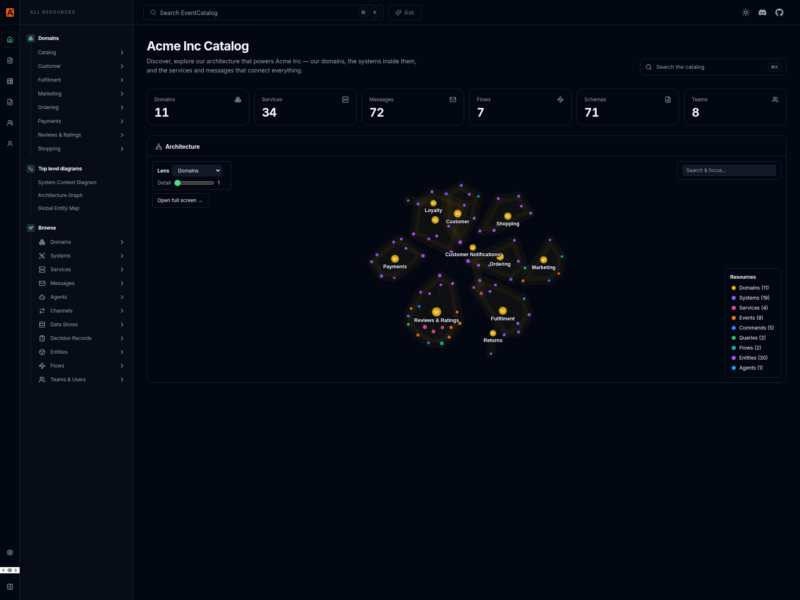
EventCatalog is a documentation tool built for software architecture rather than for generic pages. Instead of a wiki of loose articles, it gives you structure for the things an architecture is made of — domains, systems, services, messages, schemas and the relationships between them — and publishes that structure as a browsable catalog with an architecture graph, generated from files that live in your own repository.
Documenting architecture with its own primitives
A catalog is a directory of Markdown and MDX files plus small metadata files, one per resource, kept in Git alongside the code. EventCatalog understands domains, systems, services, messages, data stores, data products, entities, channels, flows, architecture decision records, teams and users, so each one gets a real page with its relationships instead of a heading inside a longer document. Business flows stitch services and messages into an end-to-end story, ADRs and runbooks attach to the resource they describe, and resources carry semantic versions so the catalog can show how a contract has changed over time.
Architecture graph, schemas and change detection
The catalog renders an architecture graph and a standalone visualiser component, plus a schema explorer that indexes OpenAPI, AsyncAPI, Protobuf, JSON Schema and Avro documents in one searchable place, including per-field search across the whole catalog. Static builds check internal links and anchors, a linter tests the catalog against your own rules, and the breaking-changes package compares resource versions so a change to a published schema shows up before it reaches production.
AI agents and generators
Every catalog is exposed to AI tooling: a built-in assistant answers questions about the architecture, an MCP server lets external agents query the catalog, and the published site emits llms.txt and an api-catalog document following RFC 9727. More than fifteen generators import existing contracts from AsyncAPI, OpenAPI, Kafka, Confluent Schema Registry and AWS EventBridge, a Node.js SDK manages the catalog programmatically, and Studio adds a collaborative canvas for drawing and planning diagrams.
Requirements and deployment
EventCatalog needs Node.js 22 or newer. The scaffolding CLI creates a working catalog in one command and the development server serves it on port 3000. By default a build emits a static HTML site into dist that can be hosted anywhere, and the repository ships a Dockerfile exposing port 3000 for container hosting. Server-side rendering mode is only required for the AI chat with your own keys and for authentication, and is recommended for very large catalogs whose static builds get slow. Everything runs on your own infrastructure: the catalog lives in your repositories and is not sent to the vendor or a third party.
Source-available, not open source
EventCatalog is not an OSI open-source project. From version 5.0 it is source-available under the Business Source License 1.1: the code is public and you may copy, modify, redistribute and use it non-commercially, but production use outside the free grant needs a paid licence. Production use is free for individuals working on personal projects, for organisations under USD 10 million in annual revenue and under USD 10 million in total funding, for public open-source projects, and for teaching or research. Every other organisation gets a 60-day evaluation and then a commercial licence — Business from USD 5,995 a year and Enterprise from USD 24,995 a year, priced by the number of teams. A trial countdown appears in the catalog header, but builds keep working after a trial or a licence ends. Each release series converts to the MIT licence four years after its first public release, releases up to and including 4.x stay MIT, and the SDK, CLI, connectors, diff, linter, visualiser, breaking-changes and scaffolding packages are MIT today. The documentation you write in your own catalog remains yours.
Project and community
EventCatalog was started in 2021 by David Boyne and is developed by EventCatalog Ltd, with close to 3,000 stars on GitHub, contributors from across the event-driven community, and a project figure of more than 40,000 catalogs created. The documentation, a hosted demo catalog and a Discord community are linked from the project site.
Alternatives
- MkDocs — MIT-licensed open-source static documentation generator; strong for prose documentation, without architecture primitives.
- Docusaurus — MIT-licensed documentation site framework with versioning and MDX, if you want a fully open-source tool you control.
- BookStack — open-source self-hosted wiki for free-form knowledge bases rather than a structured architecture catalog.