Raneto
MIT
- Platform
- Docker Web
- Licence
- MIT Open source
- Website
- raneto.com
- Source code
- github.com/ryanlelek/Raneto
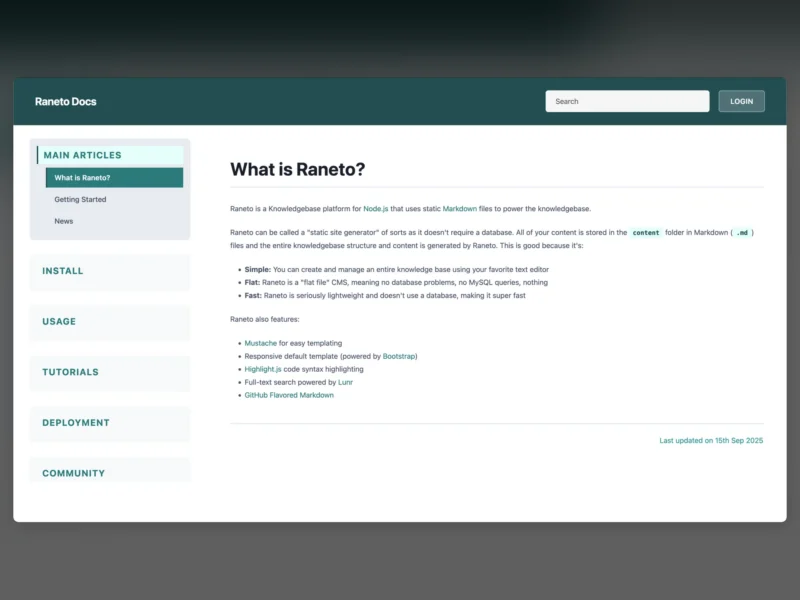
Raneto is a Markdown-powered knowledge base for Node.js — a static site generator with a browser, in the project’s own framing. Pages are .md files in a content directory, there is no database to run or query, and the site is built from those files as it is served. Documentation, a staff handbook, a support FAQ or an internal wiki all fit; writers edit text files in their own editor, and the result is deployed with the app.
Content and navigation
- Everything lives in a content directory: a page is a Markdown file, a category is a folder, and pages are ordered through their front matter.
- GitHub Flavored Markdown throughout, with Highlight.js syntax highlighting for code blocks.
- Full-text search over page titles and contents, powered by Lunr, reachable from the header search box.
- The default template is a responsive Bootstrap layout driven by Mustache, so the chrome can be swapped for your own template without touching the content.
Editing and access
- A Markdown editor in the browser can be enabled for writers who would rather not push to git, and a login system protects editing when it is on.
- Credentials and the session secret come from
config/config.jsor, with higher priority, from environment variables —ADMIN_USERNAME,ADMIN_PASSWORDand aSESSION_SECRETof at least 32 characters. - Authentication and the editor are separate switches (
AUTHENTICATION,ALLOW_EDITING), so a public read-only documentation site needs no login at all.
Running it
- Published on npm as
raneto— 0.18.1, released in March 2026. Install the package, pointCONTENT_DIRat the Markdown folder and start it; the default listener is127.0.0.1:8080, andADDRESSandPORTmove it. - A
Dockerfileships in the repository for a container build, andBASE_URL,SITE_TITLE,LOCALEand a Google Analytics ID are all settable as environment variables. - With no database in the picture, a deployment is the app plus a directory of text files — easy to version, review in a pull request or back up with rsync.
Alternatives
- LeafWiki — single Go binary serving a Markdown-file wiki with tree navigation
- Pepperminty Wiki — complete wiki engine in a single PHP file
- Docmost — collaborative docs with a database-backed editor