Kan
- Platform
- Web Docker
- Licence
- AGPL-3.0 Open source
- Website
- kan.bn
- Source code
- github.com/kanbn/kan
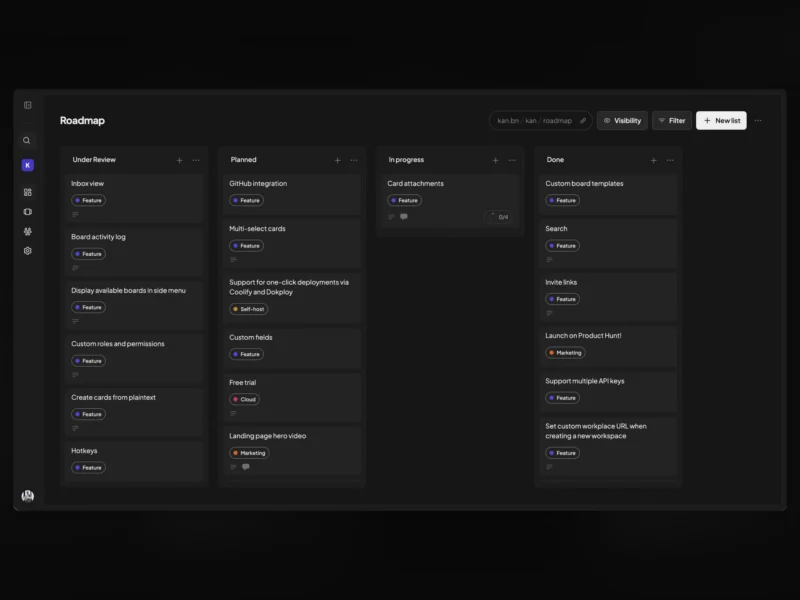
What Kan is
Kan is an open source kanban board built as a direct answer to Trello: boards, lists and cards, drag and drop, and very little in the way. It is a TypeScript application — Next.js for the interface, NestJS for the API, Postgres underneath — and it runs either from a Docker Compose file on your own server or through the project’s own hosted service.
How teams use it
- Boards that stay simple. Drag-and-drop cards between lists, with checklists, labels, assignees and comments on each card.
- Collaboration without a manual. Workspace members, invite links, board visibility controls and mentions with email notifications.
- History you can read. An activity log records card changes, so you can see who moved what and when.
- Reusable structure. Board templates and custom workspace usernames save rebuilding the same board for every project.
- Finding things. Search plus label and filter controls across a board.
- Moving in from Trello. A Trello import brings existing boards across instead of starting from scratch.
- API and AI clients. The API is available on paid plans, and the project ships an MCP server (
@kan.bn/mcp) that lets an MCP-compatible client read and change boards on your own instance through an API token.
Running it yourself
The documented deployment is Docker Compose: the compose file in the repository starts the web service on port 3000 with a Postgres database and runs the database migrations on start. Three environment variables are required — POSTGRES_URL, NEXT_PUBLIC_BASE_URL and a BETTER_AUTH_SECRET of at least 32 characters — while SMTP email, OAuth and OIDC login, S3-compatible file storage and rate limiting are configured through the optional variables in .env.example. The first account registered on a fresh instance is the one you administer it with.
Kan’s source is published under the AGPL-3.0, so self-hosting carries no licence cost. The hosted service at kan.bn is a separate commercial option — free for a single user, then priced per seat — and the Enterprise tier is the one that adds SAML SSO and an on-premise deployment option.
Alternatives
If you want more than a board — Gantt views, time tracking, backlog planning — the directory’s project and task management category covers a wider spread. Kaneo adds list, calendar and Gantt views over the same tasks; Planka is the other long-standing open source Trello alternative; and DumbKan takes the minimal-board idea further still.