DumbKan
- Platform
- Web Docker
- Licence
- GPL-3.0 Open source
- Website
- dumbware.io/
- Source code
- github.com/DumbWareio/DumbKan
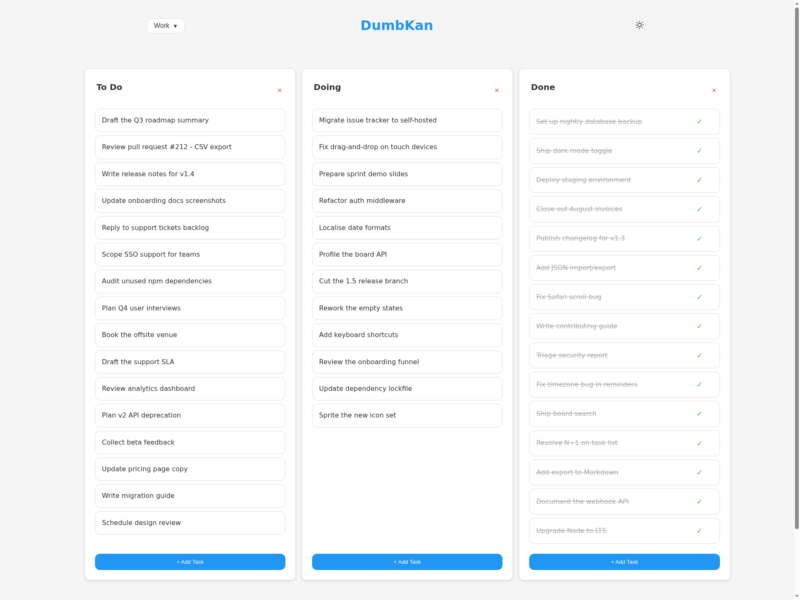
DumbKan is a deliberately small kanban board: one Node.js/Express server that renders a named board of columns and keeps every task in a single JSON file. There is no database, no user system and no build step — pull the container or run npm start, open the page, and start adding tasks. It is aimed at someone who wants a task board on a home server without standing up a full project-management platform.
What it does
Boards are created and switched from the header, and each board owns its own columns. Columns can be added, renamed inline and removed, with the last one protected so a board cannot be emptied by accident. Tasks are plain text cards: create them with the add button, edit by double-clicking on desktop or double-tapping on mobile, and move them between columns by drag and drop or touch. A light/dark toggle follows the system preference and persists between visits.
Storage and access
All state lives in one file, /app/data/tasks.json, so persistence is a matter of mounting that directory as a volume — there is nothing to back up but a JSON document, and nothing to migrate. Setting the optional DUMBKAN_PIN environment variable puts the board behind a 4–10 digit PIN, which is the only access control the app offers.
Deployment
- Docker:
docker run -d -p 3000:3000 -v $(pwd)/data:/app/data dumbwareio/dumbkan:latest - From source:
npm install, thennpm start; the server listens on port 3000 unlessPORTsays otherwise.
What it is not
There are no accounts, roles or assignees, and no due dates, comments, attachments, labels or filters — a task is a line of text in a column. Because the browser loads and saves the whole board document, two people editing at the same moment will overwrite each other. The project’s most recent commits date from June 2025, so treat DumbKan as a finished small tool rather than one under active construction.
Licence
GPL-3.0 — free and open source software. The code is published at github.com/DumbWareio/DumbKan.
Alternatives
- Kanboard — PHP and SQLite, if you want automation rules, swimlanes and real users
- Planka — a fuller board with cards, members and attachments
- 4ga Boards — a modern self-hosted board with project structure
- Nullboard — browser-only, with no server to run at all