AutoGen
- Platform
- Linux macOS Windows
- Licence
- MIT Open source
- Website
- microsoft.github.io/autogen/
- Source code
- github.com/microsoft/autogen
AutoGen is Microsoft Research’s framework for building applications out of several AI agents that talk to each other: a planner, a coder, an executor and a verifier can be wired into one team, given tools, and left to work through a task between themselves or alongside a human in the loop. It is the project that popularised the multi-agent conversation pattern, and its architecture is what Microsoft built Microsoft Agent Framework on.
Read the status before you install it. AutoGen has been archived and is no longer maintained by Microsoft — no bug fixes, no security fixes, no new features, and its own README advises against production use and recommends Microsoft Agent Framework for new work. The last package release was autogen-agentchat 0.7.5 in September 2025. The code, documentation and a published migration guide all remain available, which makes AutoGen a useful reference for how these systems are put together, but a new project should start elsewhere.
Three layers, one framework
The Core API handles event-driven agents, message passing and a local or distributed runtime, with Python and .NET implementations that can interoperate. AgentChat sits on top of it with the opinionated, quick-to-prototype API most examples use: AssistantAgent, UserProxyAgent and ready-made teams. The Extensions package supplies the pieces agents need in practice — model clients for OpenAI, Azure OpenAI, Anthropic and Ollama, code executors, MCP workbenches and tool wrappers.
Conversation patterns
Teams are chosen by topology rather than by a single loop: round-robin group chat, a selector that lets a model pick the next speaker, swarm-style handoffs between specialists, and Magentic-One, an orchestrator with web-browsing, code-execution and file-handling agents for open-ended tasks. Each pattern is a class you configure, and the same team definition can run locally or across a distributed runtime.
Tools and code execution
An agent gets capabilities by being handed Python functions as tools, or by being given a code executor that runs generated code inside Docker — a command-line executor for shell work, a Jupyter executor for data work. Tool calls, results and intermediate messages are all visible in the message stream, which is what makes the framework useful for studying agent behaviour rather than only for shipping it.
Studio and Bench
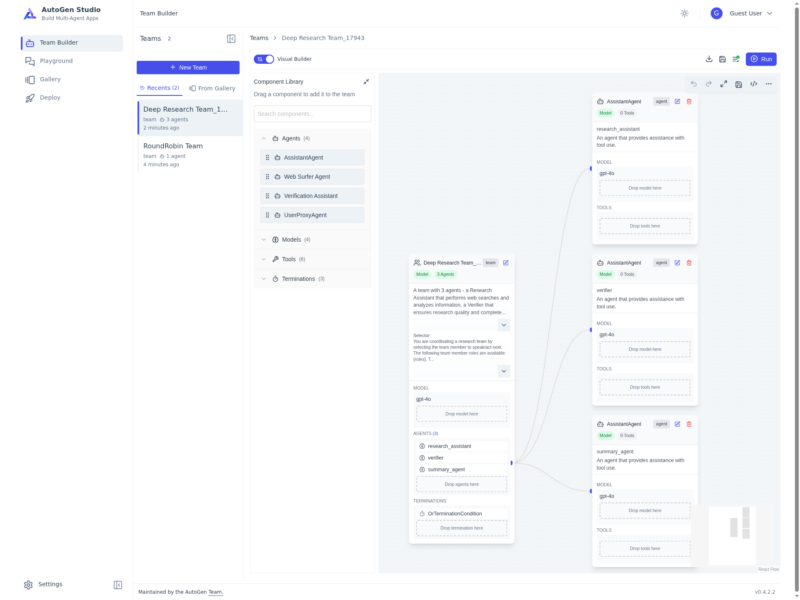
AutoGen Studio is the no-code face of the framework: pip install autogenstudio then autogenstudio ui opens a builder where agents, models, tools and termination conditions are dragged onto a canvas, a team is saved, and the Playground runs it with the full conversation on screen. AutoGen Bench runs benchmark tasks across agent configurations and reports success rates, so two team designs can be compared on numbers instead of impressions.
Requirements
Python 3.10 or later. The current install is pip install -U "autogen-agentchat" "autogen-ext[openai]"; Studio needs its own package. Any endpoint that speaks the OpenAI chat-completions API can drive a team, so a local runtime such as Ollama or vLLM is enough to experiment without a cloud account — and because the framework runs as ordinary Python processes, it installs on Linux, macOS and Windows alike.
The code is MIT licensed; the CC-BY-4.0 file in the repository root covers the documentation, not the software.