ProjectSend
- Platform
- Docker Web
- Licence
- GPL-2.0-or-later Open source
- Website
- projectsend.org/
- Source code
- github.com/projectsend/projectsend
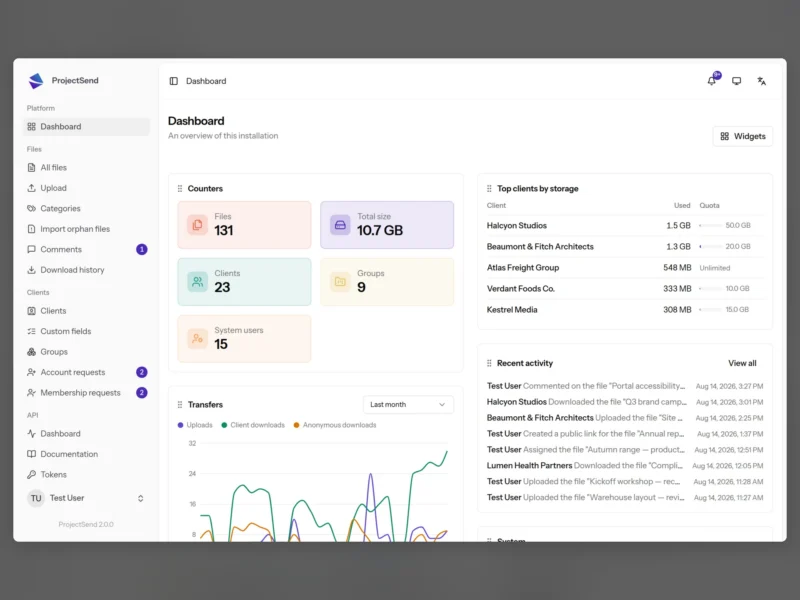
ProjectSend is a self-hosted client file-sharing application: you upload what you want to send, decide exactly who may see it, and each client signs in to their own private page to download it. There is no public link passed around by email, no third-party service holding your clients’ documents and no per-seat pricing — the files stay on your server. It is written in PHP, has been developed in the open since 2011, and the current release is 2.8.1 (November 2026).
What the client sees
- A private area per client — each person signed in sees only what has been shared with them, not a common dumping ground.
- Email sign-in with optional two-factor authentication, and per-client accounts that an administrator creates or that arrive through an account request form.
- Search, filter and sort across their own files, then download one file, several at once as a zip, or a whole folder.
- Comments on individual files, so questions sit next to the thing they are about instead of in a separate email thread.
- Email notifications when something new arrives, in the reader’s own language — the interface ships in 16 translations.
What the administrator gets
- Resumable uploads that survive a dropped connection, which is what makes multi-gigabyte deliveries actually arrive.
- Folders, categories and client groups to organise the library, and sharing with one client, a whole group or publicly, with an expiry date or a download limit per share.
- Thumbnails and previews for images and documents, so a client can recognise a file before downloading it.
- Per-client storage quotas and custom fields for the details you need to keep on each client.
- A full activity log and download history — who received what, and when.
Running it
ProjectSend requires PHP 8.4 or newer with MySQL or MariaDB. Two install paths are documented: a Docker image (projectsend/projectsend, tag 2.8.1) with a Compose file that brings up the web application and its database, or the zip release dropped onto an existing web server. With Docker the first visit shows a setup screen that creates the administrator account, or the credentials can be seeded from environment variables. Files can live on local disk, in an S3-compatible bucket such as MinIO or Backblaze B2, or in Google Cloud Storage. For teams, sign-in can go through LDAP or a social provider instead of local passwords, roles and permissions are granular enough that an uploader need not be an administrator, and a REST API with scoped tokens and generated OpenAPI documentation is available for automation. Privacy tooling includes GDPR-style account erasure with a grace period.
Open core, and the hosted version
The software is licensed GPLv2 or later; a commercial licence is offered for organisations that need to embed it in a closed-source product, white-label it, or obtain warranties. The same team also runs ProjectSend Cloud, a hosted service, and publishes the line between the two: client accounts and groups, assignment and expiration, client uploads, download tracking, categories and folders, themes and branding, two-factor authentication, role-based permissions, S3-compatible storage, public links, translations and the extension API are all in the free core, while billing, provisioning, managed backups, infrastructure monitoring, managed email deliverability and cross-organisation administration belong to the hosted offering. Self-hosting to share files with paying clients carries no obligation to publish anything, because running the software on your own server is not distribution.
Compare it with PlikShare for a storage-agnostic workspace with per-storage encryption, SkySend for zero-knowledge single links, or Sharry for a smaller two-direction sharing tool. The full directory is at all tools.