Perl
- Platform
- Linux Windows macOS
- Licence
- Artistic or GPL (dual-licensed) Open source
- Website
- perl.org/
- Source code
- github.com/Perl/perl5
Overview
Perl is a general-purpose programming language created by Larry Wall and first released in 1987, built from the start for the job it still does best: reading text and turning it into something useful. Its regular-expression engine, hashes and list handling made it the standard tool for system administration and log processing through the 1990s, and it has never stopped being maintained — the language ships a new stable release every year, with 5.44.0 the current version on perl.org. Perl 5 is dual-licensed under the Artistic License and the GPL, runs on more than a hundred platforms, and carries an archive of third-party modules, CPAN, that is still one of the largest in existence.
Key Features
- Regular expressions at the core — pattern matching, substitution and capture groups are part of the syntax rather than a library, and Perl’s regex engine is what most other languages’ engines were modelled on.
- CPAN — the Comprehensive Perl Archive Network holds tens of thousands of ready-made distributions, installed with
cpanm Module::Nameor the bundledcpanclient. - Practical data types — scalars, arrays and hashes are enough for most scripting work, and references compose them into arbitrary structures.
- Backwards compatibility — code written for Perl 5.8 usually still runs on 5.44, which is why large legacy codebases are still maintained rather than rewritten.
- Modern syntax where you want it —
use v5.36brings subroutine signatures,say, postfix dereferencing and lexicalsubs without giving up the older style. - Text processing built in — sorting, formatting with
printfandsprintf, report generation and one-liners withperl -peandperl -necover the everyday jobs of a shell script without a compile step. - Portable and embeddable — the interpreter runs on Unix, Linux, macOS, Windows (Strawberry Perl) and well over a hundred platforms, and can be embedded in other programs such as Apache through mod_perl.
- Proven test culture —
Test::Moreand the TAP protocol shaped how most of today’s test runners report results.
Why Use Perl?
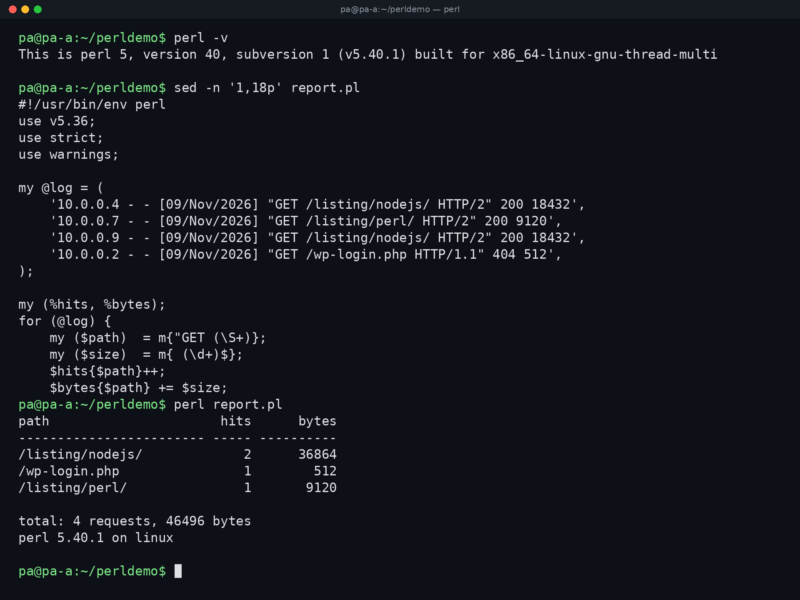
Perl is the shortest path from a messy text file to a correct answer. Where another language needs a parser, a data model and a build step, a twenty-line Perl script does the same job with a regular expression and a hash — and it runs everywhere a shell runs, with no deployment beyond the interpreter that is already installed. That is why decades of system tooling, monitoring probes, log pipelines and report generators are written in it, and why they keep working. CPAN adds what the core omits: database drivers, HTTP clients, JSON and YAML parsers, mail handling and scientific libraries, most of them maintained for as long as Perl itself. Its pragmas and taint checking also make it unusually well suited to scripts that handle untrusted input under strict and warnings.
Use Cases
- Log parsing, report generation and text transformation on servers.
- System administration, cron jobs, monitoring probes and deployment glue.
- One-liners that replace long
sed,awkandgreppipelines. - Bioinformatics and research pipelines built on BioPerl and CPAN’s scientific modules.
- Legacy web applications and CGIs, still commonly run through mod_perl or PSGI.
- Test harnesses and data munging between systems that speak different formats.
Getting Started
Perl is already installed on virtually every Linux and macOS system — check with perl -v, and on Windows install Strawberry Perl from perl.org. Read the language reference with perldoc perlintro and the module documentation with perldoc Module::Name. Start strict: use strict; use warnings; at the top of every file, and use v5.36 when you want signatures and say. Install modules from CPAN with cpanm (from App::cpanminus) rather than editing files by hand. Remember that Perl 6 became a separate language, Raku — this listing covers Perl 5, which is what perl installs.