Safebucket
- Platform
- Web Docker Linux
- Licence
- Apache-2.0 Open source
- Website
- docs.safebucket.io
- Source code
- github.com/safebucket/safebucket
Overview
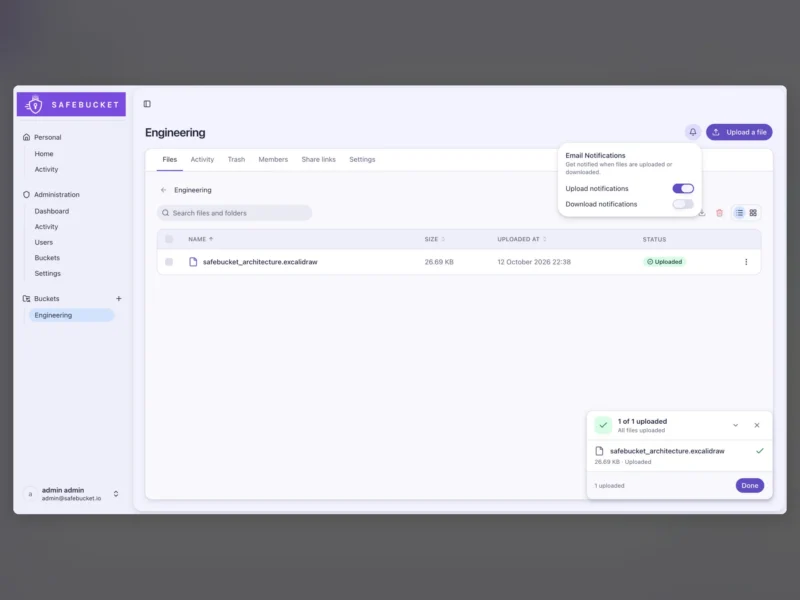
Safebucket is an open-source file sharing platform built so that file data never touches the application server. Uploads and downloads are passed straight to S3-compatible object storage through presigned URLs, while the Go API only manages metadata, permissions and audit logs. The interface is a React single-page app, and every layer underneath it — storage, database, event bus, cache, activity sink and notifier — can be replaced with a service you already run. Bring your own storage and your own identity provider; Safebucket handles buckets, access control and the paper trail.
Why files bypass the server
- Presigned upload and download URLs mean the application server never handles file bytes, so disk and bandwidth on the API host stay small even for large libraries.
- Storage backends are pluggable: AWS S3, Google Cloud Storage, MinIO, RustFS or any S3-compatible provider.
- Databases: PostgreSQL or SQLite. Events: NATS JetStream, AWS SQS or Google Pub/Sub. Cache: Redis, Valkey or in-memory. Activity logs: Loki or the filesystem.
- Published container images are signed with cosign using keyless signing through GitHub Actions OIDC, so a deployment can verify provenance instead of trusting a tag.
Sharing and collaboration
- Buckets act as the sharing boundary, with nested folders, rename support, a configurable upload size limit and time-limited presigned URLs for every transfer.
- Quick share publishes a file, folder or whole bucket through a public link; recipients need no account. Options include an expiry date, a maximum view count and password protection.
- Reverse share turns a folder or bucket link into an upload target for external people, with a maximum upload count and a per-file size limit — useful for collecting files without giving away write access.
- Redirect download links can be consumed from a terminal:
curl -OJLsaves the file under its original name, and password-protected shares authenticate once with a cookie. - In-browser previews cover images, video, audio, PDFs and text; multi-select bulk download bundles up to 100 files or 1 GB into a ZIP assembled client-side.
- Files can carry an expiration date at upload, and deletion is a soft delete into a trash with a configurable retention period (7 days by default) before automatic purge.
Access control, identity and audit
- Platform roles separate administrators, regular users (who create their own buckets) and guests (who only see buckets they were invited to).
- Bucket roles are owner, contributor and viewer, enforced at the API middleware on every request.
- SSO through any OpenID Connect provider, LDAP or Active Directory authentication, and local passwords for outside users — several providers can run side by side with per-provider domain restrictions.
- TOTP multifactor authentication works across all providers and can be enforced per provider; accounts can register more than one device.
- Invitations for external users use a challenge-based acceptance flow with attempt limiting and lockout.
- Activity tracking records logins, uploads, downloads, deletions and membership changes in searchable audit logs with date-range filtering, plus per-bucket views for owners and a system-wide dashboard for administrators.
Deployment
Ready-made templates cover a full Docker Compose stack (Safebucket, PostgreSQL, RustFS, Valkey, NATS, Loki and Mailpit), a minimal lite Compose file, an infrastructure-only dev setup for running the app from source, and Terraform modules for AWS that provision ECS Fargate, RDS, ElastiCache, S3, SQS and CloudWatch. Standalone Linux binaries for amd64 and arm64 ship with each release alongside their signatures. Two things to know before adopting it: the project is still pre-1.0 (v0.8.1, November 2026), and the lite stack needs an S3-compatible bucket to point at — when the instance is reached from another machine, the external storage endpoint, allowed origins, API URL and web URL have to be set in the environment file first.
Alternatives
- Nextcloud — a full collaboration suite with file sync, calendars, contacts and office editing, where Safebucket is deliberately narrower and link-sharing focused.
- ownCloud — the original self-hosted file sync platform, with desktop and mobile clients rather than a server-side storage bypass.
- Seafile — sync and share with built-in block-level deduplication and versioning, a different trade-off from pluggable object storage.