Haptic
AGPL-3.0
- Platform
- Web macOS Docker
- Licence
- AGPL-3.0 Open source
- Website
- haptic.md
- Source code
- github.com/chroxify/haptic
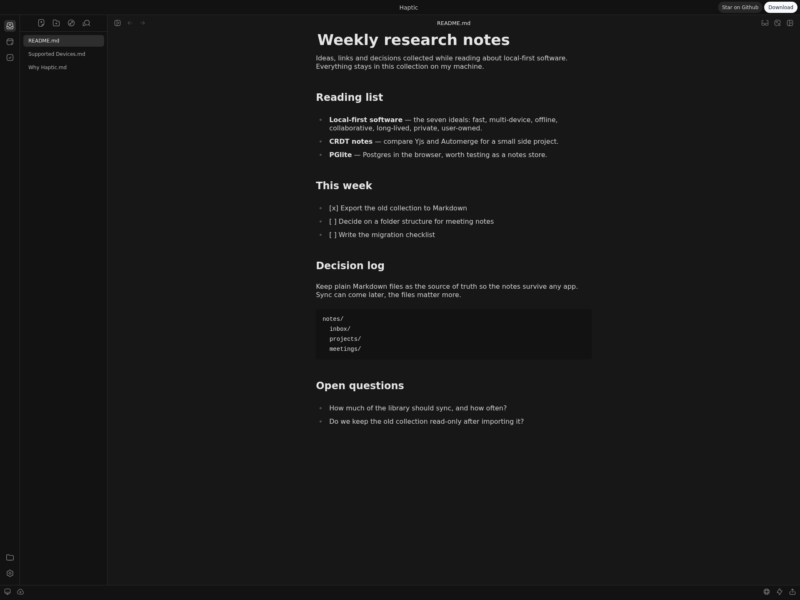
Haptic is a markdown notes app built around one idea: notes should live on your machine, not on someone else’s server. It ships as a Tauri desktop application and as a web app you can self-host, and it keeps everything in a local database rather than in a cloud account. The interface is deliberately sparse — a collection in the sidebar, one note in the middle, and very little else competing for attention.
A collection, not a database of secrets
- Notes are grouped into collections, which is Haptic’s name for a folder of markdown files — the sidebar lists the files in the open collection and nothing hidden behind a sync service.
- Editing is a rich markdown experience with headings, lists, checklists and code blocks rendered as you write, with the plain markdown underneath staying portable.
- Keyboard-first navigation: collections open from a shortcut, notes are created without leaving the keyboard, and the whole interface is built for long uninterrupted writing sessions rather than for dashboards.
Local-first by construction
- The desktop app stores data in a local Postgres-compatible database (PGlite) inside the application, so the notes work offline and nothing is uploaded anywhere.
- The web build runs the same Svelte frontend against PGlite in the browser, which means a self-hosted instance is a static app plus your own storage — no separate backend database to run.
- Because notes are markdown files in a collection, they remain readable and portable outside Haptic.
Running it
- Download the desktop build for macOS from the project site, or build it yourself from the Tauri source.
- Self-host the web version with one container:
docker run -d -p 3000:80 chroxify/haptic-web:latestand open port 3000 — the image is published on Docker Hub, and a one-click Vercel deployment is also documented for theapps/webworkspace. - Licensed AGPL-3.0, with the code developed in the open on GitHub.
Worth knowing before you commit
- Haptic is young and the roadmap is honest about it: cross-device sync, note and collection sharing, native mobile apps, and Windows and Linux desktop builds are all still listed as planned rather than shipped — macOS is the supported desktop platform today.
- There is no plugin ecosystem and no publishing pipeline. If you need wikilinks, graph views or a second brain with backlinks, this is not that app; it is a fast, clean editor for people who already know how they like to write.
- Because the web build keeps its database in the browser, treat a self-hosted instance as a per-browser library rather than a shared multi-user server.
Alternatives
- Joplin — markdown notes with sync, web clipper and end-to-end encryption
- Logseq — outliner with backlinks, journals and a graph view
- Standard Notes — long-lived encrypted notes across platforms
- Grimoire — local-first bookmark and reading library for technical material