ties
- Platform
- Linux Docker
- Licence
- AGPL-3.0-or-later (source); docs CC-BY-SA-4.0 Open source
- Website
- demo.ties.pub
- Source code
- github.com/raffomania/ties
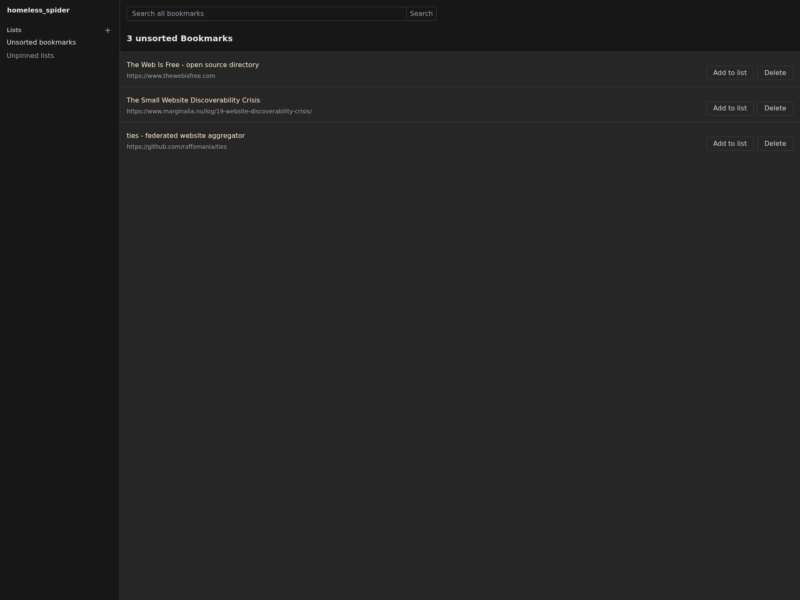
ties (formerly linkblocks) is a self-hosted, federated network for bookmarking, organising and sharing good web pages. Instead of handing your reading list to a commercial bookmark service, you run your own small corner of the web: keep the pages you like, sort them into lists, annotate them, and follow other people whose taste you trust so their finds show up in your feed.
The project is a single Rust binary (axum + htmx with server-rendered templates) backed by PostgreSQL, so deployment is one container plus a database. It speaks ActivityPub-style federation, which is what makes “follow a user and get their bookmarks” work across separate instances rather than inside one silo.
Key Features
- Bookmarks and lists — save any URL with the web form or the drag-to-toolbar bookmarklet, then group bookmarks into pinned and unpinned lists.
- Trust-based search — mark users as trusted and search across their bookmarks, optionally widening the net to users trusted by the people you trust.
- Following and feeds — follow users with similar taste and get a running feed of new pages instead of starting from an empty search box.
- Annotations and discussion — annotate, highlight and talk about pages together with other users.
- Public and private curation — share carefully curated or deliberately chaotic collections publicly, while keeping unsorted bookmarks to yourself.
- Small operational footprint — one binary, all assets baked in, integrated TLS if you want it, automatic database migrations on start, optional OIDC single sign-on.
Why Use It
Discovery on the open web has collapsed into a handful of feeds and search engines that reward the same pages. ties takes the opposite approach: curation by people, shared between instances. Because trust is transitive and explicit, a search over trusted bookmarks is closer to asking a well-read friend than to querying an index — and because the data lives on an instance you control, your reading list does not disappear with a product decision.
It is also refreshingly boring to run: no Node toolchain, no broker, no cache tier — a Rust binary and PostgreSQL, with the whole UI rendered server-side.
Use Cases
- Replacing Pocket, Raindrop or browser bookmarks with something you host and can export.
- Running a link blog or curated reading list for a community, with a real search over what the group has collected.
- Keeping a research trail of annotated sources that stays readable years later.
- Trying federation on a small, single-user scale before committing a community to it.
Things to Know
ties is explicitly in an exploratory, pre-1.0 phase: only single-user instances are supported, and the project warns that all data in the system should be considered publicly available — even bookmarks in private lists. Breaking changes are expected between minor versions, though database migrations run automatically on start.
Requirements
A PostgreSQL database plus the compiled binary, or the published container image ghcr.io/raffomania/ties with a BASE_URL and admin credentials set. Building from source needs a Rust toolchain (1.91 or newer).