Rangarr
- Platform
- Docker Linux
- Licence
- MIT Open source
- Website
- github.com/JudoChinX/killarr
- Source code
- github.com/JudoChinX/rangarr
Rangarr is a lightweight orchestration service that automates and staggers media searches across multiple *arr instances — Radarr, Sonarr, Lidarr, Readarr, Whisparr v2 and Whisparr v3 — from a single container. Rather than letting every app fire its own searches at the same moment, it hands out a global pool of search slots, interleaves the instances and spaces requests out over time, so your indexers and API limits are never hammered.
Key Features
- Multi-instance support — one service drives Radarr, Sonarr, Lidarr, Readarr, Whisparr v2 and Whisparr v3.
- Global slot allocation — search capacity is pooled across all instances, so no search slot is wasted.
- Instance interleaving and smart staggering — requests rotate between instances and are spaced out, avoiding the thundering-herd effect against shared indexers.
- Proportional interleaving and weighted distribution — balances missing-item searches against upgrade searches inside each instance, and lets you weight one instance above another (for example, movies over music).
- Season pack support — groups Sonarr and Whisparr v2 searches by season, with configurable count or ratio thresholds and automatic fallback to individual episodes for seasons that are still airing.
- Independent scheduling — missing-item and upgrade searches run on separate intervals, so you can poll for missing content aggressively while checking for upgrades less often.
- Retry logic — configurable skip windows for recently searched items, independent retry intervals for missing and upgrade searches, and startup connection retries to absorb Docker Compose race conditions.
- Custom format score awareness — finds Radarr, Sonarr and Whisparr items sitting below their custom format score target, the candidates the *arr Cutoff Unmet endpoint silently omits.
- Tag filtering, active-hours windows and a queue limit — restrict searches to tagged items, run only inside set hours (cross-midnight windows included), and pause when the download queue is already busy.
Why Use It
Once a library moves past a few hundred titles, the bottleneck stops being storage and starts being indexer quota. Every *arr app wants to search its own missing list on its own schedule, and the result is a burst of requests at startup, rate limits, and long waits for the items you actually wanted. Rangarr removes that coordination problem: it reads the wanted lists from each instance, merges them into one queue, and releases searches at a pace you define — one every N seconds, N per cycle, in the order that has gone longest without a search.
Use Cases
- Shared indexers across several apps — one Prowlarr-backed indexer set feeding Radarr, Sonarr and Lidarr without tripping API limits.
- Large, slow-to-complete libraries — chip away at a big backlog of missing items a few searches per cycle instead of a nightly stampede.
- Upgrade hunting on a budget — keep upgrade searches on a slower cadence than missing searches, or weight the movie instance above music.
- Overnight-only searching — restrict all activity to an active-hours window and leave the indexers quiet during the day.
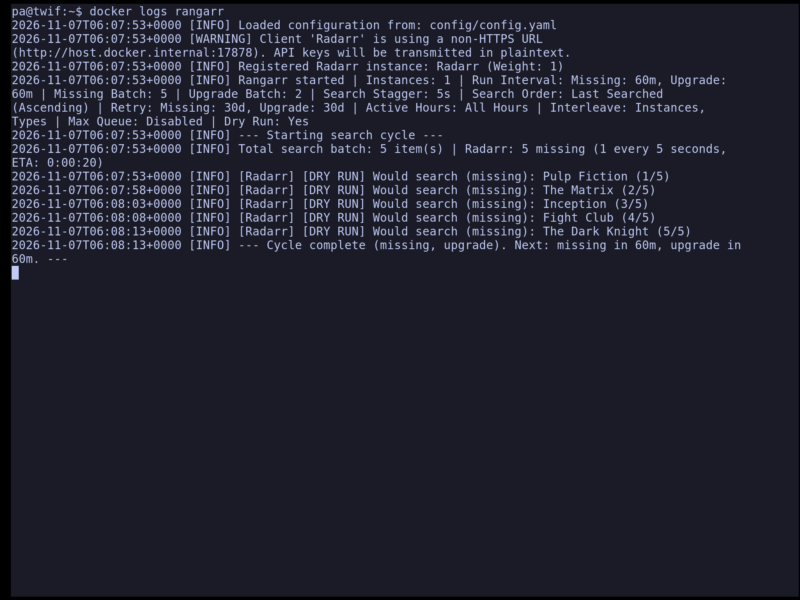
Configuration is a single config.yaml or a set of RANGARR_* environment variables, and there is no database to persist. There is no web dashboard either — the service is operated through its structured logs, which report the batch plan and each search as it is released.
Licence
MIT — free and open source, self-hosted in your own Docker environment.