Profilarr
- Platform
- Docker Linux Web
- Licence
- AGPL-3.0 Open source
- Website
- dictionarry.dev
- Source code
- github.com/Dictionarry-Hub/profilarr
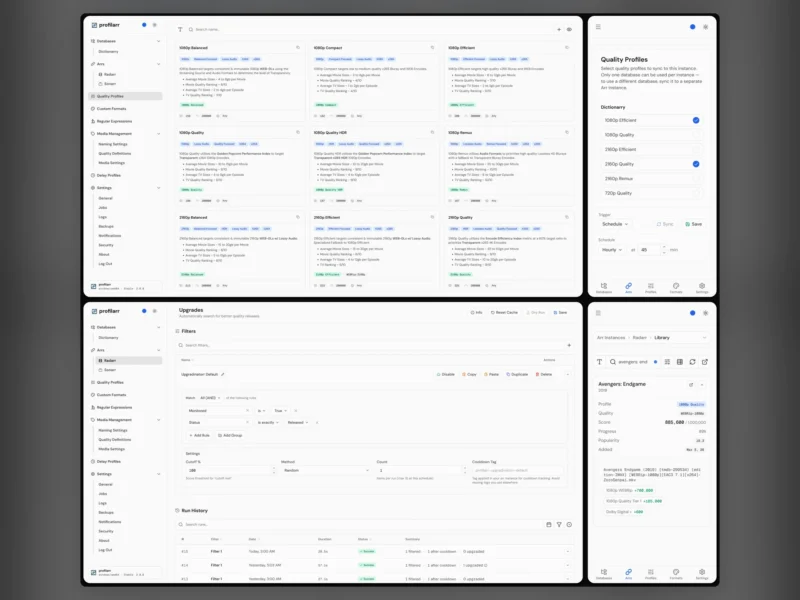
Overview
Profilarr is a configuration management platform for Radarr and Sonarr. Instead of hand-editing quality profiles and custom formats in each Arr’s web interface — and hoping the two instances stay in step — you build the configuration once in Profilarr, test it, and deploy it to as many Arr instances as you run.
It is a TypeScript application shipped as a Docker image, with a web UI organised around three verbs: build, test, deploy. Databases of ready-made quality profiles and custom formats (Dictionarry, TRaSH Guides, Dumpstarr) can be linked and kept current, or you can maintain your own. Testing happens before anything touches a server, and deployment covers sync, automated upgrades, bulk renames and scheduled jobs. Local tweaks survive upstream updates, so an imported database does not overwrite your deliberate changes.
Key Features
- Link curated databases: connect to Dictionarry, TRaSH Guides or Dumpstarr as sources of quality profiles, custom formats and media management settings, and pull updates as they are published.
- Build your own: create a private database from the PCD template and share it with your own instances; local tweaks persist across upstream updates with conflict handling.
- Quality profiles: group and order qualities and score custom formats per application.
- Custom formats: match releases by resolution, source, release group, size, language and more, with reusable regular expressions shared across formats.
- Media management and delay profiles: naming conventions, media settings, quality definitions, protocol preferences, delays and score gates.
- Test before deploying: regular expressions can be validated against embedded Regex101 test cases, custom formats can be tested against real releases with a breakdown and match visualisation from a parser that mirrors Radarr and Sonarr’s own parsing logic, and a profile can be simulated against a film or series to see what it would score and pick.
- Sync to any number of Arrs: push profiles, formats and settings to multiple Radarr and Sonarr instances, with per-instance schedules.
- Automated upgrades: searches with configurable filters, selectors, cooldowns and methods, with a run history that records what each pass did.
- Bulk rename with dry run: preview file and folder renames before applying them.
- Scheduled jobs and notifications: sync, upgrades, renames, backups and cleanup on a schedule, reporting to Discord, Telegram, Slack, ntfy, Pushover, Gotify, Apprise or a generic webhook.
Why Use Profilarr
Quality profiles and custom formats are the part of a media stack that is easiest to get subtly wrong and hardest to keep consistent. Every hand-edited change in one Arr drifts the moment a second instance, a TRaSH Guides update or a new release group appears. Profilarr treats that configuration as code: one source of truth, tested against real release names, deployed to every instance, and diffable when something changes. The dry runs and the test views matter more than the convenience — you can see what a profile would choose for a specific title, and what a rename would do, before any of it is applied to a library.
Typical Uses
- Running several Radarr and Sonarr instances (4K and 1080p, or films and TV) from one set of profiles instead of three diverging copies.
- Adopting TRaSH Guides custom formats without rebuilding them by hand in each Arr.
- Rolling out a scoring change to every instance at once and keeping a record of what changed.
- Auditing why a particular release was grabbed by simulating a profile against it.
- Bulk-renaming a library with a dry-run preview first.
- Scheduling recurring upgrades with filters and cooldowns so the stack keeps chasing better copies without hammering indexers.
Getting Started
Profilarr v2 runs as a container: ghcr.io/dictionarry-hub/profilarr:latest for linux/amd64 and linux/arm64, publishing port 6868 and mounting /config. Environment variables are PUID, PGID, UMASK, TZ, PORT, HOST and AUTH (login on by default; off or OIDC are the alternatives), plus ORIGIN when you reach it through a reverse proxy. Custom format and profile testing needs a second small service, ghcr.io/dictionarry-hub/profilarr-parser, exposed on port 5000 — everything else works without it. Tag latest/2 track stable, develop is the pre-release channel. Supported Arr versions are Radarr v5 and v6 and Sonarr v4 (v5 is experimental). The host needs a Linux kernel of 3.17 or newer, so Synology DSM’s 3.10 kernel is not supported by v2. After first start, open http://localhost:6868, add your Arr instances with their API keys, link a database, and sync a single profile before deploying the rest.
Licence
Free and open source, licensed under the GNU Affero General Public License v3.0 (AGPL-3.0); the full text is in the repository’s LICENSE file.