Jackett
- Platform
- Docker Linux macOS Windows Web Self-hosted
- Licence
- GPL-2.0 Open source
- Website
- github.com/Jackett/Jackett
- Source code
- github.com/Jackett/Jackett
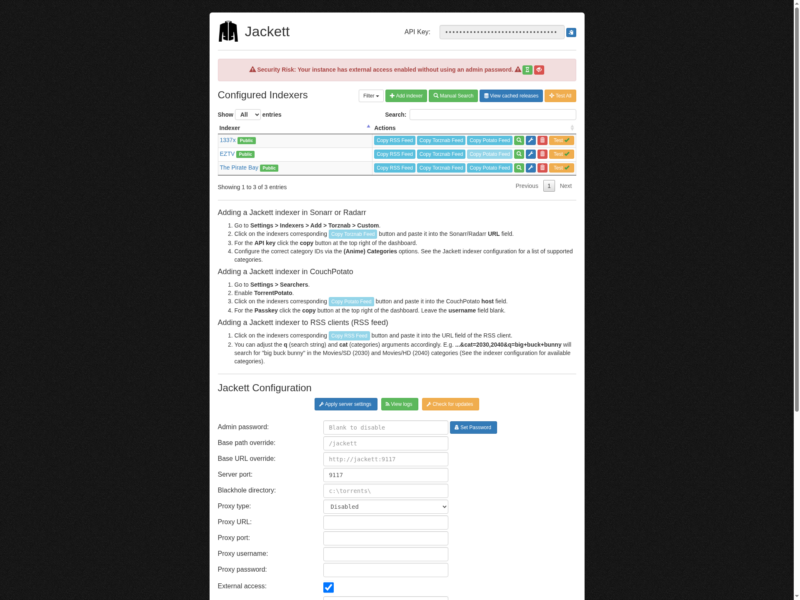
Overview
Jackett is a proxy server that lets your media automation stack talk to torrent trackers it has no native support for. Applications such as Sonarr, Radarr, Lidarr, Readarr, Mylar3, CouchPotato and SickRage send their normal search queries to Jackett, which translates them into site-specific HTTP requests for each tracker, parses whatever comes back (HTML or JSON), and returns the results in a standard format the requesting app already understands. Written in C# on .NET and licensed GPL-2.0, it is one of the oldest and most widely deployed pieces of the self-hosted media stack: the tracker scraping logic lives in one place instead of being rewritten inside every downloader.
Key Features
- Torznab and TorrentPotato APIs: the two interfaces Sonarr, Radarr, Lidarr, Mylar3, CouchPotato and similar apps expect, so Jackett exposes every configured tracker as a normal indexer.
- A single maintained indexer repository: hundreds of tracker definitions for public, semi-private and private sites, updated centrally instead of in each client. Adding a tracker means picking it from a list, not writing a scraper.
- Search across many trackers at once: individual indexers can be queried, or several wrapped in an aggregate indexer so a single search hits a whole group and the results are merged.
- Recent releases as feeds: every indexer exposes an RSS feed of the newest uploads, usable by downloaders and feed readers that do not speak Torznab at all.
- Built-in web interface: a dashboard on port 9117 for adding indexers, copying Torznab or Potato feed URLs, running manual searches, viewing cached releases and testing indexers in bulk.
- Caching: configurable search and Torznab caches cut repeat hits on trackers that throttle or ban aggressive querying, which matters on private sites with hit-and-run and ratio rules.
- Cloudflare handling: optional FlareSolverr integration clears the browser-check challenge that blocks many trackers when they are scraped from a server.
- Portable: official binaries for Windows, Linux (x64, ARMv7 and ARMv6) and macOS, plus a widely used container image for Docker, Podman and NAS platforms.
How It Works
- You add a tracker in the Jackett dashboard and give it whatever credentials that site needs (passkey, cookie or username and password).
- Jackett verifies the indexer with a test search and shows the Torznab URL and API key for it.
- You paste that URL and key into Sonarr, Radarr or another client as a Torznab indexer.
- When the client searches, Jackett queries the tracker, parses the results and returns them as standard Torznab XML, so the client treats the tracker exactly like a built-in indexer.
Use Cases
- Giving Sonarr and Radarr access to private trackers that have no native integration in those apps.
- Centralising tracker credentials and scraping logic on one host instead of spreading it across several downloaders.
- Feeding a torrent client or RSS reader with recent uploads from a set of trackers.
- Running a single search across dozens of trackers from one web page when hunting for an obscure release.
Things to Know
- Jackett is an indexer proxy, not a downloader: it returns search results, and a client such as qBittorrent, Transmission or Deluge still does the transfer.
- Some trackers forbid automated access or require you to keep the hit rate low. The caches and per-indexer settings exist for that reason, and site rules still apply.
- For stacks built purely around Sonarr and Radarr, Prowlarr covers much of the same ground with tighter native integration; Jackett remains the broader option because it also serves older and non-arr clients.
- The container image is the easiest deployment path; the web interface and API key are served over plain HTTP, so expose it on a trusted network or put it behind a reverse proxy that adds authentication.
Licence
Jackett is free and open source software under the GNU General Public License v2.0. The full source and release binaries are published on GitHub.