Decypharr
- Platform
- Docker Linux macOS Windows Web Self-hosted
- Licence
- MIT Open source
- Website
- docs.decypharr.com
- Source code
- github.com/sirrobot01/decypharr
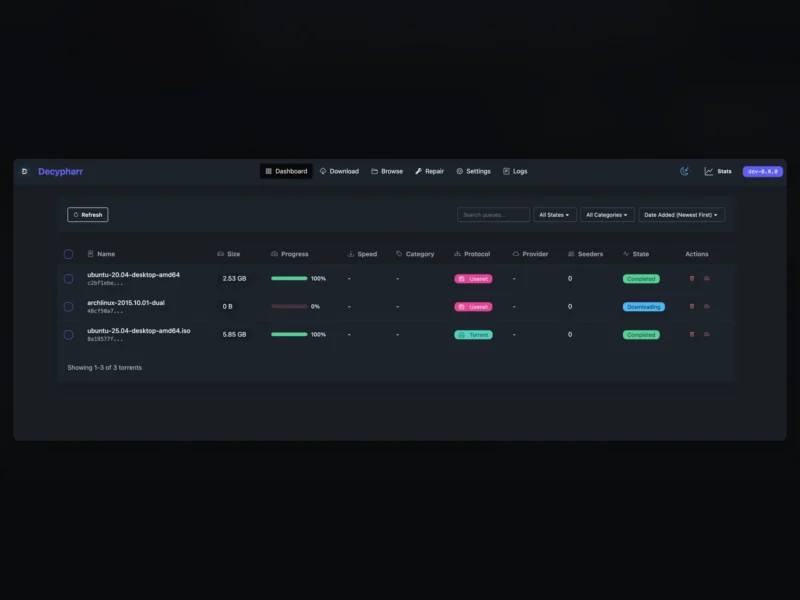
Overview
Decypharr is a media gateway for Debrid and Usenet, written in Go. It sits between your media automation stack (Sonarr, Radarr, Lidarr and friends) and a cloud source, so those apps keep talking to the qBittorrent or SABnzbd API they already know while the actual bytes come from somewhere else. Instead of downloading releases to local disk, Decypharr hands torrents to a Debrid provider or streams Usenet content over its own NNTP connection, then exposes the result as a mounted filesystem your media server can read directly.
Key Features
- Drop-in Arr compatibility: mocks both the qBittorrent and the SABnzbd API, so an existing Sonarr/Radarr/Lidarr setup only needs the host and port pointed at Decypharr.
- Multiple providers behind one interface: Real-Debrid, TorBox, Debrid-Link, AllDebrid and Premiumize, with several accounts load-balanced side by side.
- Direct Usenet streaming: processes NZBs over an NNTP connection of its own, with no separate Sabnzbd or NZBGet instance in the chain.
- Flexible mounting: an internal DFS virtual filesystem, embedded or external rclone, or WebDAV. Read-only NFSv4 and SMB servers expose the same libraries to other machines, including custom virtual folders.
- Auto-repair worker: scans the library and re-fetches broken links, expired downloads and missing files.
- Web interface: a dashboard with live download queues, a file browser, a repair view, settings and logs on port 8282.
How It Works
- The Arr application sends a torrent or an NZB to Decypharr, exactly as it would to qBittorrent or SABnzbd.
- Decypharr forwards torrents to your Debrid provider, or pulls the Usenet release itself over NNTP.
- The provider library, or the NNTP stream, becomes a mounted remote filesystem.
- Plex, Jellyfin or Emby reads it as if the files were local, and playback can begin before a release has fully transferred.
Use Cases
- Media automation on small disks or NAS boxes where keeping full releases locally is not practical.
- Debrid subscribers who want their existing Arr stack to use that subscription without changing download clients.
- Hybrid setups that mix Debrid for torrents and Usenet for releases in the same queue.
Requirements and Caveats
Decypharr is the bridge, not the source: it needs at least one Debrid subscription or a Usenet provider with NNTP access, and those are paid services. The recommended deployment is the Docker image cy01/blackhole, which asks for /dev/fuse and SYS_ADMIN so it can mount. Standalone binaries are published for Linux (x86_64 and arm64), macOS (Intel and Apple silicon) and Windows. Configuration lives in a config.json placed next to the binary or in the mapped /app directory.
Alternatives
- qBittorrent — open source BitTorrent client that downloads to local storage instead of streaming from a Debrid service.
- Jellyfin — open source media server to pair with the Arr stack for playback.