Open-Source Civilization Alternatives: Freeciv vs Unciv vs FreeCol
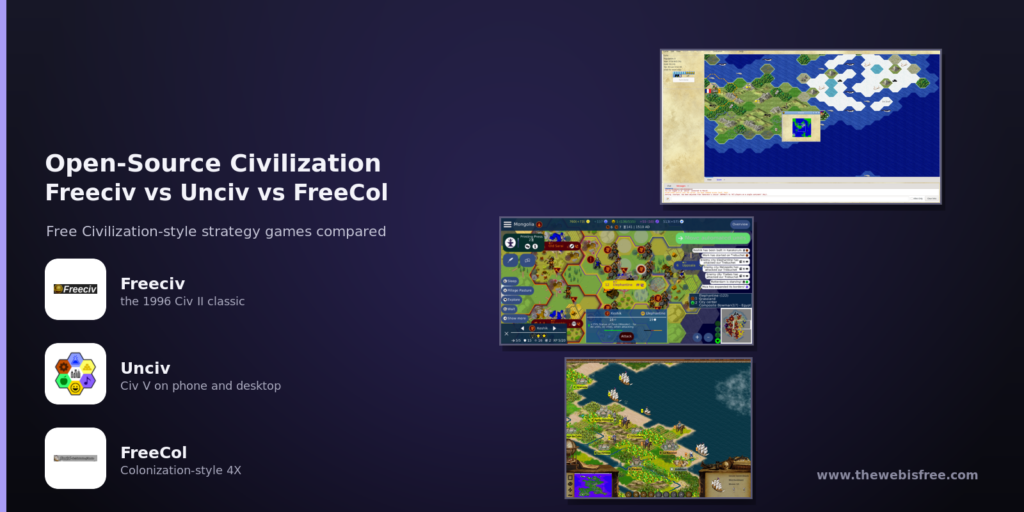
Civilization is one of the few game series that open source has cloned, remade and reimagined rather than merely imitated. Three projects in our directory carry that torch, and they arrive from three completely different directions: Freeciv is the original free remake, a Civilization II-style game that has been in continuous development since 1996; Unciv is a modern Civilization V-style remake built mobile-first in Kotlin; and FreeCol takes the same engine philosophy to Sid Meier’s Colonization instead. All three are free software, none of them has an ad, a store or a subscription, and all three are still being worked on. Here is how they actually differ.
The Three Contenders at a Glance
- Freeciv — the veteran: a Civilization II-style empire builder with the biggest nation roster and the deepest multiplayer tradition, stable release 3.2.6 (4 September 2026).
- Unciv — the modern one: a Civilization V-style 4X written in Kotlin, designed for phones first, release 4.22.10 (13 October 2026).
- FreeCol — the sibling: not a Civilization clone at all but a faithful open-source remake of Sid Meier’s Colonization, stable release 1.2.0.
In one sentence: Freeciv is the most complete and most moddable, Unciv is the one you will actually finish a game of on the train, and FreeCol is the one to install if you loved Colonization rather than Civilization.
Freeciv — The 1996 Classic That Never Stopped
Freeciv began in 1996 as a collaborative effort to build a free Civilization-style game, and it is officially described by its own project as “a Free and Open Source empire-building strategy game inspired by the history of human civilization”. Its default ruleset deliberately follows Civilization II, so anyone who played the 1996 original will recognise the city screen, the technology tree and the tax/luxury/science sliders immediately — but the project has kept moving, with the stable series now on 3.2.x and a security and bugfix release, 3.2.6, landing on 4 September 2026.
- Scale: the standard nation set is enormous — the project’s own documentation counts more than 550 playable nations and over 50 unit types, each nation with its own city-name list and flag.
- Multiple rulesets: Freeciv ships the classic Civilization-style ruleset and supports community rulesets that change units, technologies and the whole shape of a game; ruleset tooling is part of the project.
- Multiplayer as a first-class mode: the game is built around a separate server process, so LAN and internet games, hosted servers and AI-filled slots all come for free — and the longturn community plays games where a single turn arrives per day, lasting months.
- Multi-client: GTK+, Qt and SDL desktop clients share the same server, and Freeciv-web is an HTML5/WebGL client that runs the whole game in a browser with no installation.
- Platforms: Windows, macOS and Linux (official builds), plus a wide range of UNIX-like systems through distribution packages.
- Licence: GPL-2.0-or-later — code and rules included, freely redistributable.
The trade-off is presentation. Freeciv is a 2D, isometric, deliberately unglamorous game: it looks like Civilization II because it is trying to play like Civilization II, and the interface is dense with information rather than streamlined. That is a feature for a certain kind of player — nobody else gives you this much simulation for free. Download Freeciv — full details are on our Freeciv listing.
Unciv — Civilization V in Your Pocket
Unciv is a different proposition entirely. Written in Kotlin on the LibGDX engine by Yair Morgenstern and a large community of contributors, it is an open-source reimplementation of Civilization V that was designed for Android first and desktop second. It is fast, small, ad-free and genuinely free — and at 4.22.10, released on 13 October 2026, it is also one of the most actively released games in the whole directory.
- Familiar rules: the Civ V formula — hex tiles, one unit per tile, city-states, culture, great people, social policies, city expansion — reimplemented from scratch, with the base ruleset covering the Civilization V civilisation roster and its leaders.
- Mobile-first design: simplified 2D graphics and a touch-friendly UI mean it runs smoothly on old phones and low-power laptops where a commercial 4X would crawl.
- Multiplayer: built-in network multiplayer over the internet or a LAN, driven by the project’s own UncivServer, with turn-based games you can pick up and put down.
- Modding in the game: a mod library you browse and install from inside the app — custom rulesets, units, technologies, maps, nations and full scenarios — plus the ability to build your own.
- Everywhere Java runs: Android (Google Play and F-Droid), Windows, Linux, macOS, Raspberry Pi, and any platform with a Java runtime via the standalone
.jar. - No strings: no ads, no in-app purchases, no DRM, no account, no telemetry — and 11,000+ stars on GitHub, which makes it one of the most popular open-source strategy games in existence.
- Licence: Mozilla Public License 2.0 (MPL-2.0).
The honest caveat: Unciv is a reimplementation, not a port. It plays like Civ V rather than being Civ V — the AI is weaker than Firaxis’s, the art is minimal, and some systems are simplified. What you get in exchange is a complete 4X that installs in seconds, weighs almost nothing and plays perfectly with one thumb. Download Unciv — see also our Unciv listing.
FreeCol — The Colonization Cousin
FreeCol is the odd one out, and deliberately so. It is not a Civilization clone: it is a free, open-source remake of Sid Meier’s Colonization (1994), the game about founding colonies in the New World, trading with Europe and the indigenous nations, and eventually declaring independence. It has been developed by its community for over two decades and its current stable release is 1.2.0.
- Colony economy: buildings, production chains, food, trade goods and inter-colony trade routes — the economic layer is deeper than Civilization’s and is the heart of the game.
- Diplomacy and the natives: negotiate, trade or fight with the other European powers and with the indigenous nations of the New World.
- Founding Fathers: earn liberty bells to attract historical figures that grant national bonuses, the system Colonization is remembered for.
- Seven playable powers: English, Dutch, French, Spanish, Portuguese, Swedish or Russian colonies, each with its own advantages.
- Single-player, hotseat and multiplayer: configurable AI opponents, local hotseat play and network games, including mid-game join.
- Built-in Colopedia and mod support: an in-game encyclopedia plus a map editor and scenario/mod loading.
- Platforms and licence: Java, so it runs wherever a Java runtime does; GPL-2.0.
If you have never played Colonization, FreeCol is a genuinely different kind of empire game — one about trade and independence rather than conquest. It is also the slowest-moving of the three, so treat it as a stable, finished-feeling classic rather than a game that will surprise you with updates. Details are on our FreeCol listing.
Scope and Civilisations
Freeciv wins on raw scale. More than 550 nations, 50-plus units, several rulesets and a world that can carry over a hundred players (the browser version advertises up to 500) add up to the biggest free empire game available. Unciv is smaller by design: it reproduces the Civ V roster rather than inventing one, and its growth comes from mods rather than from a sprawling nation list. FreeCol is smaller again in scope but deeper per colony — fewer decisions, each with more consequences.
None of the three has a story campaign in the modern sense. This is sandbox 4X: start a game, choose a map, choose opponents, and play until somebody wins.
AI Opponents
All three ship computer opponents and all three let you fill the map with them.
- Freeciv: the server spawns AI civilisations into empty slots, and its AI is competent at building an economy, expanding and raiding — long established, if predictable at the highest level.
- Unciv: the AI is the weakest of the three and is honest about it; the game’s strength is the human-versus-human and casual single-player experience, not a chess-engine opponent.
- FreeCol: configurable AI European powers and native nations that trade, negotiate and go to war, tuned for the colony economy rather than for warfare.
If you want a hard opponent, Freeciv is the best of the three; if you want a game you can play in an hour without thinking too hard, Unciv’s lighter AI is a feature, not a bug.
User Interface, Platforms and Mobile
This is where Unciv pulls ahead decisively. Freeciv is desktop software: GTK+, Qt and SDL clients with mouse-driven, information-dense screens, and a browser client (Freeciv-web) that makes it playable on a tablet or phone but never feels native there. Unciv was built for touch — large tap targets, one-thumb scrolling, a UI that scales from a phone screen to a desktop monitor, and native builds for Android, Windows, Linux, macOS and Raspberry Pi from one Kotlin codebase. FreeCol sits in the middle: a Java desktop application with a conventional Swing interface that runs on any platform with a Java runtime, including older machines.
- Best on a phone: Unciv, by a wide margin.
- Best on a desktop: Freeciv, for depth and configurability.
- Runs on anything with Java: Unciv and FreeCol.
Multiplayer and Modding
Freeciv’s multiplayer is the most mature: a dedicated server model that supports LAN and internet games, hosted servers, AI-filled slots and even longturn games where one turn is played per day. Unciv’s network multiplayer is newer but works well — it runs through the project’s own UncivServer, and games can be picked up and put down like a mobile game should be. FreeCol supports network play and local hotseat, with mid-game joins.
Modding is a strong suit for all three, in different ways:
- Freeciv: rulesets and tilesets are the core of the project. Units, technologies, buildings and entire game flows are data, scriptable with Lua — you can build a different game on the same engine.
- Unciv: the friendliest modding story of the three, because the mod library is inside the game. Browse, install and switch rulesets without leaving the app, and share your own creations with everyone.
- FreeCol: scenarios and maps, with a map editor bundled and a community of custom content.
Licence and Cost
- Freeciv — GPL-2.0-or-later; Windows, macOS, Linux and UNIX-like systems, plus the browser client.
- Unciv — MPL-2.0; Android, Windows, Linux, macOS, Raspberry Pi and any Java runtime.
- FreeCol — GPL-2.0; any platform with a Java runtime.
There is no freemium tier, no in-game store, no advertising and no account requirement in any of the three. You can copy, modify and redistribute every one of them, and all three are packaged by the major Linux distributions.
How to Choose
- You grew up on Civilization I or II and want that game, for free: Freeciv.
- You want Civilization V-style 4X on your phone: Unciv.
- You loved Colonization rather than Civilization: FreeCol.
- You want to play with friends on a hosted server for months: Freeciv, and its longturn community.
- You have an old laptop or a cheap Android tablet: Unciv — it is the lightest of the three by a wide margin.
- You want to mod or build your own 4X: Unciv’s in-game mod library first, then Freeciv’s rulesets for real engine-level work.
The Bottom Line
These three are not competing for the same evening, which makes the recommendation easy. Unciv is the one to install first: it is free, it is tiny, it runs on the phone in your pocket and on the laptop on your desk, and it gives you a complete Civilization V-style 4X with mods and multiplayer inside the app. Freeciv is the one to install when you want the real thing done properly — the biggest nation roster in free software, rulesets you can rewrite, a mature server for long games and nearly thirty years of accumulated design. FreeCol is the specialist pick: install it if the words “Sid Meier’s Colonization” mean something to you, because nothing else fills that gap. Play Unciv on the commute, keep Freeciv for a proper weekend campaign, and keep FreeCol for when you want to build a colony rather than an empire.
Browse the rest of our Games category — including the full directory of free and open source tools — or read 0 A.D. vs OpenRA vs Warzone 2100 — Best Open-Source RTS Compared and Open-Source Minecraft Alternatives: Luanti vs Veloren (and More) for more open-source gaming. If we are missing a project you love, submit a tool and we will take a look.