Open-Source Minecraft Alternatives: Luanti vs Veloren (and More)
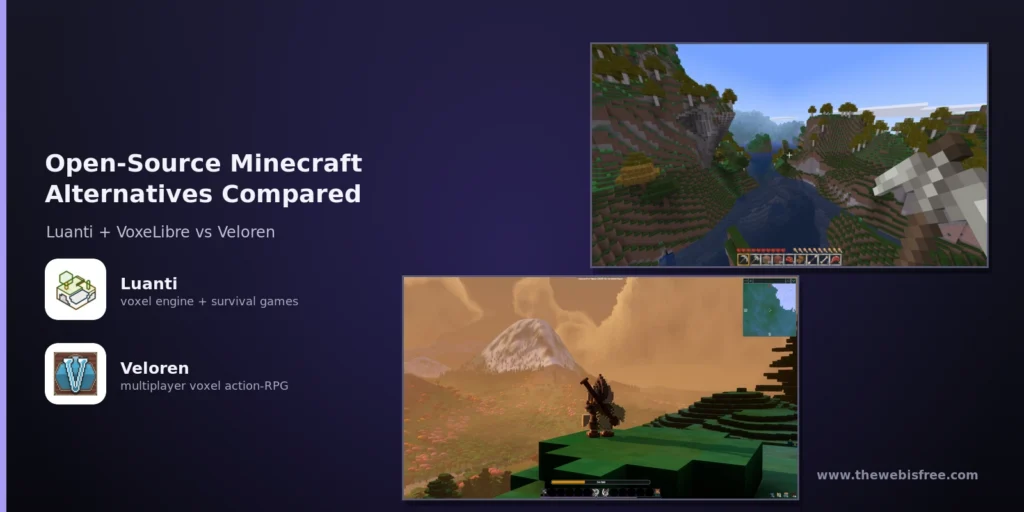
Minecraft has been the gateway to blocky gaming for well over a decade, and it is still the game every voxel sandbox gets measured against. But if you would rather build, mine and explore on software you can run, audit, modify and host yourself, the open-source world has two genuinely different answers: Luanti, an engine that runs Minecraft-like games such as VoxeLibre, and Veloren, a voxel action-RPG built from scratch in Rust. Here is how they compare, what each one is actually good at, and which one belongs on your machine.
Two Very Different Ways to Replace Minecraft
The open-source alternatives fall into two camps, and knowing which one you want saves a lot of downloading.
- Engine first — Luanti is a voxel engine, not a game. You install the engine, then pick a game to run on it from the built-in content browser: VoxeLibre for a Minecraft-style survival experience, Mineclonia for a stability-and-multiplayer-focused variant, or something completely different. The same engine doubles as a multiplayer server.
- Game first — Veloren and Terasology are single projects with their own art direction and design goals. You download the game, you play the game, and the world is whatever the developers built.
Neither camp is a drop-in replacement for Minecraft Java Edition. Mods, resource packs and Realms subscriptions do not carry over. What you get instead is software under a free licence that runs on Windows, macOS, Linux and often Android — and that you are free to host for your friends without paying for a realm.
Luanti — A Voxel Engine With Games On Top
Luanti, known as Minetest until it was renamed in 2024, has been in development since 2010 and is the most mature open-source voxel platform there is. The engine is written in C++ with a Lua scripting layer, and it is deliberately content-agnostic: blocks, mobs, world generation and the interface are all defined by the game you load, not baked into the engine.
- Latest release: 5.17.0 (August 2026), with LGPL-2.1-or-later code and CC BY-SA 3.0 media.
- ContentDB integration: browse, install and update games, modifications and texture packs from inside the running game — no manual file copying.
- Lua modding API: blocks, items, mobs, world generation and the HUD can all be changed with Lua, without touching the C++ core.
- Built-in server mode: the same binary runs as a dedicated multiplayer server, so a spare PC or a small VPS is enough to host a world.
- Portable: official builds for Windows, macOS, Linux and Android, and worlds can be moved between them.
Download Luanti — or grab it from Flathub if you prefer Flatpak on Linux. Full details are on our Luanti listing.
VoxeLibre — The Closest Thing to Minecraft on Luanti
If Luanti is the engine, VoxeLibre (until recently known as MineClone2) is the game that tries hardest to feel like Minecraft. It is a survival sandbox: gather wood, craft tools, farm, build, explore caves, fight mobs, and play with friends on a shared server. It has been under development for years and is the most reviewed game on ContentDB — rated very positive by 94% of reviewers.
- Release 0.92.3 (September 2026), requiring Luanti 5.10 or newer.
- Licence: GPL-3.0-or-later for code, CC-BY-SA-4.0 for media — so forks and community texture packs are welcome.
- Status: still labelled Beta. Expect rough edges, but a very large and playable world.
- Install: open Luanti, use the ContentDB tab, search for VoxeLibre, install.
Mineclonia — The Stability and Multiplayer Fork
Mineclonia is a fork of MineClone 2, the project VoxeLibre grew out of. Its focus is explicitly stability, multiplayer performance and features rather than strict parity with Minecraft: a deeper overworld, improved villages, wandering traders, suspicious nodes and pottery sherds, and more. It is updated frequently and, like VoxeLibre, is licensed GPL-3.0-or-later for code and CC-BY-SA-4.0 for media, with a Beta maintenance status.
If you plan to run a public or family server and want the most predictable experience, this is the Luanti game to try first. Get Mineclonia on ContentDB.
Veloren — A Voxel RPG, Not a Sandbox Clone
Veloren takes the opposite approach: instead of reimplementing Minecraft, it uses a blocky world to build something Minecraft never was — a large multiplayer action-adventure RPG written in Rust. Development has been steady since 2018, and the current stable release is v0.18.0 (January 2026), licensed GPL-3.0-or-later.
- One enormous, simulated world: mountains, deserts, jungles and caves generated as one interconnected landscape that keeps simulating as you play.
- Fast, skill-based combat: dodging, blocking, charged attacks and defensive stances across a wide range of weapons.
- Dungeons, bosses and loot: hostile camps and dungeons hide monsters, bosses, ore, gems and crafting recipes.
- Towns, NPCs and crafting: craft equipment in settlements, hire companions, and watch airships travel between sites.
- Mounts and multiplayer: tame and ride wild beasts, then adventure with friends on public servers or over your own LAN.
In short: Luanti and VoxeLibre give you Minecraft without the licence; Veloren gives you a world that plays like its own game. Download Veloren or read the Veloren listing.
Terasology — The Modular Sandbox Engine
Older than most of this list, Terasology began in 2011 as a Minecraft-inspired tech demo and grew into a modular voxel platform written in Java under the Apache-2.0 licence. Gameplay, content and world generation are split into modules, so survival, crafting-and-trading, capture-the-flag, puzzle and tower-defence experiences can all be assembled from the same engine. It is as much a research testbed for rendering, networking and procedural generation as it is a game — and the repository is still active. See the Terasology listing.
How to Choose
- You want Minecraft, free, today: install Luanti, then VoxeLibre from ContentDB. This is the closest experience to the real thing.
- You want to run a server for friends or family: Luanti plus Mineclonia, using the engine’s built-in server mode.
- You want something new rather than a clone: Veloren — much more of a co-op RPG than a building game.
- You want to build your own block game: Luanti’s Lua API, or Terasology’s module system if you prefer Java.
Multiplayer and Self-Hosting
All three families are friendly to self-hosting, which is the real advantage over Minecraft Realms. Luanti ships a dedicated server in the same binary, so a spare desktop, a home server or a small VPS is enough to keep a world online for a group. Veloren supports public servers and LAN play, and its world is shared and persistent rather than per-save. Neither requires an account with a vendor, a subscription, or a phone-home check.
The Bottom Line
There is no single “open-source Minecraft” — and that is the point. Luanti with VoxeLibre is the pragmatic pick: it looks and plays close enough to Minecraft that muscle memory transfers, it installs in minutes, and it comes with a built-in content store and server. Mineclonia is the fork to choose if you care most about server stability. Veloren is the one to play if you want a genuinely different game in a blocky world — a large multiplayer RPG rather than a sandbox. Together they cover almost every reason someone goes looking for a Minecraft alternative in the first place: no licence fee, no vendor lock-in, and a world you actually own.
Browse the rest of our Games category — including the full directory of free and open source tools — or read 10 Free & Open Source Games Worth Playing in 2026 for more Linux-friendly picks. If we are missing a project you love, submit a tool and we will take a look.