Dungeon Crawl Stone Soup
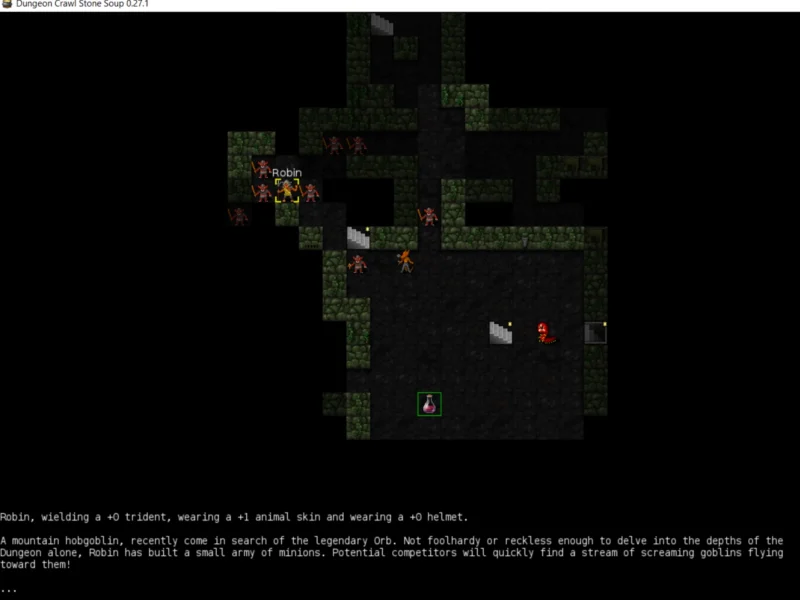
Dungeon Crawl Stone Soup (DCSS) is a free and open-source, turn-based roguelike dungeon crawler in the tradition of Rogue, Hack and Moria. It descends from Linley’s Dungeon Crawl, whose source was released to the community in 1997; the “Stone Soup” fork has been developed by a team of volunteers since 2006 and is still under active development. You build a character from a species and a background, descend into a randomly generated dungeon, retrieve the legendary Orb of Zot and carry it back out alive. Every level, item and monster placement is generated fresh for each run, and death is permanent: when your character dies the run is over and the next one starts from a brand new dungeon. There is no scripted storyline and no fixed route to victory, so each attempt is driven by the loot you find, the gods you choose to worship and the branches you decide to enter. The design brief behind Crawl is to strip out busywork rather than challenge, so the game automates the tedious parts – travelling, exploring, even fighting ordinary monsters – and leaves the tactical decisions to you. It ships both as a classic text-mode (console) build and as a graphical tiles build, and it can also be played, or watched live, in a browser on community WebTiles servers. The current stable release is 0.34.1 (March 2026).
Key Features
- 27 playable species – from forgiving choices such as Minotaurs, Gnolls and Mountain Dwarves to deliberate challenges like Felids, Octopodes, Mummies, Poltergeists and Vine Stalkers, each with its own aptitudes, anatomy and quirks.
- 24 backgrounds – warriors (Fighters, Gladiators, Monks, Hunters, Brigands), zealots (Berserkers, Chaos Knights, Cinder Acolytes), adventurers (Artificers, Wanderers, Delvers), metamorphs (Shapeshifters, Stalkers), mystics (Warpers, Hexslingers, Enchanters, Reavers) and mages (Hedge Wizards, Conjurers, Summoners, Necromancers, Elementalists, Alchemists and more).
- Gods with real obligations – worship a deity for powerful gifts and abilities, but each one imposes conduct you have to respect or face its wrath.
- Procedurally generated dungeon with themed branches – the Dungeon, Lair, Orcish Mines, Vaults, Elf, Crypt and Depths, plus branches such as Spider Nest, Shoals, Swamp, Snake Pit and Slime Pits, and punishing extended endgame areas for the 15-rune run.
- Permanent death and a public scoring culture – deaths are final and uneditable; online play publishes scoreboards, morgue files and a live spectating feed.
- Deep but readable systems – skills trained by use, spell schools and memorisation, weapon brands, artefacts, mutations, and a huge catalogue of items and monsters documented in the in-game lookup tool (LearnDB).
- Quality-of-life automation – auto-explore, travel, autofight, macros and a five-lesson tutorial plus hints mode make it welcoming without sanding off the difficulty.
- Tiles or text – a graphical tiles build or the classic console/ASCII build, plus WebTiles for playing and spectating in a browser.
Why Use Dungeon Crawl Stone Soup?
DCSS is one of the most carefully balanced traditional roguelikes ever released, and it is deliberately honest about what makes the genre fun. There are no ads, no in-game purchases, no login and nothing to unlock – it is a complete game released under a free licence and developed in the open. Where other roguelikes ask you to repeat the same trivial early game, Crawl hands you automation for the parts that are not interesting and keeps the parts that are: which god to take, which branch to enter, when to fight and when to run. Its systems are transparent enough to be learnable and deep enough that experienced players still find new tactics, and every death can usually be traced back to a decision you can explain. Runs are also short enough to fit in a sitting, saves are tiny, and the game itself is lightweight – a console build runs happily in a terminal on a modest machine or over SSH, while the tiles build is comfortable on a desktop.
How to Get Started
Both the tiles and console builds bundle a tutorial and a hints mode, and the official site links a manual, a community wiki and an in-game knowledge base. The quickest way to try it without installing anything is to play in the browser on one of the public WebTiles servers, where you can also watch other players’ games to learn the interface.
Platforms
- Windows, macOS and Linux (packaged for Debian and Ubuntu as
crawlfor the console build andcrawl-tilesfor the graphical build) - Android, with an official download from the project site
- Any modern browser via WebTiles, on the community servers – no installation required
- Other Unix-like systems through distribution packages and source builds; the codebase is portable C++
Licence
Free and open source. The game is released under the GNU General Public License, version 2 or later, with most tiles and other assets placed in the public domain (CC0) and a handful of bundled components under BSD, MIT and zlib licences – all compatible with the GPL. There is no proprietary component and no paid edition.
Website
- crawl.develz.org – official site: downloads, live games, documentation and news
- github.com/crawl/crawl – source code, bug tracker and development
Alternatives
- Cataclysm: Dark Days Ahead – open-source turn-based roguelike with a post-apocalyptic survival simulation
- Shattered Pixel Dungeon – open-source turn-based roguelike built for phones and desktops