Open Source Security Alert: What You Need to Know (November 2026)
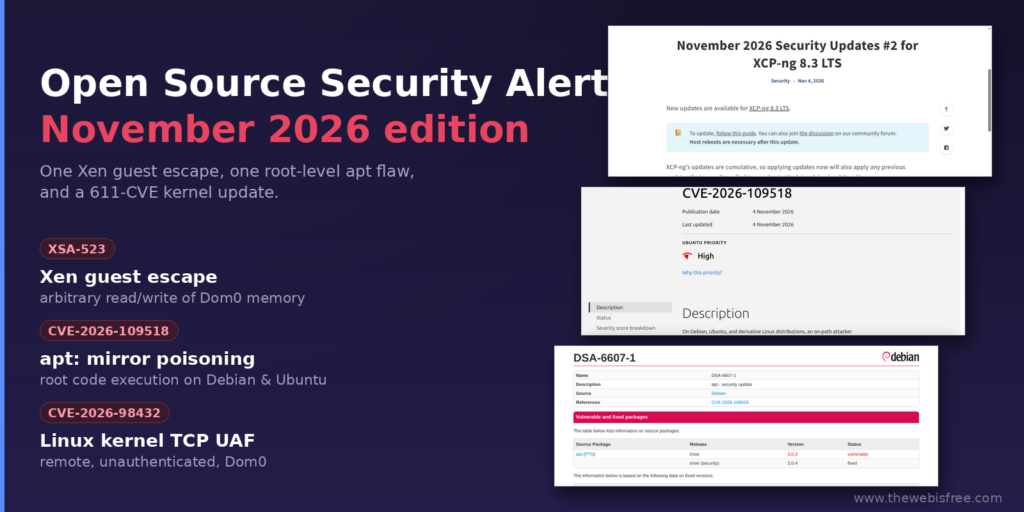
Debian published thirteen security advisories in the first four days of November, and two of them concern the layer that installs the fixes: the apt package manager and the Xen hypervisor underneath the virtual machines. XCP-ng needed two update rounds and two reboots in two days for the same reason. Here is what actually matters this fortnight, with every version number taken from the advisory or the vendor’s own update post rather than from a news summary.
This is the second edition of our monthly security roundup. October’s instalment covered the Pillow EPS injection, a 36-CVE ImageMagick update and the GitPython batch — all of which are still worth checking if you missed them.
Start here: an apt flaw that hands out root (CVE-2026-109518)
This is the one to act on today. An attacker positioned on the path between your machine and an archive server — a malicious mirror, a proxy, a hostile network — can manipulate the HTTP traffic of a package install and get the client to install an unverified package, which means remote code execution as root. The flaw is the reuse of hard links, and it needs two conditions to line up: the client follows redirects, and the client retries the download. CVE-2026-109518 is rated 7.7 High on CVSS 4.0, and Ubuntu lists it at High priority.
The retry condition is the awkward part, because retries are on by default. Acquire::Retries defaults to 3 from Debian 12 (bookworm) and Ubuntu 22.04 LTS (Jammy) onward, so every current release is in the default blast radius. Older releases that ship a default of zero are not exploitable out of the box.
Fixed packages are already out, in Debian via DSA-6607-1 on 4 November:
- bookworm — 2.6.2 (was 2.6.1)
- trixie — 3.0.4 (was 3.0.3)
- forky, sid — 3.3.6
On Ubuntu the fixed versions are 2.4.15ubuntu0.1 for 22.04 LTS, 2.8.4ubuntu0.1 for 24.04 LTS, 3.2.1ubuntu0.1 for 26.04 LTS and 3.3.3ubuntu0.1 for 26.10, with ESM packages for 20.04 and older.
There is a bootstrapping problem here that is worth saying out loud: the fixed apt has to be installed by the vulnerable apt. Two things help. First, upgrade from a network you trust — this attack needs an on-path position, so a hostile café Wi-Fi or an unvetted caching proxy is exactly the wrong place to run your patch cycle. Second, remove the retry condition for that single upgrade rather than leaving it to the default: apt-get -o Acquire::Retries=0 update, then apt-get -o Acquire::Retries=0 upgrade, then put the default back, because retries exist for flaky mirrors. Neither step replaces the fixed package; they just shrink the window while you install it. Afterwards, confirm what you are running with apt --version.
Xen XSA-523: a guest reads and writes Dom0 memory (CVE-2026-102703, CVE-2026-102704)
Two flaws in Xen’s grant copy implementation let a malicious guest read and write arbitrary memory belonging to other domains, including Dom0. A batch of grant copy operations on adjacent address ranges hits an internal cache; the conditions for re-validating that cached data were wrong, so frame numbers and grant references could be mixed up (CVE-2026-102703), and the check restricting copy-by-frame-number to the caller’s own memory was misplaced (CVE-2026-102704).
Because the reachable memory includes the hypervisor and Dom0, a single compromised guest can take over the whole host. This is a guest escape, and there is no mitigation other than the fix — it is not a case where you can firewall your way out of it.
XCP-ng shipped it on 3 November in Security and Maintenance Updates #1 for XCP-ng 8.3 LTS (XSA-523, VSA-2026-055), and advised updating immediately. Debian followed on 4 November with DSA-6610-1: xen 4.17.7+13-g2445b30a44-0+deb12u1 on bookworm and 4.20.4+63-g7abfd2bce2-0+deb13u1 on trixie, with sid at 4.20.4+63-g7abfd2bce2-1. Ubuntu’s tracker still listed all supported releases as needs evaluation when this was written, so if you run the Ubuntu xen package, check back rather than assuming the blanket “no fix needed”.
On a hypervisor, the patch is not the end of the job: the new hypervisor only takes effect after a host reboot, and every guest has to be down or migrated for that. Plan the window, don’t schedule it for a Friday.
Linux kernel CVE-2026-98432: a TCP use-after-free anyone can aim at
The kernel bug that forced XCP-ng into a second reboot is a use-after-free in IPv4 TCP connection handling, rated 9.2 Critical by Ubuntu. tcp_v4_syn_recv_sock() hands ownership of the request socket’s IP options to the child socket without copying them, while another CPU can process a retransmitted SYN for the same request socket and build a SYN-ACK from the same options under rcu_read_lock(). The child socket has no SOCK_RCU_FREE and frees the options with a plain kfree(), so ip_options_build() can read freed memory. Request socket migration reaches the same state through inet_reqsk_clone().
What makes this one different from the usual kernel batch is reach: anyone who can send TCP traffic to the host can attempt it, with no authentication, which on a hypervisor means a compromised Dom0 and therefore every VM on the box. A public exploit exists, but it relies on MPTCP, which the XCP-ng 8.3 kernel does not have — so that specific exploit does not work there. The underlying bug is present anyway, and XCP-ng is explicit that other exploitation paths cannot be ruled out.
XCP-ng released the fix on 4 November in Security Updates #2 (VSA-2026-056), and points administrators who cannot reboot straight away at an iptables-based mitigation that takes effect without a reboot and holds until the fixed kernel is running. If you can reboot, reboot: cumulative updates mean this batch also picks up anything you skipped earlier.
Debian got there first, which is worth knowing if you are now wondering whether your servers are exposed. CVE-2026-98432 was fixed in trixie’s 6.12.113-1 through DSA-6568-1 on 16 October, and in bookworm’s 6.1.190-1 through DLA-4841-1. If your kernel came from Debian’s security archive any time in the last three weeks, you already have it.
The rest of the Debian batch, and the 611-CVE kernel update
DSA-6602-1 on 2 November is the one that looks alarming in a vulnerability scanner: 611 CVE identifiers in a single linux update, taking trixie from 6.12.107-1 to 6.12.115-2. A number that size is an artefact of Debian’s kernel being a stable backport branch that collects upstream fixes for months and then ships them together — it is not 611 newly discovered holes in your server. Your vulnerability scanner will not know that, so expect a wall of findings that all clear with one package upgrade.
Two more from the same window are worth a specific look:
- Squid — request smuggling (DSA-6606-1, 3 November). CVE-2026-61642 is a request smuggling flaw in HTTP/1.1
Transfer-Encodinghandling: the header parser accepted the bareTransfer-Encoding:identity form, which the specification forbids. Affected releases run from 3.3.0.1 to before 7.6, fixed upstream in 7.6. When a cache sits in front of the affected Squid, the same trick also lets an attacker poison that cache and serve arbitrary content to other clients — which is the part that should worry anyone running a proxy in front of a website. The same advisory carries SQUID-2026:7 (CVE-2026-104786) and SQUID-2026:9 (CVE-2026-62846). trixie is fixed at 6.13-2+deb13u4; bookworm’s 5.7-2+deb12u6 still showed as vulnerable in the tracker when this was written, so oldstable proxy hosts need a decision, not just a cron job. - Eye of GNOME — a PNG is enough (DSA-6601-1, 1 November). CVE-2026-107651 is a heap-based buffer overflow in eog’s PNG metadata reader, triggered by split metadata chunks with bad state handling; the advisory says it can lead to arbitrary code execution or a crash. CVE-2026-118475 is an out-of-bounds read on a malformed colour profile. Fixed in 47.0-1+deb13u1 on trixie and 43.2-1+deb12u1 on bookworm, 50.4-1 upstream. The CVSS is a modest 5.5 because it needs the user to open the file — but eog is what a GNOME desktop opens an image with when you double-click it, so “the user opens a file” is not much of a barrier. Mail gateways and thumbnailers that shell out to image tooling deserve the same update.
The long tail: 46 CVEs in ImageMagick, 40 in Vim, 21 in Chromium
DSA-6611-1 closes 46 CVEs in ImageMagick, fixed at 8:7.1.1.43+dfsg1-1+deb13u14 on trixie — a fortnight after the previous ImageMagick advisory, which closed 36. Anything that converts images uploaded by other people belongs on this: galleries, thumbnail services, CMS upload pipelines, mail scanners. The parsing surface is enormous and the same class of bug keeps coming back.
The rest of the batch, in one place:
- vim — DSA-6600-1, 40 CVEs, trixie 2:9.1.1230-2+deb13u1. Vim parses untrusted files by design; if you open logs, patches or mail attachments in it, take the update.
- chromium — DSA-6605-1, 21 CVEs, jumping from 150.0.7871.181 to 156.0.8078.79. Restart the browser after the upgrade or the old process keeps running the old code.
- symfony — DSA-6612-1, 4 CVEs, trixie 6.4.49+dfsg-0+deb13u1. Relevant if you run PHP applications on the symfony framework rather than something that vendored it years ago.
- git-annex — DSA-6603-1, CVE-2026-112818, cross-repository data exfiltration via a special remote. trixie is fixed at 10.20250416-2+deb13u1; bookworm still showed vulnerable at the time of writing.
- incus — DSA-6604-1, trixie 6.0.4-2+deb13u12. No CVE identifiers are attached in the tracker, which is exactly why it is easy to miss.
- puppet-agent and trapperkeeper-authorization-clojure — DSA-6608-1 and DSA-6609-1, both without CVE identifiers in the tracker. If you run Puppet, the agent update belongs in the same window as the rest.
How to check your own systems
Ask the package manager what you actually have, rather than reading release notes and hoping:
apt --version
apt policy apt xen-hypervisor linux-image-amd64 squid imagemagick eog vim chromium git-annex
Then apply the batch and see what still needs a restart. On Debian and Ubuntu, needrestart tells you which services are still running the old libraries, and it is the difference between “upgraded” and “patched”:
apt-get update
apt-get upgrade
needrestart -r l
For the hypervisor side, xen-detect from the xen-utils package tells you whether a machine is a Dom0, a guest or bare metal, and xl info gives you the hypervisor and Xen versions so you can compare them against the fixed builds above. On a kernel, uname -r against the 6.12.113-1 and 6.1.190-1 thresholds from DSA-6568-1 is the whole check.
If you want the authoritative lists rather than my summary, every advisory here is a plain HTML page: the Debian security announcements, the Debian security tracker, and the XCP-ng update tag.
The Bottom Line
Order of operations this week. First apt, because a network attacker with root on your patch client defeats everything else you do afterwards — and it takes one upgrade. Second the Xen guest escape, scheduled with the reboot it needs. Third the kernel, which on Debian is very likely already done and on XCP-ng means a second reboot or the iptables stopgap from VSA-2026-056. Everything else — ImageMagick, eog, Vim, Chromium, Squid — fits in the normal monthly patch cycle, except bookworm’s Squid, which has no fixed package yet and needs an actual decision about the proxy.
Patching is only half of knowing where you stand. Our security directory lists open-source tools that inventory a fleet for you: Trivy for containers and dependencies, Wazuh for host-level monitoring, CrowdSec for behaviour-based blocking. All free, all self-hostable.
Start with the apt advisory at security-tracker.debian.org and check whether your mirror is the one you think it is — free, no account required.