Yacht
- Platform
- Linux Docker Web
- Licence
- MIT Open source
- Website
- dev.yacht.sh
- Source code
- github.com/SelfhostedPro/Yacht
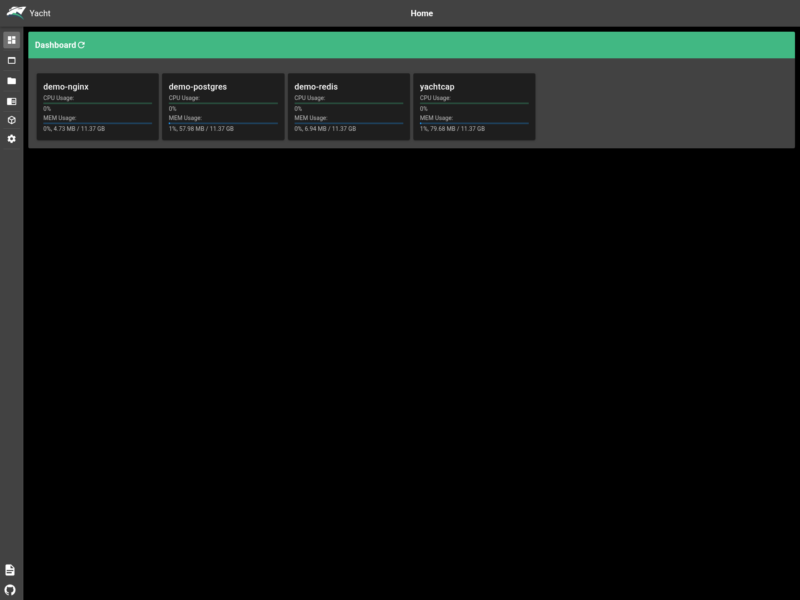
Overview
Yacht is a free, self-hosted web interface for managing Docker containers, built around templating. Instead of running docker run by hand for every service, you point Yacht at a template catalogue and install what it lists with a single click; its author describes it as a decentralised app store for servers, where anyone can publish the packages.
It runs as one container with access to the Docker socket, so the same dashboard works on a home server, a VPS or a small cluster. The backend is Python with Flask, the interface is Vue with Vuetify.
Key features
- Container management — list, start, stop and inspect the containers on the host, with advanced editing for a container’s configuration.
- Template framework — reads Portainer-style template files, so an existing template catalogue can be reused as it is.
- 1-click deployments — pick an application from the template list and Yacht creates the container with the ports, volumes and environment the template defines.
- Template updating — the template URL is stored, so one button re-reads it and refreshes the catalogue.
- Docker Compose compatibility — compose projects can be deployed and managed alongside single containers.
- Shared settings and variables — common paths such as config, media and data are set once in the server settings, and templates that use
!config-style placeholders get the values substituted at deploy time.
Deployment
Yacht ships as a Docker image and expects /var/run/docker.sock to be mounted. The environment variables worth setting are PUID and PGID for the user it runs as, SECRET_KEY so a restart does not log you out, ADMIN_EMAIL for the first account, DISABLE_AUTH when authentication is handled in front of it by something like Authelia, DATABASE_URL to use PostgreSQL instead of the built-in SQLite, and COMPOSE_DIR for the compose variant. Linux is the only platform the project verifies; on ARM devices the memory graphs need the cgroup flags added to the boot command line. Installation and getting-started guides live at dev.yacht.sh.
Project status
Yacht is alpha software and the repository says so plainly: published tags stop in the 0.0.x and v0.1a range, the README notes that the application has not been updated in a while, and work on the next version continues in a separate rewrite. It has also been offered on the DigitalOcean Marketplace and on Linode. Treat it as a testing ground for templates rather than a production control plane, and check the repository before depending on it.