Valkey
- Platform
- Linux macOS Docker
- Licence
- BSD-3-Clause Open source
- Website
- valkey.io
- Source code
- github.com/valkey-io/valkey
Overview
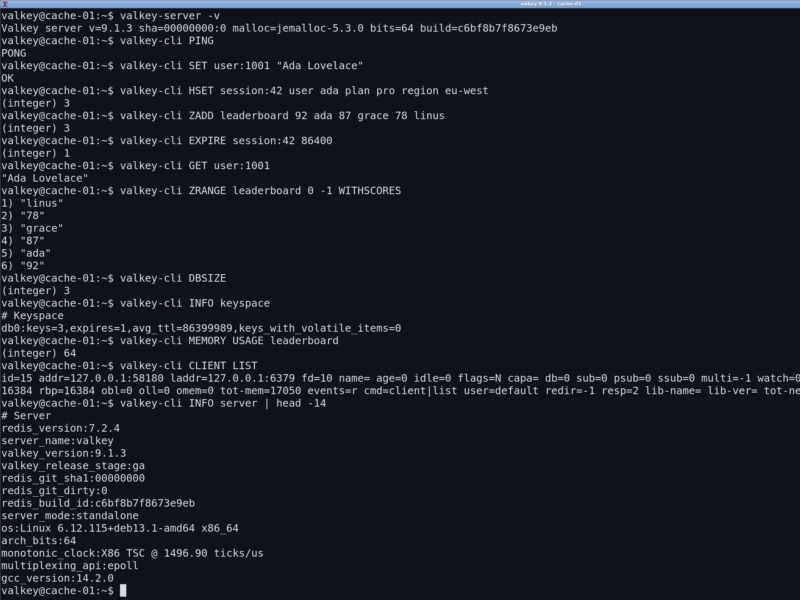
Valkey is a high-performance key/value data structure server: an in-memory store that speaks the Redis wire protocol, persists to disk, replicates across machines and can be clustered for horizontal scale. It is the community fork of the last BSD-licensed Redis release (7.2.4), created in 2024 when Redis Ltd moved its own server to a source-available licence, and it is now governed by the Linux Foundation under the BSD-3-Clause licence.
Because the protocol and command set are unchanged, Valkey is a drop-in replacement in practice: existing Redis client libraries connect as they always did, legacy tooling such as redis-cli and Helm charts keep working against it, and a migration usually means re-pointing a connection string rather than rewriting an application. What changed is the licence and the governance model – development happens in the open on GitHub, and the project ships regular releases on several maintained branches at once (9.1.3, 9.0.7, 8.1.11, 8.0.12 and 7.2.15 were all published in the same week of October 2026).
It runs as a standalone daemon or as a cluster, and it is used for the whole range of key/value workloads: caching, session storage, rate limiting, leaderboards, queues and job metadata, pub/sub messaging, and – for many teams – as a primary database where the working set fits in memory.
Key Features
- Rich native data types – strings, numbers, hashes, lists, sets, sorted sets, bitmaps and bitfields, HyperLogLog, streams with consumer groups, and geospatial indexes, each with an expressive command set that operates on the structure in place rather than reading and rewriting whole values.
- Extensibility – built-in Lua scripting through
EVALandEVALSHA, Functions, and a module API for compiled extensions that add new commands and data types. In the 9.1 line Lua itself is a module, so a deployment that does not need scripting can leave the engine out entirely. - Durability – point-in-time RDB snapshots and an append-only file for replay after a crash, plus streaming and replication compression with Zstandard for large datasets.
- Scaling and high availability – primary/replica replication, Sentinel for automatic failover, and cluster mode for sharding a dataset across nodes. Valkey 9.x also redesigned the I/O threading model, which the project benchmarks at 2.1 million requests per second on a single server.
- Operational surface – ACL users with per-command permissions, and in 9.1 per-database scoping so a user can be confined to specific numbered databases with
db=inACL SETUSER; TLS; slow log; keyspace notifications;INFOmetrics and JSON-format server logs for log pipelines. - Memory efficiency – the 9.1 release claims up to 20 percent less memory for small strings, plus new commands such as
HGETDEL,MSETEXandCLUSTERSCAN. - Kubernetes and container story – official container images under the
valkey/valkeyname on Docker Hub, a generally available Valkey Helm chart (1.0.0, with Sentinel failover, TLS, ACL authentication and Prometheus metrics) and a separate Valkey Operator for managing clusters on Kubernetes. - Wide platform support – the server compiles and runs on Linux, macOS, OpenBSD, NetBSD and FreeBSD, on 32-bit and 64-bit, big- and little-endian architectures, with optional TLS, systemd integration, experimental RDMA support, and a build that omits the Lua engine.
Requirements and Deployment
Valkey is a single C binary plus a configuration file, so the fastest route is the official container: docker run --name valkey -p 6379:6379 valkey/valkey:9.1 gives a working server on the default port, and the image documentation covers persistence volumes and configuration mounts. On a host, building from source is a plain make after installing a C compiler and, for TLS, the OpenSSL development headers; optional flags add TLS (BUILD_TLS=yes), systemd support (USE_SYSTEMD=yes), Zstandard compression (BUILD_ZSTD=yes) or RDMA (BUILD_RDMA=yes).
Configuration lives in valkey.conf: set maxmemory and an eviction policy for a cache deployment, appendonly yes and the RDB save points for durability, a requirepass or ACL users for access control, and the cluster-enabled option when running in cluster mode. Client libraries are the Redis ones – Redis-py, Jedis, Lettuce, go-redis, node-redis, Predis and their peers all work unchanged over RESP, which is why adopting Valkey rarely touches application code.
Operationally it is a piece of infrastructure that wants memory headroom and a monitoring hook: the INFO sections give hit ratios, evictions, connected clients and replication offsets, and the project publishes a Prometheus-friendly metrics story through its Helm chart and Operator.
Alternatives
- Redict – the other community fork of Redis OSS 7.2.4, developed on Codeberg and licensed LGPL-3.0-only, for teams that prefer a copyleft licence over Valkey’s permissive BSD one.
- Redis itself – still the reference implementation and, through Redis Ltd, now offered under source-available and commercial terms; features such as Redis Stack modules are only available there.
- Memcached – a simpler pure cache with no persistence, replication or data structures beyond opaque blobs, which is enough for some session and page-cache workloads.
If the workload is caching only, Memcached’s simplicity is a legitimate choice; if the workload needs data structures, persistence, pub/sub and replication under an OSI licence, Valkey and Redict are the two direct successors to the old Redis OSS line.