PG Back Web
- Platform
- Docker
- Licence
- AGPL-3.0 Open source
- Source code
- github.com/eduardolat/pgbackweb
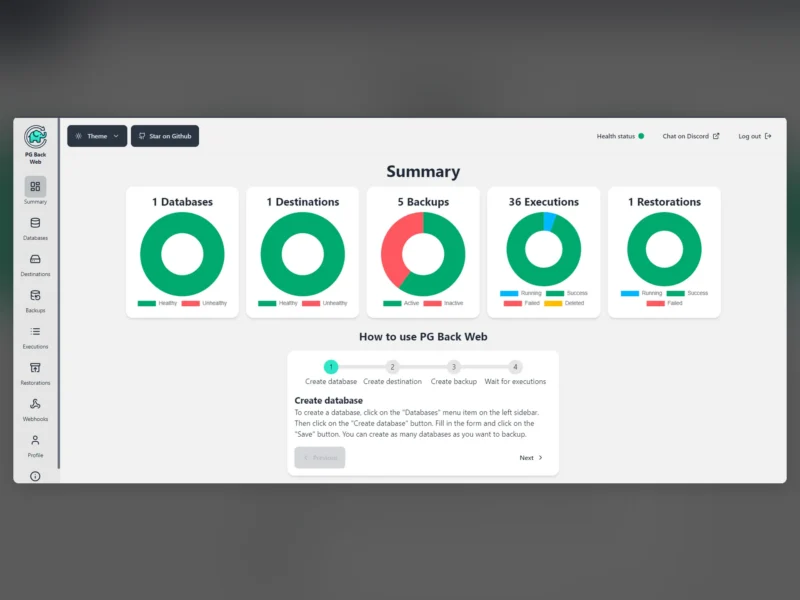
PG Back Web is a web interface for scheduled PostgreSQL backups. It runs as a small Docker service in front of pg_dump and pg_restore: you register your database connections once, say how often to dump them, and it keeps the history, shows the logs of every run and lets you download or restore a dump from a browser tab. Nothing needs installing on the database server itself — the backups are taken through a normal connection string.
What it does
- Connections once — add each PostgreSQL cluster with a host, port, user and password; the password is encrypted on the way in with the instance’s
PBW_ENCRYPTION_KEY. - Scheduled dumps — a per-database schedule runs
pg_dumpin the background, so a backup does not depend on a cron entry somebody has to remember. - Execution history — every run is recorded with its status and log, which is the part usually missing from a plain shell script.
- Download and restore — pull a dump file down, or hand it back to
pg_restoreagainst the same database from the same page. - Local and S3 destinations — write dumps to a mounted directory or to one or more S3 buckets, and keep retention in the destination rather than on the source host.
- Health checks — the app periodically tests that a connection still works and that its destination is writable, so a dead backup target shows up before the day you need a restore.
Versions and notifications
The image bundles pg_dump and pg_restore for PostgreSQL 13 through 18, so one container can back up a mixed fleet — a 13 cluster and an 18 cluster from the same interface. Webhooks can fire when a backup finishes or fails, when a health check fails, and on other events, which is enough to bridge it into an existing alerting setup without another agent.
What you need to run it
Two containers: the application and a PostgreSQL database that stores its own metadata. The documented start is a Compose file with PBW_ENCRYPTION_KEY (your secret) and PBW_POSTGRES_CONN_STRING (where its own data lives); the UI listens on port 8085, and the first visit creates the administrator account. TZ controls the timezone used for scheduling and backup filenames.
Licence
AGPL-3.0 — free and open source, self-hostable from the published Docker image. The project is being renamed to UFO Backup to reflect a planned expansion beyond PostgreSQL; the current code and image remain under the PG Back Web name.
Alternatives
- Databasus — another self-hosted PostgreSQL backup UI, also with scheduling and S3 destinations.
- pgweb — a browser client for PostgreSQL rather than a backup service, useful for inspecting what was dumped.
- pgAdmin — the long-standing PostgreSQL administration suite, whose backup dialog is per-database and manual.