tududi
- Platform
- Web Docker
- Licence
- MIT Open source
- Website
- tududi.com/
- Source code
- github.com/chrisvel/tududi
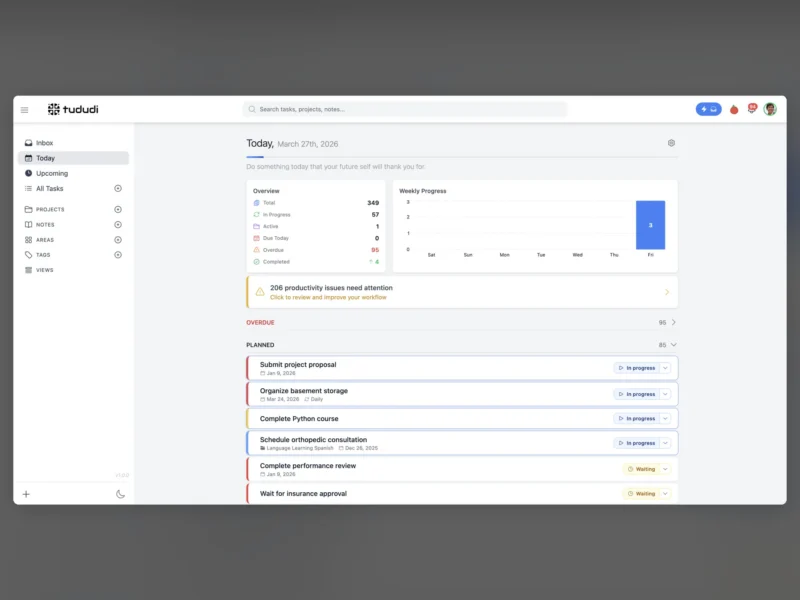
What tududi is
tududi is a self-hosted app for organising tasks, projects, areas and notes under one roof – the life-management niche that Todoist, TickTick and Things sell as a subscription, running on your own server instead. It is written by Chris Veleris in JavaScript (Express backend, React frontend), published on GitHub as chrisvel/tududi under the MIT licence, and ships as a Docker image backed by PostgreSQL.
The idea behind it is a fixed hierarchy rather than a flat task list: tasks and notes can be tagged, tasks belong to projects, projects belong to areas, and areas are the top-level buckets of your life or your work.
Structure: areas, projects, tasks, notes
- Tasks. Create, complete and delete tasks, filter them by Today, Upcoming and Someday, and sort by name, due date, date created or priority.
- Subtasks. Break a task into smaller steps with progress tracking and navigation between them.
- Projects and areas. Group related tasks into a project, and group projects into an area so personal, household and work streams stay apart.
- Notes and tags. Free-form notes attach to projects, and both tasks and notes can carry tags.
- Quick capture. A quick-note box for writing something down before deciding where it belongs.
Recurring tasks, treated properly
Recurrence is the part most small task apps get wrong, and tududi spends much of its complexity here. Daily, weekly, monthly, monthly-on-a-specific-weekday and monthly-on-the-last-day patterns are all supported, with custom intervals (every two weeks, every three months) and optional end dates, plus a choice between repeating from the due date or from the day you actually completed the task. Generated instances keep a link back to the parent pattern, and the recurrence settings can be edited from any instance rather than only from the original.
Sharing, households and small teams
Projects can be shared, and the People list holds members and contacts together. Three roles – admin, user and guest – govern what each can do, groups share a project, area or goal with several people at once, and a member can exist without an email address, which covers a child or another household member who needs tasks and a sign-in link but no mailbox. A contact such as a plumber can be assigned a task without becoming a full member, and an Everyone board shows the whole household’s day in one view.
CalDAV, SSO and an API
- CalDAV is enabled by default and syncs in both directions with tasks.org on Android, Apple Reminders, Thunderbird and Evolution, and with external servers such as Nextcloud or Baikal. Recurring tasks keep their RRULE, conflicts are detected rather than silently overwritten, and stored passwords are encrypted with AES-256-GCM.
- OIDC single sign-on covers Google, Okta, Keycloak, Authentik, PocketID and Azure AD, with automatic user provisioning on first login, account linking and admin roles assignable by email domain.
- A REST API with per-user API keys and Swagger documentation sits at
/api/v1for scripts and automation workflows.
Running it yourself
The official image is one application container plus a PostgreSQL database, and version 2.0 dropped SQLite entirely: DATABASE_URL points at the database, the schema is created on first start, and pending migrations run on every start – the container refuses to boot if one fails, so a pg_dump before bumping the image tag is the documented habit. Moving a 1.x install with a SQLite file to 2.0 is an export and import, not an in-place upgrade. A hosted subscription is offered as well for people who would rather not run the server.
Where it fits
tududi is the middle ground between a plain to-do list and a full project tracker: more structure than a checklist, far less ceremony than a Jira-style tool, and a CalDAV surface that lets the phone’s own reminders app stay the front end. For a self-hosted option with a more project-oriented board view, see Vikunja or Focalboard; for a desktop app that tracks time alongside tasks, Super Productivity; for a notes-first workspace, AppFlowy.