Saltcorn
- Platform
- Docker Linux
- Licence
- MIT Open source
- Website
- saltcorn.com/
- Source code
- github.com/saltcorn/saltcorn
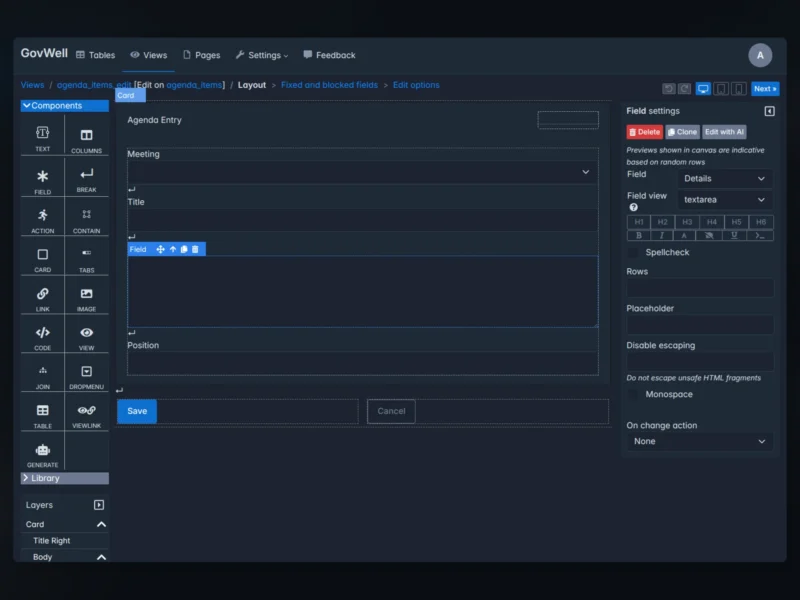
Saltcorn is a no-code database application builder you host yourself. You define tables and their fields, then assemble lists, forms, detail pages, dashboards and menus in a drag-and-drop builder instead of writing an application. It is the self-hosted, open-source answer to the spreadsheet-database products: closer to NocoDB and Teable than to a classic CMS, with a workflow engine, a plugin store and multi-tenancy on top.
The stack is deliberately small: Node.js 20-24, Express and PostgreSQL (SQLite for a single-user trial), with the builder itself built on craft.js and the scripting and workflow editors on Blockly and CodeMirror. The whole instance is one Node process plus a database, which is why it fits on a 2 GB virtual machine.
Features
- Typed tables and fields, including relations and calculated fields, with an entity-relationship diagram of the schema
- Views for list, show, edit, create, statistics, feed and dashboard layouts, all assembled in the drag-and-drop builder
- Actions and a workflow editor for multi-step automations, with a Blockly-based scripting surface for the steps that need logic
- Plugins installed from the marketplace (npm packages), plus local plugins developed against a running instance
- Multi-tenancy: one instance can serve each tenant its own application on a subdomain
- Mobile builds from the same definitions, with the
saltcorn/saltcorn-with-mobileimage carrying the Android and Java toolchain - A co-pilot chat that drafts pages and fields from a prompt
- A
saltcornCLI for installation, plugin management, tenant creation and backups
What to know before you deploy
- MIT licensed and free to self-host; the core, the builder and the plugin manager are all in the open repository.
- Requirements: Node.js 20-24 and PostgreSQL, with SQLite as a single-user option. 2 GB of RAM is the comfortable figure for a small instance — 1 GB works but upgrades get tight.
- Three install paths:
npx saltcorn-install -yon Debian, Ubuntu, AlmaLinux or Fedora,npm install -g @saltcorn/clifollowed bysaltcorn setup, or the published Docker image with the example compose file. - Behind a reverse proxy, Socket.io needs the usual upgrade headers — chat, the log viewer and the streaming API all depend on it.
- Mobile app builds need the separate mobile image or your own Android SDK and Java 21; the default image leaves those dependencies out to stay small.
- It is a builder, not a hosted service: you own the database, the backups and the upgrades, and there are no per-seat limits.
Alternatives
NocoDB turns an existing database into a spreadsheet interface, Teable is the closest spreadsheet-grid experience, and NocoBase goes further into plugin-driven application scaffolding. Saltcorn is the lighter of the four to run — a single Node process — and the one that includes multi-tenant hosting and mobile builds in the open core.