OneDev
- Platform
- Linux Windows macOS Docker
- Licence
- MIT (Community Edition) Open source
- Website
- onedev.io
- Source code
- code.onedev.io/onedev/server
Overview
OneDev is a self-hosted development platform that folds together the tools a team normally stitches up separately: Git hosting, code review, issue tracking, CI/CD, a package registry, a project wiki and browser workspaces. It is one Java application, deployed once, and the repository, the issues and the pipeline that tests them live in the same place — so an issue shows the commits that touched it, a pull request shows the builds it triggered, and a build shows the coverage report it produced.
It is not a thin layer over someone else’s forge: OneDev implements its own Git server with per-commit code search and symbol navigation, and its own CI engine, which is designed to be configured in a form-based editor rather than in YAML. The project’s other pitch is efficiency — its installation docs budget a 2 core / 2 GB box — and it is developed on itself, which the maintainers dogfood at code.onedev.io.
Git hosting and code review
- Language-aware symbol search and navigation at any commit, plus regular-expression code search.
- Discussions started on any source line or diff hunk, with suggested changes that can be applied in place; comments stay attached to the code rather than to a thread.
- Code protection rules that require review or a passing build when particular users touch particular files on particular branches.
- Source and diff annotation with results extracted from unit test, coverage and static-analysis reports.
- Renovate integration for dependency updates through pull requests.
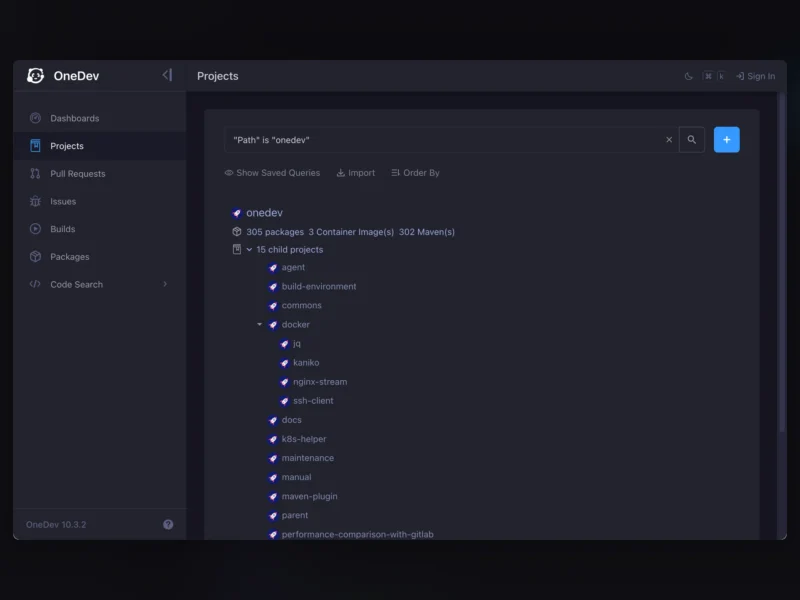
- A project tree where settings defined on a parent project are inherited by its children.
Issues, Kanban and workflows
Issue states, fields and links are user-defined, and transitions can be manual or rule-driven: an issue can move itself when related work is committed, tested, released or deployed, which is what keeps the Kanban board current without a separate automation tool. Confidential issues inside public projects, time tracking, saved and subscribed queries, and a service desk that turns incoming email into issues round out the tracker.
CI/CD
Build specs are edited through a web form: job dependencies, triggers, caches and step commands are declared as fields instead of in a YAML file. Jobs run on the server itself, in Docker containers, through Kubernetes, or on remote agents, and a job can be executed locally against uncommitted changes to skip the commit-push-wait loop. The same engine reports coverage and static-analysis output back onto the commit it built.
Packages, wiki and workspaces
The built-in registry serves Docker, npm, Maven, NuGet, PyPI, RubyGems and Helm artefacts, cross-referenced with the builds that publish them. The project wiki is Markdown kept in the repository, editable in the browser or through Git and browsable by branch or tag. Workspaces start a preconfigured development container or an isolated sandbox VM on any branch, so a terminal coding agent such as OpenCode, Claude Code or Codex can run in the browser with no local setup.
AI in the workflow
Recent releases push AI past a chat sidebar. Built-in AI can query projects in natural language, explain code, review commits and pull requests, help write build specs and investigate failing builds; from version 17 the AI teammates can be assigned issues and pull requests and carry them through — implementing, reviewing, fixing CI failures and resolving merge conflicts. A command-line client (TOD) and shipped agent skills let external coding agents read and edit issues, pull requests and builds.
Running it
OneDev ships as a single Java distribution for Linux and Windows on amd64 and arm64 and for macOS on Apple Silicon, as an official container image (1dev/server, web on port 6610 and SSH on 6611), and with instructions for a Kubernetes cluster. Deployment is one data directory; container and Kubernetes executors need access to the Docker socket or a cluster to launch jobs. Several servers can replicate projects for high availability or spread them for horizontal scale.
Editions
The Community Edition is free and open source under the MIT licence, and it is a complete product — Git hosting, CI/CD, packages, wiki and issue tracking are all in it. An Enterprise edition adds further capabilities at $6 per user per month. Development happens at code.onedev.io; the GitHub repository is a public mirror.
Alternatives
- Gitea — a light, Go-based Git forge that leaves CI to a separate system.
- Forgejo — the community-governed Gitea fork, with Forgejo Actions built in.
- Jenkins — the long-standing automation server: far more extensible, and far more to operate.
If the appeal is one installable service that owns the repository, the issues and the pipeline together, OneDev is worth a look in the directory.