Obskurnee
- Platform
- Docker Web
- Licence
- Personal Use License Source-available
- Source code
- github.com/zblesk/obskurnee
Overview
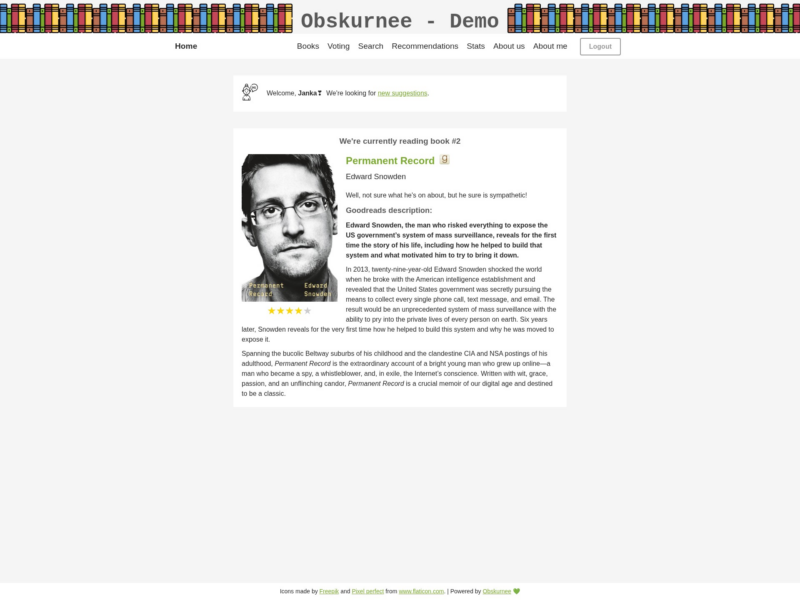
Obskurnee is a small web app for running a book club’s reading decisions: members suggest books, a moderator closes the suggestion round, and the app generates a poll whose winner becomes the club’s next read, featured on the home page. It is self-hosted only — there is no central service to sign up to, just a public demo where any made-up email and password gets you in.
The project is deliberately narrow: it implements one club’s workflow rather than every reading-app feature. It is available in English and Slovak, and the source is published under a Personal Use License that covers personal, non-commercial use only — it is not open source.
Voting rounds
A round can be a direct vote over suggested books, or a two-stage topic round: members first propose themes (a genre, a publication year, an author’s nationality) and once a theme wins the app opens a fresh round for books that fit it. Anyone in the club can add suggestions to an open round; a moderator closes it, the poll is generated automatically, and when every member has voted the result is evaluated and the chosen book moves to the front page.
Shelf, reviews and recommendations
Every book the club has finished stays on a shared shelf, where members can rate and review it, so the club builds a record of what it has read instead of losing the discussion in a chat thread. Recommendations work like round suggestions but are not tied to a round — a place to post something you have to tell everyone about. A notice board on the home page carries club-wide announcements and stays hidden while it is empty.
Goodreads and profiles
Adding a book usually means pasting a Goodreads URL and letting the app scrape the metadata, with room for a comment alongside it. Each member gets a profile that can carry a Goodreads link — which is also used to load their “currently reading” shelf — a phone number and a short bio, and the profile page collects that member’s reviews and recommendations. Only moderators can add new users, and new accounts are prompted to fill in their profile on first login. All long text fields accept Markdown, with ::this:: marking a spoiler.
Running it yourself
The published Docker image is the whole deployment: docker run -p 8080:8080 -e DefaultCulture=en zblesk/obskurnee starts it, and /setup creates the first user. That command loses its data on restart, so a real club wants a compose file that mounts /obskurnee/data and, if it wants mail, Mailgun credentials. Obskurnee has no built-in HTTPS and is meant to sit behind a reverse proxy — do not expose it directly. The stack is ASP.NET Core on .NET 10 with a Node 22 client; building from source means npm install in obskurnee.client and dotnet run in Obskurnee.Server. Development is unhurried — the readme calls the current release a polished MVP — so expect a small, stable feature set rather than a growing one.
The Personal Use License is the limit worth reading before installing: the author grants use for yourself and your friends on your own server, for non-commercial purposes, with no warranty. Commercial or public deployments are not covered.
Alternatives
Nothing else on the directory runs book-club voting, but BookWyrm is the open-source home for shared reading — tracking, reviews and discussion across a federated network — and Calibre with Calibre-Web covers the library itself, so a club that wants an open route can combine the two.