Storyteller
- Platform
- Docker Web Android iOS
- Licence
- MIT Open source
- Website
- storyteller-platform.dev
- Source code
- gitlab.com/storyteller-platform/storyteller
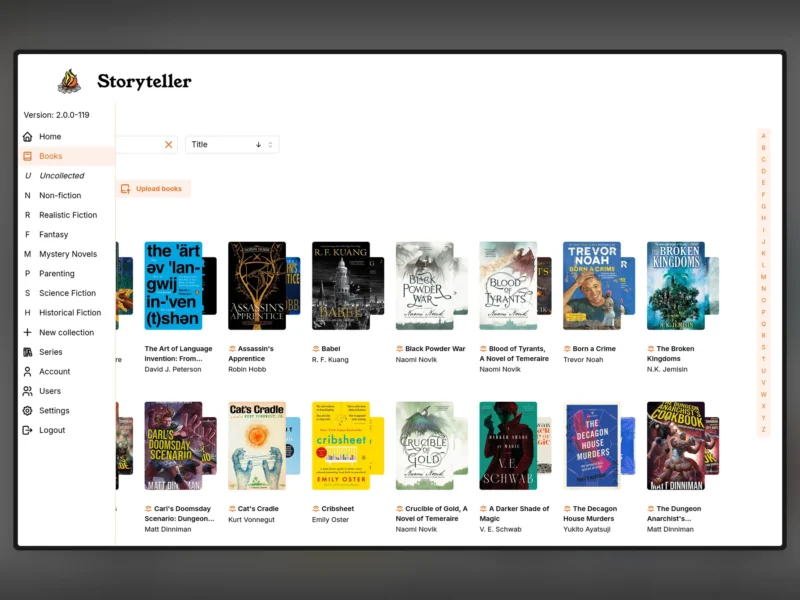
Overview
Storyteller turns an ebook you own and the matching audiobook into a single read-along book: the text is highlighted sentence by sentence as the narration plays, so reading and listening stay at the same place. The project calls the result a readaloud and the process behind it forced alignment — the same idea as Amazon’s Whispersync, applied to files you already have. Everything runs on your own server, and the books it produces are standard EPUB 3 with media overlays, so they open in other readers too.
It is a three-part platform: a server that does the alignment and stores the library, a web interface for managing it, and Android and iOS apps for reading and listening. The mobile apps are the intended way to enjoy a readaloud; the server also serves a REST API and an OPDS feed, and KoReader can be pointed at the library directly.
Library and alignment
EPUBs and most standard audio formats go in, and the library holds ebooks, audiobooks and finished readalouds side by side. Metadata is editable and cover art can be swapped, books arrive by manual upload or auto-import into a library or collection, and multiuser support lets you share an instance with family by sending an invite link rather than creating accounts for them.
Alignment is a job the server runs per book, and it is the part that needs real hardware: the documentation publishes minimum resource requirements and an optional GPU path for accelerating the work. Both inputs must be free of DRM — Storyteller will not process protected files — which is why the docs point buyers at DRM-free audiobook stores.
Deployment
The server ships as a Docker image on the GitLab container registry and needs a secret key and a data volume: docker run -p 8001:8001 -v ~/Documents/Storyteller:/data -e STORYTELLER_SECRET_KEY=$(openssl rand -base64 32) registry.gitlab.com/storyteller-platform/storyteller:latest. Compose files and upgrade guides are published for anyone who wants a real deployment rather than a test container, and hosted instances on PikaPods or ElfHosted exist for readers who would rather not run a server. Active development is evident — the repository took commits on the day this listing was written and the docs track version 2.x.
Alternatives
Audiobookshelf is the closest open-source neighbour: a self-hosted audiobook and ebook server with mobile apps, podcasts and progress sync, but it plays your files rather than producing synced readalongs. Calibre-Web and Librum cover the ebook library and reader side without the audio. If what you want is a request pipeline for new books rather than alignment of the ones you own, AudioBookRequest is the other direction.