monetr
- Platform
- Web Docker Self-hosted
- Licence
- FSL-1.1-MIT Source-available
- Website
- monetr.app
- Source code
- github.com/monetr/monetr
What monetr is
monetr is a budgeting application built around recurring expenses rather than around a monthly envelope: the money you already know is going out — rent, insurance, subscriptions, the annual bill that lands in one lump — is set aside first, and what is left is what you can actually spend. It is written in Go with a TypeScript front end, it is free to self-host, and it keeps its data in PostgreSQL with Docker Compose as the officially supported way to run it. The model follows Simple, a consumer budgeting product that shut down in 2021.
Expenses, funding schedules and goals
The core object is the expense: an amount that repeats — a monthly subscription, an annual insurance premium, a quarterly bill — with a due date and a contribution schedule. monetr works out how much has to be set aside from each pay cycle for the money to be there when the bill arrives, and presents that as a funding schedule, so the balance on the account is never mistaken for money that is genuinely free. Goals work the same way for something being saved towards rather than paid.
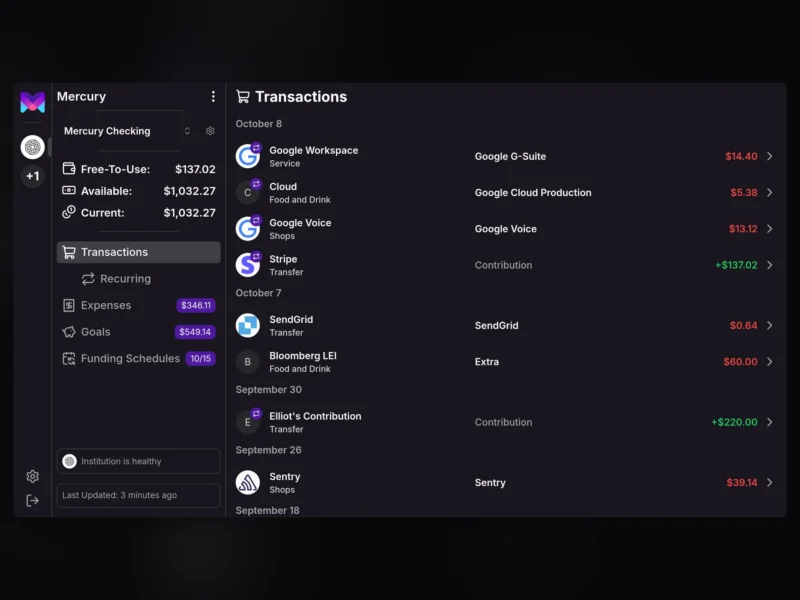
Transactions are listed by day against the account’s current, available and free-to-use balances. Recurring transactions are detected and kept apart from one-off spending, and the forecast view projects the balance forward across the coming pay cycles, so a low point two weeks out is visible before it happens rather than after.
Bank connections and data
Accounts connect through Plaid, which brings its own per-connection cost, with Lunch Flow and SimpleFIN as alternatives where those suit better. Transactions that no connection can reach can be uploaded as files, and the REST API, webhooks and API keys make the instance scriptable. Security options include multi-factor authentication, a proof-of-work or reCAPTCHA challenge at sign-in, and optional KMS-backed encryption for stored secrets.
Licensing — source-available, not open source
monetr is published under the Functional Source License 1.1 with an MIT future licence (FSL-1.1-MIT). The source is public and self-hosting is free, but FSL is not an OSI-approved open-source licence: it forbids using the code to offer a competing product or service, and each release converts to the MIT licence two years after it is published. Read it as source-available — you can study, run and modify it for your own use, but it is not unencumbered open source.
Running it yourself
Docker Compose is the supported installation path and bundles PostgreSQL; the documented minimum is a host with 512 MB of RAM and 1 GB of disk. Redis is optional and used for caching, and a domain with HTTPS is only needed when the instance is reachable from outside your network. Container images are also published for Kubernetes deployments.
Alternatives
- Actual Budget — envelope budgeting you host yourself, with local-first sync to desktop and mobile clients
- Firefly III — self-hosted personal finance manager with double-entry bookkeeping and bank importers