Min Browser
- Platform
- Linux Windows macOS
- Licence
- Apache-2.0 Open source
- Website
- minbrowser.org/
- Source code
- github.com/minbrowser/min
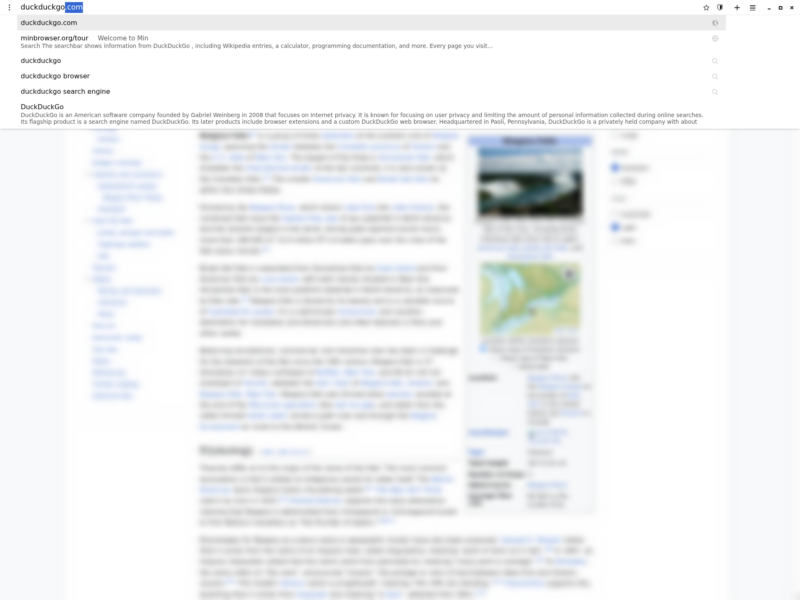
Min is a fast, minimal web browser built on Electron that keeps the interface down to an address-and-search bar, a tab strip and a slide-over menu. Where a mainstream browser opens with toolbars, panels and a new-tab feed, Min opens on a single search field and gets out of the way. It is aimed at people on modest hardware and at anyone who wants reading and research to feel lighter than a full desktop browser session.
What Min does
- One search field for everything — typing returns DuckDuckGo answers, history matches, bookmarks and direct URLs in a single ranked list, so most navigation never leaves the keyboard.
- Ad and tracker blocking on by default — third-party ads and trackers are blocked out of the box, with per-site exceptions plus optional script and image blocking, and a running count of what has been blocked.
- Full-text search of pages you have visited — Min indexes page text, so a half-remembered sentence finds the page again long after you closed it.
- Tasks instead of tab overload — tabs can be grouped into named tasks, closed, and reopened later with the whole group intact.
- Reader view and focus mode — an article can be reduced to its text, or the window reduced to the page alone.
- Bookmark tagging, a dark theme and password-manager integration — bookmarks are taggable rather than folder-bound, and Min hands credential filling to the password manager you already use.
Who it suits
Min is a deliberately narrow browser: the list above is the product, and everything outside it is left to the web. That makes it a good daily driver for reading, research and low-spec laptops, and a poor fit for anyone who depends on a large extension ecosystem or on browser-level sync between devices.
Releases and requirements
Min is written and maintained by PalmerAL and ships prebuilt for Windows, macOS and Linux — a Windows installer, a macOS application bundle, and .deb/.rpm packages, with AUR and Pi-Apps packaging for Arch and Raspberry Pi. The current release is 1.35.7 (August 2026); building from source needs Node.js and npm install. Being Electron-based, it renders modern sites the same way any Chromium engine does.
Alternatives
- Mozilla Firefox — a full extension ecosystem and cross-device sync instead of a minimal shell.
- Brave Browser — Chromium with a much more aggressive built-in blocker and its own rewards programme.
- Tor Browser — for anonymity over the Tor network rather than a lighter interface.