Lumio
- Platform
- Web Docker
- Licence
- FSL-1.1-ALv2 Source-available
- Website
- lumio-app.de
- Source code
- github.com/markusthiel/lumio
What Lumio is
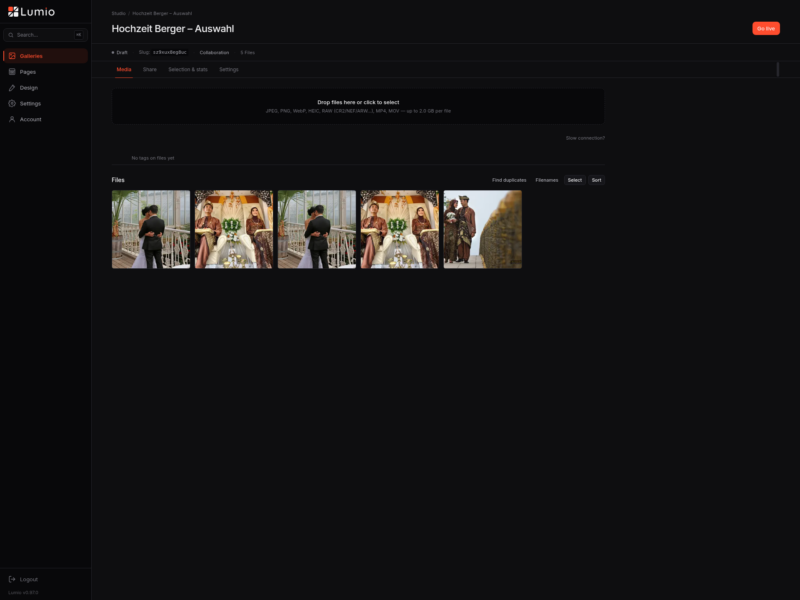
Lumio is a self-hosted gallery platform for photographers and studios: you upload the shoot, send the client a link, and the client marks favourites, tags and annotates the frames they want — the workflow Pixieset, Picdrop and Pic-Time sell as a subscription, running on your own server instead. It is developed by Markus Thiel and published on GitHub as markusthiel/lumio, distributed as a Docker Compose stack rather than a hosted service.
The project positions itself explicitly as a source-available alternative to those hosted tools, and the licence is the part to read first (see Licence below): the code is public, but this is not OSI open source.
Client proofing, not just a gallery
The gallery is the delivery surface; the review tools are the product.
- Proofing. Clients like frames, assign colour tags, give star ratings, leave per-photo comments and draw annotations directly on the image, and a team can vote on the same set.
- Video review. Moving images get the same treatment: a filmstrip to scrub through, annotations anchored to a timestamp, and drawing on the still frame.
- Studio side. Galleries, smart collections and tag filters, with a dark and a light theme for the back office.
- Gallery design. Per gallery you set layout, image arrangement, slideshow transitions, hero image, event logo and colours; whitelabel reaches down to logos and custom domains per studio.
- Formats. JPEG, PNG, WebP, HEIC/HEIF and PDF; RAW from the common brands (CR2, CR3, NEF, ARW, RAF, DNG, ORF, PEF, RW2, X3F) through LibRaw; video with HLS adaptive streaming and scrubbing previews.
- Beyond delivery. Optional AI auto-tagging with a CLIP model, analytics on views, downloads and the funnel from visit to order, a print shop using your own providers, and signed webhooks for gallery events.
Running it yourself
The stack needs Linux with Docker Engine 24 or newer and Compose v2, on amd64 or arm64; the documented entry-level size is 2 vCPU and 4 GB of RAM for a photo-only studio, with more CPU and memory once video transcoding is involved. The install is a clone, a copy of .env.example with five generated secrets, and docker compose up -d. The first start builds the images locally and takes three to five minutes — the result is a Next.js frontend, a Fastify API over Postgres and Redis, a Python Celery worker for RAW decoding and thumbnails, a bundled S3-compatible store and a Caddy proxy. The admin account is created from the API container with npm run create-admin.
Two ports matter in deployment: 80 for the application and 9000 for object storage, because the browser uploads to and loads images from S3 directly. Block 9000 and uploads fail immediately. Storage can stay on the bundled server with its persistent volume, or move to S3, Cloudflare R2, Backblaze B2, Wasabi or Hetzner Object Storage. Single mode creates its tenant automatically; a multi-tenant mode without billing, with tenants created by a super admin, is documented for agencies running several photographers. There is no native desktop client and no mobile app — the interface is the browser.
Security is taken seriously in the design: signed URLs, Argon2 password hashing, two-factor authentication, an audit log, and a data processing agreement under Article 28 GDPR that clients can sign electronically. Two languages of documentation and a UI available in German, English, Italian, French and Finnish make it usable outside its German home market.
Project status
Active rather than abandoned: v0.97.0 shipped on 5 November 2026, the repository carries around 90 stars and a changelog with frequent releases, and the documentation is maintained in three languages. That pace means the feature list above will keep moving; treat it as the state of the project today rather than a fixed promise.
Licence
Not open source. Lumio is published under the Functional Source License 1.1 with an Apache 2.0 future licence (FSL-1.1-ALv2), which makes the code source-available rather than OSI-approved. Individuals, photographers, studios and agencies may use, self-host and modify it, including commercially for their own clients. You may not run it as a competing hosted SaaS for third parties; for that a commercial licence is available from the author. Every release converts to Apache 2.0 two years after publication, at which point the restrictions fall away.
Open source alternatives
If an OSI-approved licence is a hard requirement, the directory already lists Piwigo for GPL-licensed albums and digital asset management, Lychee for a self-hosted photo library, and Photoview for browsing a folder of photos and videos. None of them ships Lumio’s client-proofing workflow, which is the gap Lumio is aimed at.