Cobalt
- Platform
- Docker Self-hosted Web
- Licence
- AGPL-3.0 (API), CC-BY-NC-SA-4.0 (web UI) Open source
Cobalt
Website: cobalt.tools
Cobalt is an open-source media downloader: paste a link to a public post and it hands back the video, audio, image or GIF as a file. It exists because the sites that offer to save a video are usually wrapped in ads, trackers and the occasional piece of malware. Cobalt has none of that. It is free to use with no paid tier, cobalt.tools is the project’s own public instance, and the code can be self-hosted. What separates it from a browser extension is the backend: cobalt resolves the link on a server, then redirects to the direct media URL, streams the file through a tunnel, or sends the parts to your browser to remux locally.
The public instance currently advertises twenty services, from Reddit, TikTok and Vimeo to SoundCloud, Bluesky and Tumblr. YouTube is handled in the source but is not offered by the main instance, so do not read the public deployment as a complete list of what the software can do. Cobalt does not cache files; the README calls it a fancy proxy, and forced tunnelling means your network sees only the cobalt instance. It is meant for free, publicly accessible content, and the documentation covers running your own instance with Docker Compose.
Key Features
- Paste-and-save interface: one URL box, a choice of auto, audio or mute, and a download, with no account on the public instance.
- Twenty services on the public instance: including Reddit, TikTok, Vimeo, SoundCloud, Bluesky, Twitch clips and Tumblr.
- Quality and format controls: video from 144p to 4320p, audio at up to 320 kbps in MP3, OGG, WAV or Opus, and four filename styles.
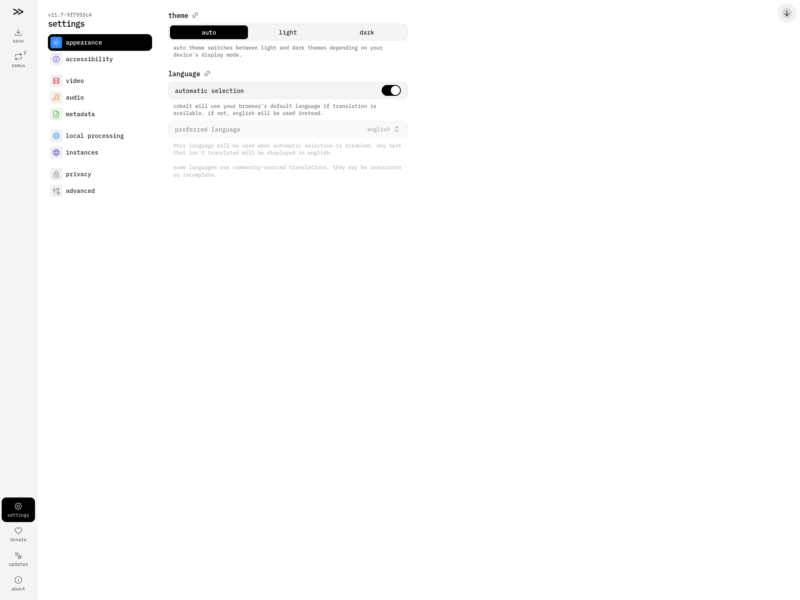
- On-device processing: local processing can be disabled, preferred or forced, so remuxing and transcoding run in the browser; cobalt can also add subtitles in a chosen language and optional audio covers.
- Privacy by design: anonymous backend requests, a zero-log policy, encrypted tunnel information and an always-proxy option that forces every file through the instance.
- Self-hosting: a Docker Compose package that updates through Watchtower and needs only
API_URL; bare metal needs Node 18 or newer and pnpm. - Automation API: a JSON
POST /takes the URL and options and returns tunnel, redirect, local-processing or picker responses, with rate-limit headers. - Instance protection: operators can require API keys or issue short-lived bearer tokens after a Cloudflare Turnstile challenge.
Licence
Most of the repository, including the API, is AGPL-3.0: run a modified cobalt as a network service and you must offer its users the source of your changes. The web frontend is CC-BY-NC-SA-4.0, which allows copying and adaptation but not commercial use. The backend is therefore open source and self-hostable, while the bundled interface is not a commercial product.